

Key Takeaways
- Mobility refers to active, controlled range of motion; flexibility is about passive tissue length.
- Flexibility is a component of mobility, but good flexibility does not guarantee good mobility.
- Mobility training targets joints and neuromuscular control; flexibility training targets muscles and connective tissue.
- Both practices have distinct value and can work together as part of a balanced movement routine.
- Neither approach replaces professional evaluation when pain or injury is involved.
Option A
Mobility
The functional, movement-first approach.
Best for: People looking to improve how their body moves through real-world and athletic tasks.
Option B
Flexibility
The tissue-length, passive-range approach.
Best for: People aiming to increase muscle and soft-tissue extensibility and reduce tension.
If your goal is to move better during daily activities or exercise
Mobility
Mobility training builds active, usable range of motion - the kind that translates directly into squatting, reaching, and rotating in everyday life.
If you experience chronic muscle tightness or stiffness after long periods of sitting
Flexibility
Targeted stretching routines can lengthen shortened muscles and reduce tension, especially for those with sedentary habits.
If you want a well-rounded physical maintenance routine
Mobility
Mobility work tends to incorporate flexibility alongside strength and control, offering broader functional benefits in a single practice.
If you are preparing for or recovering from a yoga or dance practice
Flexibility
Disciplines like yoga and dance rely heavily on tissue extensibility; dedicated flexibility training supports both performance and recovery in these contexts.
Why the Distinction Actually Matters
The words mobility and flexibility are used interchangeably in gyms, wellness apps, and everyday conversation - but they describe genuinely different physical qualities. Conflating them can lead to training the wrong thing for your actual goal, or overlooking a gap in your movement capacity that stretching alone won't close.
Understanding the difference isn't just semantic. It shapes which exercises you choose, how you structure a warm-up, and what to prioritize if you're dealing with stiffness, limited range, or functional decline over time. Much like how mindfulness and meditation overlap but serve distinct purposes, mobility and flexibility share common ground while addressing different physical needs.
Defining Each Term Clearly
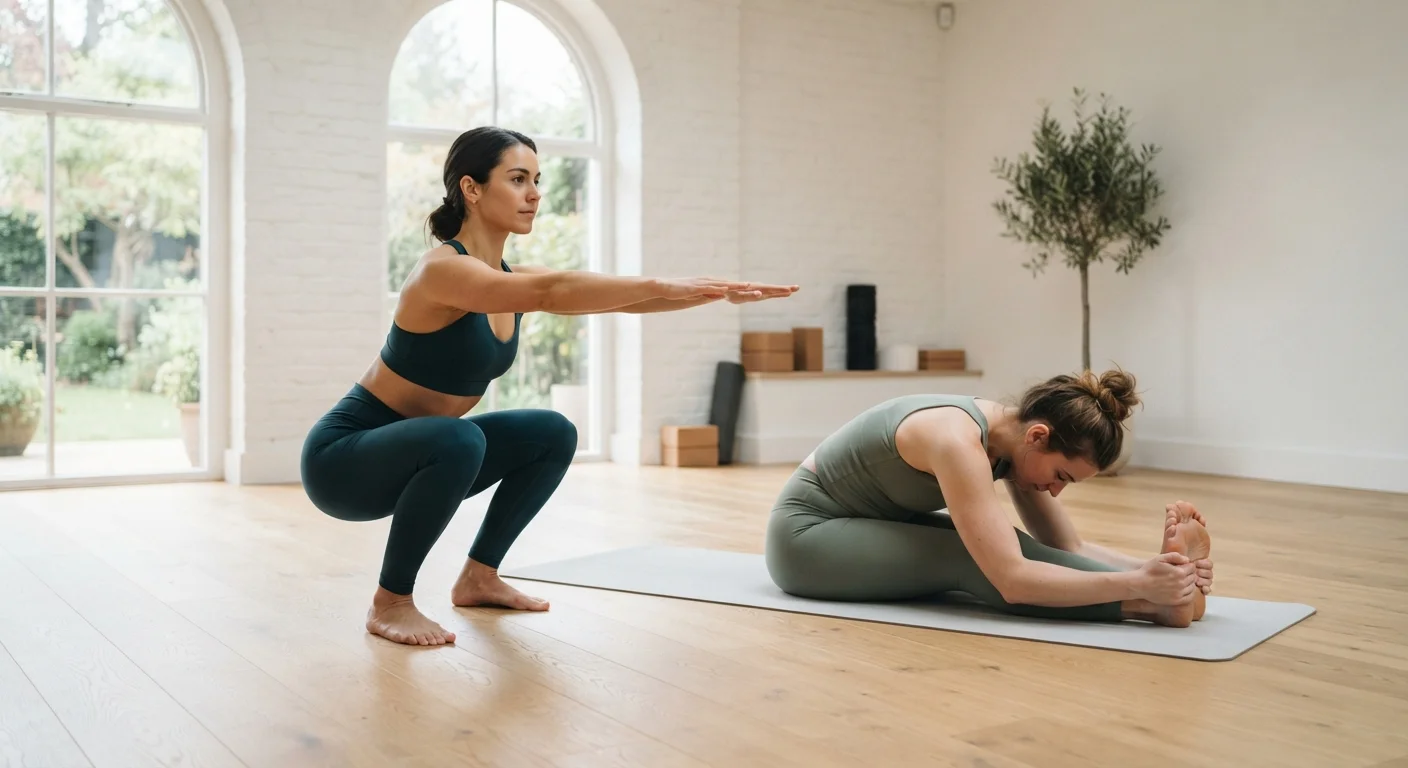
Flexibility is the ability of a muscle or group of muscles - along with surrounding connective tissue - to lengthen passively. When you hold a static hamstring stretch, you're working flexibility. The key word is passive: an external force (gravity, a strap, a partner) assists the movement, and the muscle isn't required to generate active control at that end range.
Mobility is the ability to actively move a joint through its full range of motion with control. It requires not just tissue length, but neuromuscular coordination, strength, and stability at the limits of that range. A deep squat with proper form is a mobility challenge, not just a flexibility one - your hips, ankles, and thoracic spine all need to produce and control movement simultaneously.
This distinction explains why someone can touch their toes in a seated stretch yet struggle to hold a deep squat without compensating. Tissue length is present; the active motor control to use that range is not. Flexibility is a component of mobility, but it is not the whole picture.
| Criterion | Mobility | Flexibility |
|---|---|---|
| Core definition | Active, controlled joint range of motion | Passive muscle and tissue length |
| Requires muscle activation | Yes - strength and control at end range | No - passive lengthening is the goal |
| Primary tissue targeted | Joints, neuromuscular system | Muscles, fascia, tendons |
| Common training methods | CARs, end-range strengthening, loaded movement | Static stretching, passive holds |
| Functional carry-over | High - directly supports movement tasks | Moderate - supports mobility but is not sufficient alone |
| Role in a routine | Warm-up, skill practice, movement training | Cool-down, recovery, tension relief |
How Each Practice Works in the Body
Flexibility training primarily targets the length of muscles and fascia (the connective tissue surrounding muscle fibers). Static stretching - holding a position for 20 to 60 seconds - is the most common method. Over time, regular static stretching can increase a muscle's tolerance to length, allowing for a greater passive range. Dynamic stretching, which moves through a range repeatedly, bridges the gap somewhat between pure flexibility and mobility work.
Mobility training targets joints directly, working on the quality of movement at the joint capsule level as well as the strength and coordination needed to control that movement. Tools include controlled articular rotations (CARs), end-range strengthening exercises, and movement practice that deliberately explores the edges of joint range under load. These approaches also involve the nervous system more directly, training the brain to recognize and accept new positions as safe and usable.
~80%
Adults not meeting movement guidelines
The CDC estimates that approximately 80% of US adults do not meet the recommended guidelines for both aerobic and muscle-strengthening activity.
30-60 sec
Effective static stretch duration
Research published in sports medicine literature generally supports hold durations of 30 to 60 seconds per muscle group for measurable flexibility gains in adults.
For people living more sedentary lives, both qualities tend to decline over time. As the research on activity patterns consistently shows, the gap between active and less active populations often shows up first in functional movement capacity - making both practices relevant to long-term health. The health gap between sedentary and active lifestyles compounds in ways that mobility and flexibility training are both positioned to address, in complementary ways.
When to Prioritize One Over the Other
The choice between mobility and flexibility work depends on what your body actually needs - which is worth exploring with a physical therapist or qualified movement professional, especially if pain or injury is involved.
As a general framework: if your challenge is getting into a position at all, flexibility may be limiting you. If your challenge is controlling a position once you're in it, or maintaining form under load, mobility work is likely the priority. In practice, a well-designed movement routine often includes both - flexibility work to open up tissue, followed by mobility work to train the nervous system to own that new range.
When to Seek Professional Guidance
If you notice persistent joint pain, significant asymmetry in range of motion between sides, or limited progress despite consistent training, a physical therapist or sports medicine professional can assess underlying causes. Self-directed mobility and flexibility work is appropriate for general wellness, but professional evaluation is worthwhile for any movement limitation linked to pain or dysfunction.
Neither practice should be pursued to the point of pain. A sensation of moderate stretch or mild effort is appropriate; sharp or joint-based discomfort is a signal to stop and consult a professional.
This article is for general informational purposes only and does not constitute medical advice. Always consult a qualified healthcare or movement professional before beginning a new exercise program, particularly if you have an existing injury or health condition.