

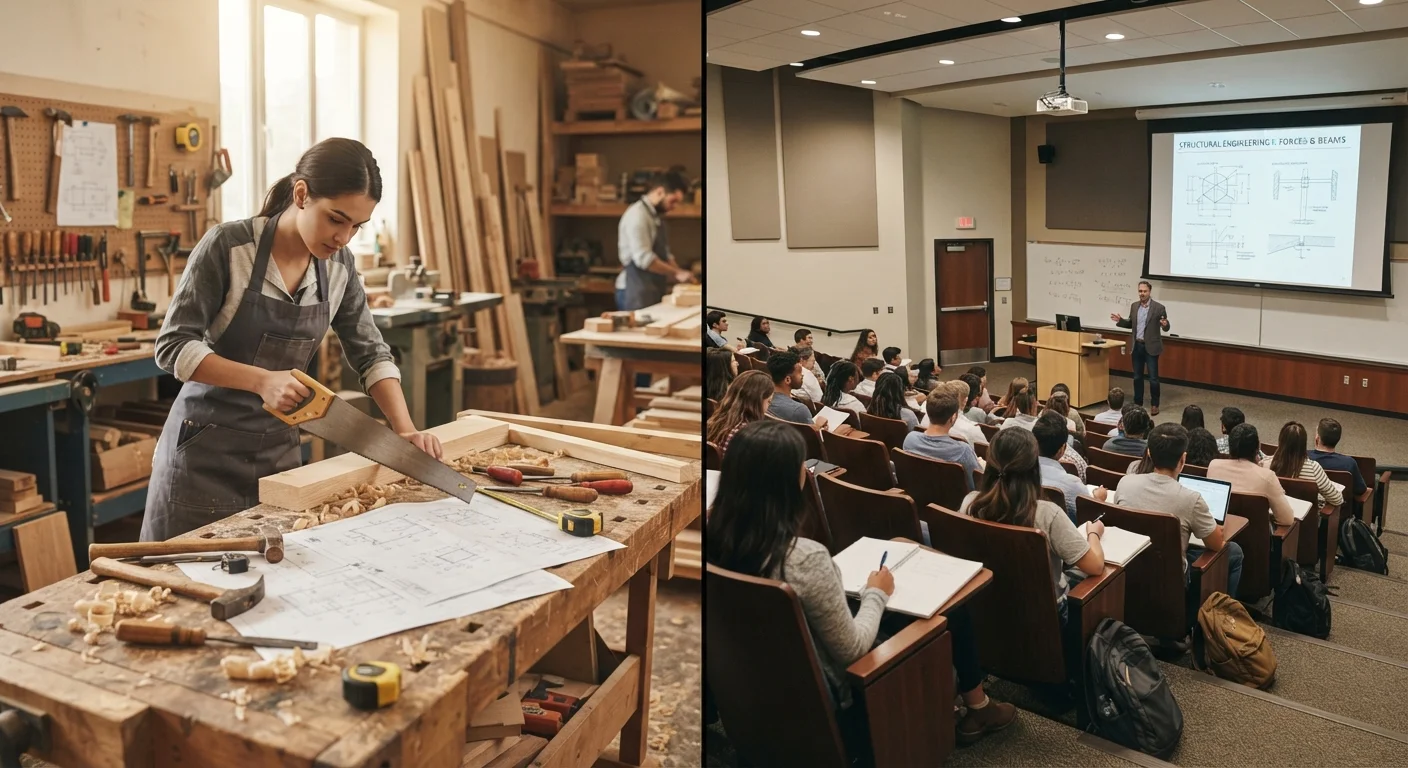
Key Takeaways
- Trade school typically takes one to two years and targets specific skilled trades, while a four-year degree takes longer but opens broader career categories.
- Vocational programs generally carry lower tuition costs, and graduates often enter the workforce sooner with less debt.
- Some career fields - engineering, law, medicine, education - require a bachelor's degree or graduate credential by design.
- Neither path is universally superior; the right choice depends on your career goals, learning style, and financial situation.
- Both routes can lead to stable, well-compensated careers when aligned with labor market demand.
Option A
Trade School (Vocational Training)
The focused, skills-first path to a specific career.
Best for: Learners who want hands-on, job-ready training in a defined field within one to two years.
Option B
Traditional Four-Year College
The broad, credential-intensive path to a wider range of roles.
Best for: Learners who want a general academic foundation, professional networks, and fields that require a bachelor's degree or higher.
If you want to enter a skilled trade quickly with lower debt
Trade School (Vocational Training)
Vocational programs are purpose-built for fast workforce entry. Shorter timelines and lower tuition typically mean graduates can begin earning sooner with less financial burden.
If your target career legally or professionally requires a bachelor's degree
Traditional Four-Year College
Fields like nursing (BSN-required roles), engineering, and teaching carry degree mandates that vocational credentials cannot substitute for.
If you value broad academic exploration before committing to a specialty
Traditional Four-Year College
The general education curriculum at four-year institutions lets students sample disciplines and pivot majors before locking into a career track.
If you are drawn to hands-on, applied work over theoretical coursework
Trade School (Vocational Training)
Trade programs center on practical skill demonstration, apprenticeships, and lab work - a format that suits learners who absorb knowledge by doing rather than reading.
If you are uncertain and want more options to explore
Traditional Four-Year College
A four-year degree preserves more professional optionality and can serve as a foundation for graduate study, though it requires a larger time and financial commitment.
What Each Path Actually Involves
Trade schools - also called vocational schools or career and technical education (CTE) programs - provide concentrated instruction in a specific occupation. Programs typically run from several months to two years and cover fields such as electrical work, HVAC, welding, dental hygiene, automotive technology, and medical assisting. Instruction combines classroom learning with substantial hands-on lab work, and many programs include externships or apprenticeship components that place students in real job environments.
Traditional four-year colleges and universities award a bachelor's degree upon completion of roughly 120 credit hours, usually spread across four years. Students complete general education requirements alongside major coursework, gaining both disciplinary depth and transferable analytical skills. Some fields - including most graduate professional programs - use the bachelor's degree as a prerequisite. For a detailed breakdown of how degree levels compare, see what each degree type actually means.
| Criterion | Trade School | Four-Year College |
|---|---|---|
| Typical Duration | 6 months - 2 years | 4 years |
| Credential Awarded | Certificate or Associate's | Bachelor's Degree |
| Average Tuition Cost | Lower (often under $20K total) | Higher (varies widely) |
| Curriculum Focus | Occupation-specific, hands-on | Broad general ed + major |
| Time to First Job | Faster entry | Delayed by program length |
| Career Flexibility | Narrower but deep | Broader range of options |
| Graduate School Access | Limited without further study | Direct pathway available |
Cost, Time, and Return on Investment
Cost is one of the starkest contrasts between these paths. Vocational programs at public institutions often run well under $20,000 total - sometimes far less - while the average four-year public university can cost significantly more when tuition, fees, room, and board are combined over four years. Private colleges typically cost more still. This matters because student debt can constrain financial decisions for years after graduation.
Time-to-employment is equally important. A trade school graduate may enter the workforce two or three years before a four-year peer, accumulating wages and on-the-job experience during that window. However, starting salaries in some degree-required professions can be higher, and lifetime earnings in certain fields favor those with bachelor's or advanced credentials. The economic calculation depends heavily on which trade or which degree you compare - a licensed electrician and a philosophy graduate are not a fair pairing.
~$33K
Median annual wage for trade occupations
The U.S. Bureau of Labor Statistics reports median wages for installation, maintenance, and repair occupations; individual trades vary significantly above and below this figure.
65%+
Of U.S. jobs requiring postsecondary education
Georgetown University's Center on Education and the Workforce has estimated that a majority of U.S. jobs require some form of postsecondary credential, though not necessarily a four-year degree.
2-3 Years
Earlier workforce entry for trade graduates
Because vocational programs run one to two years versus four, graduates typically begin accumulating work experience and wages years ahead of four-year peers.
For learners weighing non-degree alternatives beyond these two paths, apprenticeships, MOOCs, and competency-based programs offer additional options worth understanding.
Who Each Path Suits - and Why
Choosing between these paths is less about prestige and more about fit. Trade school suits learners who have identified a specific skilled occupation, prefer experiential learning, want to limit debt exposure, and are ready to work in a structured industry. Electricians, plumbers, radiologic technologists, and HVAC technicians are all in fields with consistent labor market demand, and licensure - not a bachelor's degree - is typically the professional threshold.
Four-year college suits learners who are undecided on a specialty and need time to explore, who are targeting fields with explicit degree requirements, or who anticipate needing graduate credentials later. It also provides campus-based networking, alumni connections, and research opportunities that vocational programs generally do not replicate.
Some Fields Have Hybrid Requirements
Certain professions sit between these two paths. Registered nursing, for example, is accessible through both an associate degree (ADN) and a bachelor's degree (BSN), though employers and health systems increasingly prefer or require the BSN. Similarly, community colleges offer career-focused associate degrees that blend general education with occupational preparation. See community college vs. four-year university tradeoffs for more on that middle ground.
Neither route is a default or a fallback. Both require genuine engagement to deliver results. If your uncertainty is about how to learn rather than what to learn, comparing self-directed vs. structured learning may also help clarify your approach.