
Digital Credentials Explained: Certificates, Badges, and Micro-Credentials Unpacked

| Open Badge Standard Maintainer | IMS Global Learning Consortium (IMS Global, Open Badges specification) |
| Typical Micro-Credential Duration | A few hours to several weeks (UNESCO, 2022 micro-credentials overview) |
| Employer Recognition (Digital Badges) | Varies significantly by industry and issuer (Credential Engine, 2023 landscape report) |
| Number of Unique Credentials in the US | Over 1 million documented (Credential Engine, Counting US Postsecondary Credentials, 2023) |
| Stackability | Many micro-credentials are designed to stack toward certificates or degrees (American Council on Education, credit equivalency research) |
The Three Core Types of Digital Credentials
The phrase digital credential covers a wide range of qualifications, and conflating them can lead to mismatched expectations - for learners and employers alike. Three types appear most frequently in online learning contexts.
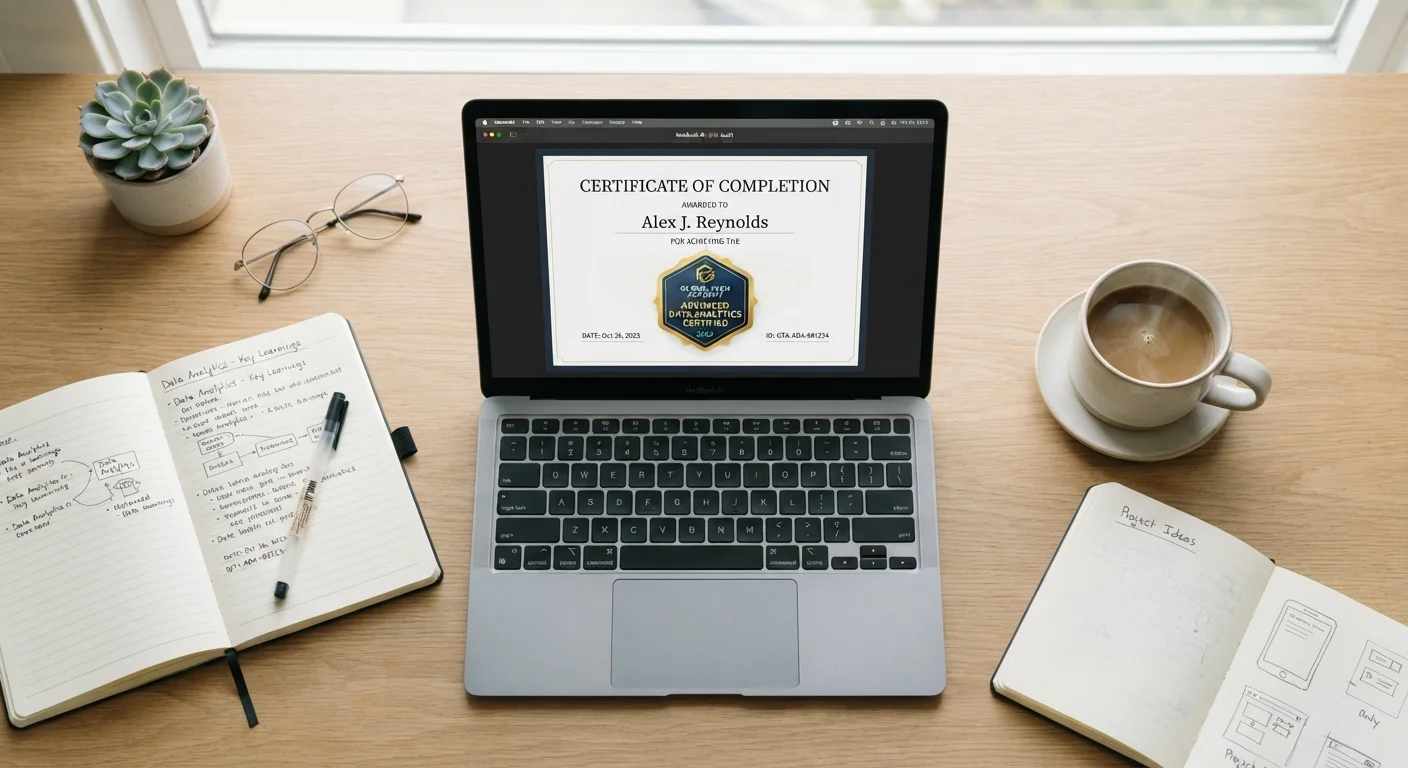
Completion certificates are the most common. Issued by a course platform after a learner finishes a program, they confirm participation rather than measured competency. They carry value as evidence of initiative but are generally not assessed credentials.
Digital badges use the Open Badges standard - maintained by IMS Global - to embed verifiable metadata inside a clickable image. Anyone who receives a badge can share it on LinkedIn or a résumé, and anyone who views it can verify the issuer, criteria, and date. Badges can represent anything from a single skill workshop to a multi-module specialization.
Micro-credentials are structured, often assessed awards focused on a narrow competency. Unlike a badge (which is a delivery format), a micro-credential is a credential type - it may be delivered as a badge, a certificate, or a transcript notation. Their key feature is that they are frequently stackable: completing several can count toward a larger certificate or, in some institutional programs, college credit.
Digital Credential
An electronically issued document or token that verifies a learner has completed a course, demonstrated a skill, or met a defined standard. Digital credentials can be shared online, embedded in profiles, and verified by employers.
Open Badge
A digital image file embedded with verifiable metadata - including the issuer, earner, and criteria - based on an open technical standard developed by Mozilla and now maintained by IMS Global. Clicking the badge reveals the full record.
Micro-Credential
A short, focused learning award that certifies competency in a narrow skill or subject area. Micro-credentials are often stackable, meaning multiple completions can count toward a larger qualification.
Stackable Credential
A credential designed to build sequentially on others, allowing learners to accumulate recognized qualifications over time toward a certificate, degree, or professional milestone.
Completion Certificate
A document confirming that a learner finished a course or program. Unlike a certification, it does not necessarily assess competency - it confirms participation and completion.
Professional Certification
A credential awarded by an industry or standards body after a learner passes a formal assessment. Professional certifications typically require renewal and signal demonstrated competency recognized within a field.
For a broader map of the credential landscape - including degrees, diplomas, and professional certifications - see The Academic Credential Landscape.
How Employers Actually Evaluate Digital Credentials
Employer reception to digital credentials is neither uniform nor fully settled. A few factors reliably influence how a credential is weighed.
| Open Badge Standard Maintainer | IMS Global Learning Consortium (IMS Global, Open Badges specification) |
| Typical Micro-Credential Duration | A few hours to several weeks (UNESCO, 2022 micro-credentials overview) |
| Employer Recognition (Digital Badges) | Varies significantly by industry and issuer (Credential Engine, 2023 landscape report) |
| Number of Unique Credentials in the US | Over 1 million documented (Credential Engine, Counting US Postsecondary Credentials, 2023) |
| Stackability | Many micro-credentials are designed to stack toward certificates or degrees (American Council on Education, credit equivalency research) |
Issuer reputation matters most. A badge issued by a recognized professional association, an accredited university, or a widely known industry body carries more weight than one from an unfamiliar platform. Before pursuing a credential, it is worth researching whether the issuing organization is known in your target field.
Assessment rigor is the second key variable. Credentials that required passing a proctored exam, completing a portfolio, or demonstrating a skill to a qualified evaluator signal more than those awarded for watching videos. When listing credentials, being specific about what was required helps hiring managers make an accurate judgment.
Relevance to the role often outweighs prestige. A narrowly focused micro-credential in cloud security may carry more practical weight for a specific IT role than a broad completion certificate from a well-known platform.
Completion vs. Competency: An Important Distinction
Not all digital credentials verify what you know - some only confirm you showed up. A completion certificate proves you finished a course; a professional certification proves you passed an assessment. When sharing credentials with employers, be precise about which type you hold and what it required.
Learners navigating short-form programs should also read Bootcamps and Short-Form Credentials for an honest assessment of where these pathways deliver and where they face limits. For credentials with established industry recognition, Industry Certifications That Carry Real Weight offers useful context.
For learners exploring structured alternatives to traditional degrees, Alternative Academic Pathways covers how MOOCs, apprenticeships, and competency-based programs fit into this picture. Practical skill-building resources are also available through the Skill Building hub.
1M+
Unique credentials documented in the US
According to Credential Engine's 2023 landscape report, the US credential market includes more than one million distinct offerings across degrees, certificates, badges, and licenses.
~70%
Employers open to non-degree credentials for hiring
A 2022 survey by the Society for Human Resource Management found a majority of employers considered alternative credentials relevant when evaluating candidates, though weight varied by role and industry.