
Online Degree vs. Traditional Campus Degree: A Framework for Thinking It Through

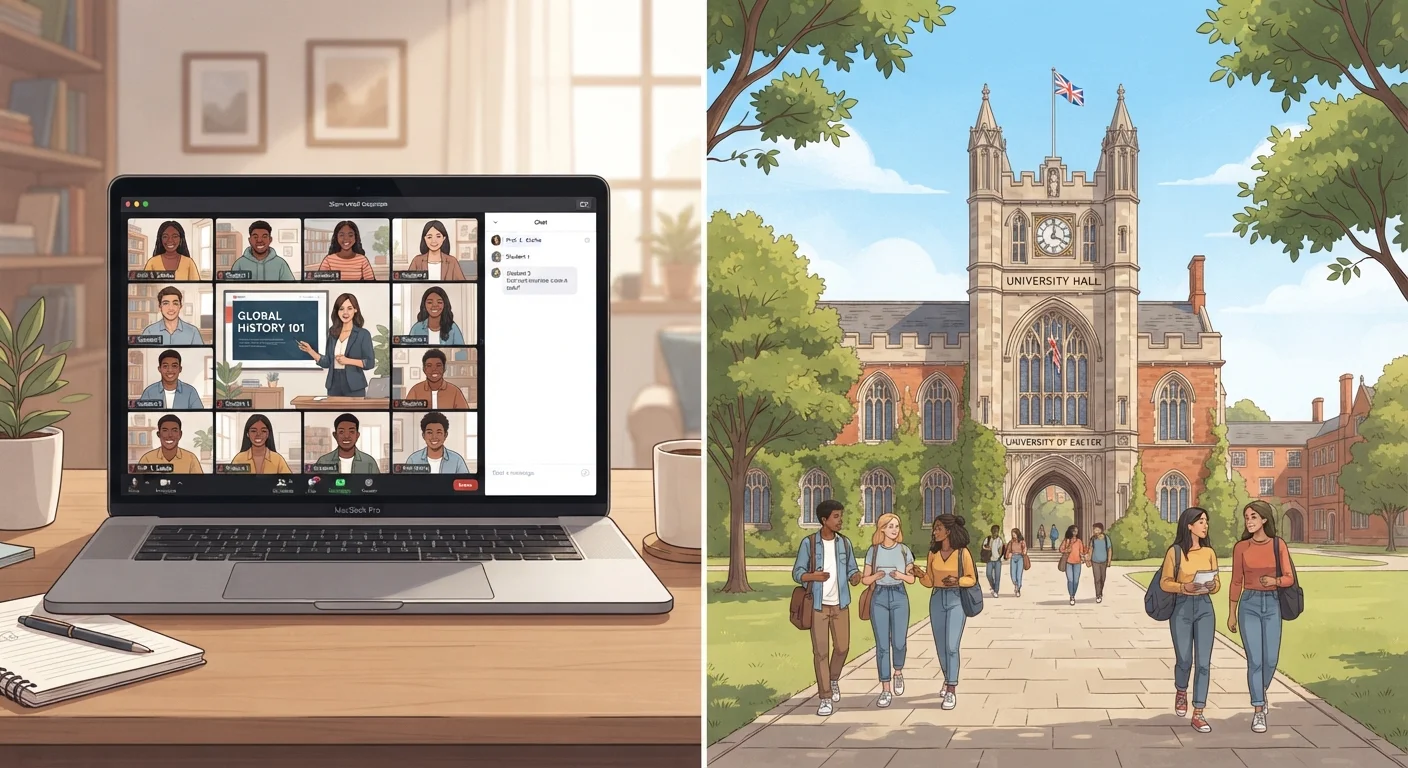
Key Takeaways
- Accreditation matters equally for both paths - an unaccredited degree, online or campus-based, carries significant risk.
- Online degrees generally cost less per credit hour, but total savings depend heavily on the institution and program.
- Employer perception of online degrees has improved substantially but varies by industry and institution reputation.
- Campus programs offer richer in-person networking and access to facilities that online formats cannot fully replicate.
- Your learning style, schedule constraints, and career field should drive the format decision more than cost alone.
Option A
Online Degree
The flexible, location-independent credential path.
Best for: Working adults, career-changers, and anyone needing to balance study with existing personal or professional commitments.
Option B
Traditional Campus Degree
The immersive, relationship-rich academic experience.
Best for: Students who benefit from structured environments, in-person mentorship, campus resources, and direct peer networking.
If you're a working professional managing a full-time job or family obligations
Online Degree
Asynchronous coursework and self-paced scheduling make it possible to earn credentials without pausing your career or relocating.
If you're entering a field where labs, clinics, or hands-on training are required
Traditional Campus Degree
Many regulated professions - nursing, engineering, architecture - require supervised, physical practice that online formats cannot adequately substitute.
If networking and campus culture are central to your goals
Traditional Campus Degree
In-person peer relationships, alumni networks, faculty mentorship, and campus recruitment events are structurally harder to replicate online.
If managing tuition costs is your primary constraint
Online Degree
Online programs at accredited public universities often carry lower per-credit costs and eliminate housing and commuting expenses entirely.
If you're undecided on a field and want structured exploration
Traditional Campus Degree
The campus environment provides exposure to multiple disciplines, extracurriculars, and advising relationships that support exploratory learners.
Why Format Matters - and When It Doesn't
The most important question isn't "online or campus?" - it's whether the program is accredited, academically rigorous, and aligned with your career goals. Format is a delivery mechanism, not a quality guarantee in either direction. A poorly designed campus course can underserve you just as much as a low-quality online one.
That said, format does create real structural differences in how you learn, who you interact with, and what the experience costs. Understanding those differences helps you match the right environment to your actual situation. For a deeper look at what to verify before committing to any program, see this pre-application checklist for degree programs.
| Criterion | Online Degree | Traditional Campus Degree |
|---|---|---|
| Scheduling | Largely asynchronous, self-paced | Fixed class times, set academic calendar |
| Typical cost | Often lower per credit hour | Higher; includes housing and facilities fees |
| Accreditation availability | Available; must verify independently | Available; must verify independently |
| Networking depth | Virtual; limited in-person contact | Strong; in-person cohorts and faculty access |
| Hands-on learning | Limited; varies by program design | Labs, studios, clinics widely available |
| Employer recognition | Broadly accepted at accredited schools | Broadly accepted; prestige varies by school |
| Geographic requirement | None; study from anywhere | Relocation or commuting required |
| Campus resources | Digital-only libraries and advising | Physical libraries, gyms, career centers |
Cost, Accreditation, and Credential Recognition
Online degrees at accredited institutions are generally less expensive per credit hour than their residential counterparts - particularly at public universities. You also eliminate room, board, and commuting costs. However, private online programs can carry tuition comparable to campus rates, so direct program-to-program comparison matters more than assuming one format is uniformly cheaper.
Accreditation is the non-negotiable threshold for both paths. Regional accreditation (granted by bodies recognized by the U.S. Department of Education) is the standard most employers and graduate schools use when evaluating a credential. Some nationally accredited institutions have narrower transfer and recognition pathways. Before enrolling anywhere, confirm accreditation status independently through the Department of Education's database. For a detailed breakdown of what accreditation labels actually signal, this guide on online degree accreditation is worth reading carefully.
3.7M+
US students exclusively enrolled online
According to National Center for Education Statistics data, millions of students pursue exclusively online coursework at degree-granting institutions.
~15%
Typical online tuition discount vs. on-campus
Studies from education policy researchers suggest online programs at public universities often carry meaningfully lower per-credit costs than residential equivalents, though this varies widely.
Flexibility, Structure, and Learning Environment
Online degree programs are typically designed for asynchronous participation - meaning you complete readings, discussions, and assignments on your own schedule within weekly deadlines. This suits people with employment, caregiving, or geographic constraints. The trade-off is that self-directed motivation and digital communication skills become prerequisites for success.
Campus programs embed structure externally: scheduled class times, office hours, study groups, and campus events create natural accountability and community. Research on adult learning suggests that environmental cues - like a classroom or library - can meaningfully support sustained concentration, though this varies by individual. If you're weighing broader questions about structure versus self-direction, this comparison of self-directed vs. structured learning explores the trade-offs in depth.
A Note on Hybrid and Blended Programs
Many institutions now offer hybrid degrees that combine online coursework with required on-campus intensives, residencies, or lab sessions. These formats attempt to preserve scheduling flexibility while retaining some in-person depth. If a fully online or fully campus program doesn't feel right, a hybrid structure may be worth exploring. Always confirm what the in-person requirements entail before enrolling, particularly if you're managing travel or relocation constraints.
Networking, Career Outcomes, and Employer Perception
Employer attitudes toward online degrees have shifted considerably over the past decade. Surveys conducted by organizations such as the Society for Human Resource Management suggest that most hiring managers now give comparable weight to accredited online degrees, particularly when the issuing institution is well-regarded. However, certain industries - finance, law, and some engineering sectors - still place significant weight on institutional prestige and traditional campus pedigrees.
Campus programs maintain a structural networking advantage: proximity to professors, career fairs, internship pipelines, and peer cohorts who may become professional collaborators. Online programs have improved in this area through virtual networking events and alumni communities, but the depth of in-person relationship-building is difficult to replicate digitally.
It's also worth noting that not all graduate degrees - online or campus - deliver a clear financial return. Understanding the conditions under which a degree underperforms financially is important before committing. This analysis of when graduate degrees don't pay off outlines the patterns clearly.
For learners still exploring all educational formats, including shorter credentials and non-degree options, see our overview of academic pathways and this comparison of online learning platforms vs. community college.