

Key Takeaways
- Cats have a low thirst drive and depend heavily on food moisture to meet daily hydration needs.
- Wet food typically contains 70–80% moisture versus roughly 10% in most dry kibble formulas.
- No research conclusively proves dry food cleans teeth; dedicated dental diets are a separate category.
- Dry food is calorie-dense and can contribute to weight gain if portions are not carefully managed.
- Both formats can meet feline nutritional needs when the diet is complete and balanced.
- A veterinarian's guidance is essential when choosing food for cats with specific health conditions.
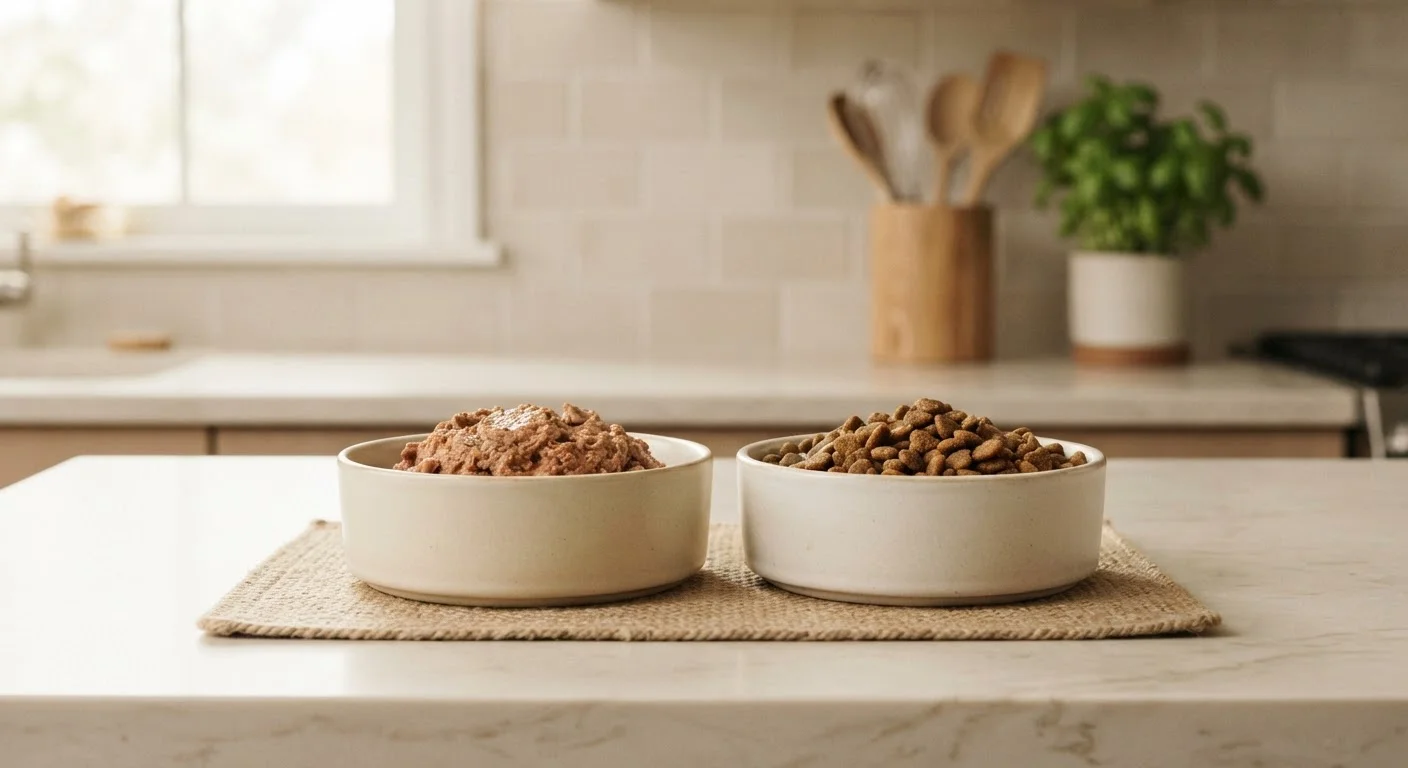
Option A
Wet Cat Food
The high-moisture, protein-forward option closely mimicking a cat's natural prey diet.
Best for: Cats needing hydration support, seniors, those with urinary tract issues, or picky eaters who respond to strong aroma and texture.
Option B
Dry Cat Food
The convenient, calorie-dense option with a long shelf life and easy portion control.
Best for: Multi-cat households, owners with busy schedules, and cats that graze throughout the day without overeating.
If your cat has a history of urinary tract issues or kidney disease
Wet Cat Food
Higher moisture content supports kidney function and urinary tract health, helping to dilute urine and reduce the risk of crystal formation. Always confirm dietary changes with your veterinarian.
If convenience and budget are primary concerns
Dry Cat Food
Dry food costs less per calorie, stores easily without refrigeration, and can be left out for cats that prefer to graze — though portion control still matters.
If your cat is overweight or prone to overeating
Wet Cat Food
The higher water content means fewer calories per gram, which can help cats feel fuller while consuming less energy overall.
If you want to cover all nutritional bases with minimal effort
Wet Cat Food
Wet formulas generally have higher animal protein content and lower carbohydrates, aligning more closely with a cat's obligate carnivore biology.
If your cat has dental disease concerns
Wet Cat Food
Standard dry kibble does not reliably prevent dental disease. Dental health is better addressed with veterinarian-recommended dental diets, treats, or brushing — regardless of food type.
Why Hydration Is at the Heart of This Debate
Cats evolved as desert-adapted predators, obtaining most of their water from prey rather than drinking freely from standing sources. This evolutionary history means domestic cats have a naturally low thirst drive — a trait that persists regardless of diet. As our feline nutrition guide explains, understanding a cat's biological needs is the foundation for any sound feeding decision.
Wet food typically contains between 70% and 80% water by weight. Dry kibble, by contrast, usually sits at around 10% moisture. For cats that don't drink much from a water bowl — which is most cats — this gap is nutritionally significant. Research in veterinary medicine has consistently linked chronic low-level dehydration to feline lower urinary tract disease (FLUTD) and chronic kidney disease, two of the most common health issues in domestic cats.
This does not mean dry food causes kidney failure in every cat, but it does mean that moisture intake is a real factor worth evaluating, particularly as cats age or if they have existing health vulnerabilities.
70–80%
Moisture content in typical wet cat food
Compared to roughly 10% in dry kibble, this difference is significant for cats with a naturally low thirst drive.
~50%
Adult cats affected by dental disease
Veterinary estimates suggest dental disease is one of the most common conditions seen in adult cats, underscoring why food type alone is not a dental solution.
2–4 hrs
Safe room-temperature window for wet food
Wet food left out beyond this window can harbor bacterial growth, making meal-feeding schedules important for safety.
Protein, Carbohydrates, and What Cats Actually Require
Cats are obligate carnivores, meaning they require nutrients — including taurine, arachidonic acid, and preformed vitamin A — that are found only in animal tissue. Both wet and dry food can be formulated to meet these requirements, but the ingredient profiles often differ in practice.
Wet food tends to be higher in animal-sourced protein and lower in carbohydrates. Many dry kibble formulas include starchy binders — such as corn, rice, or potato — to hold the shape of the pellet, which raises the carbohydrate content. Cats lack salivary amylase (the enzyme that starts carbohydrate digestion in humans and dogs) and have a limited capacity for glucose regulation, so some veterinary nutritionists suggest lower-carbohydrate diets may better suit feline metabolism. However, research on the direct health effects of dietary carbohydrates in cats is still developing, and definitive clinical conclusions are not yet settled science.
| Criterion | Wet Cat Food | Dry Cat Food |
|---|---|---|
| Moisture content | 70–80% | ~10% |
| Protein content (typical) | Higher animal protein | Variable; often lower |
| Carbohydrate content | Generally lower | Often higher (binders) |
| Calorie density | Lower per gram | Higher per gram |
| Shelf life after opening | 2–4 hours at room temp | Hours to all day |
| Cost per feeding | Generally higher | Generally lower |
| Dental benefit | No established benefit | Minimal; not clinically proven |
| Palatability | High; strong aroma | Moderate; varies by cat |
The Dental Health Claim: Separating Myth from Evidence
One of the most frequently repeated arguments for dry food is that crunching kibble helps clean a cat's teeth. This claim is largely unsupported by independent research. Most cats do not chew kibble long enough or at the right angle to produce a meaningful abrasive effect on tooth surfaces. Veterinary dental organizations generally do not recommend standard dry food as a dental health strategy.
That said, there are specifically formulated veterinary dental diets — distinct from regular dry food — that have been studied and in some cases shown to reduce plaque and tartar accumulation. These are not the same as everyday kibble and are typically recommended by a veterinarian for cats with established dental disease. For a fuller picture of feline oral health, see what most owners overlook about cat dental health.
The practical takeaway: do not choose dry food primarily to protect your cat's teeth. A consistent tooth-brushing routine or veterinarian-approved dental products will do far more.
Veterinary Dental Diets Are Not Regular Dry Food
Some dry foods carry a Veterinary Oral Health Council (VOHC) seal, indicating they have met standards for reducing plaque or tartar in controlled studies. These are distinct from standard kibble and are typically available through a veterinarian's recommendation. If dental health is a priority, ask your vet whether a VOHC-accepted product is appropriate for your cat rather than assuming any dry food provides oral benefits.
Palatability, Practicality, and the Case for Mixed Feeding
From a palatability standpoint, wet food wins for most cats. Its stronger aroma, higher fat content, and varied textures make it more appealing — especially to senior cats who may experience reduced smell or have dental pain that makes chewing harder. Cats with respiratory issues that affect their sense of smell may also respond better to more pungent wet food.
Dry food has clear practical advantages: it does not spoil once opened, it can be left in a bowl for several hours without safety concerns (unlike wet food, which should not sit out for more than two to four hours), and it generally costs less per feeding. These factors matter in households with multiple cats or owners who travel frequently.
Many veterinarians and feline nutrition researchers suggest that a mixed feeding approach — incorporating both wet and dry food — can balance the hydration benefits of wet food with the convenience of dry. The proportions depend on individual health needs, life stage, and how a cat responds. Kittens, pregnant or nursing cats, and seniors may all have different optimal ratios, and working with a veterinarian to assess those needs is the most reliable path forward.
This article is for general informational purposes only and does not constitute veterinary medical advice. Always consult a qualified veterinarian before making significant changes to your cat's diet, particularly if your cat has a diagnosed health condition.