
Engineered Hardwood vs. Solid Hardwood Flooring: What the Difference Means for Your Home

Key Takeaways
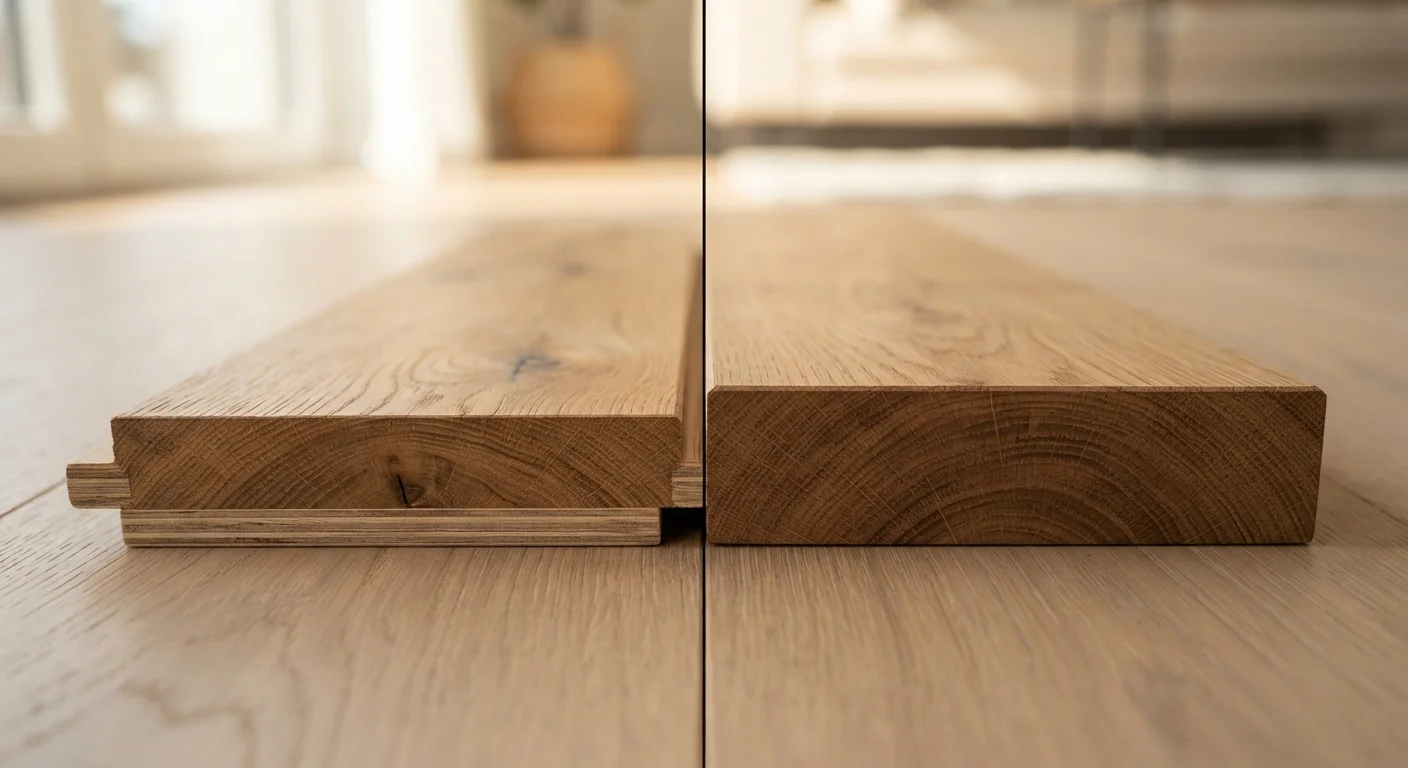
- Engineered hardwood has a real wood veneer over a plywood core, making it more stable in humidity fluctuations.
- Solid hardwood is milled from a single wood species throughout and can be sanded and refinished more times over its life.
- Engineered hardwood is generally compatible with radiant heat systems and below-grade installations; solid hardwood is not.
- Both products look nearly identical once installed - the differences are structural, not cosmetic.
- Your subfloor type, moisture levels, and climate should guide the decision as much as aesthetics or budget.
Option A
Engineered Hardwood
The dimensionally stable, versatile wood flooring option.
Best for: Homeowners installing over concrete subfloors, in moisture-prone areas, or below grade.
Option B
Solid Hardwood
The time-tested, fully refinishable classic.
Best for: Dry, above-grade spaces where long-term refinishing and maximum longevity are priorities.
If you're installing flooring in a basement or on a concrete slab
Engineered Hardwood
Engineered hardwood's plywood core resists moisture-related expansion and contraction better than solid wood, making it far better suited to below-grade and slab installations.
If you want to refinish the floors multiple times over several decades
Solid Hardwood
Solid hardwood's greater thickness allows for more sanding cycles - typically four to five over a lifetime - giving it an edge in long-term renewability.
If your home uses a radiant in-floor heating system
Engineered Hardwood
Engineered hardwood handles the temperature fluctuations from radiant heat with less risk of gapping, cupping, or warping than solid wood planks.
If you live in a region with extreme seasonal humidity swings
Engineered Hardwood
The cross-ply construction resists seasonal movement, reducing the likelihood of gaps forming in dry winters or swelling in humid summers.
If you're renovating a historic home and want authentic period character
Solid Hardwood
Solid hardwood can be sourced in wider planks and matching species to complement original flooring, and it deepens in character with each refinish over generations.
What Sets These Two Products Apart
Despite sharing a nearly identical surface appearance, engineered hardwood and solid hardwood are built differently from the bottom up - and those differences shape how each performs in your home over time.
Solid hardwood is milled from a single piece of wood, typically ¾ inch thick. Because it's one material throughout, it expands and contracts significantly as humidity changes. This makes it sensitive to moisture and limits where it can be installed.
Engineered hardwood consists of a real hardwood veneer - usually 1/16 to 1/8 inch thick - bonded over multiple layers of plywood or high-density fiberboard. The cross-grain layering creates dimensional stability, allowing the floor to handle humidity swings with far less movement. The top layer is indistinguishable from solid wood once installed.
| Criterion | Engineered Hardwood | Solid Hardwood |
|---|---|---|
| Construction | Wood veneer over plywood core | Single piece of milled wood |
| Typical thickness | 3/8" to 9/16" | 3/4" |
| Moisture resistance | Better - stable in humidity swings | Lower - expands and contracts more |
| Below-grade installation | Yes, generally suitable | Not recommended |
| Radiant heat compatibility | Generally compatible | Often incompatible or restricted |
| Refinishing potential | 1-3 times (veneer dependent) | 4-5 times over lifespan |
| Appearance | Identical to solid once installed | Real wood throughout |
| Installation methods | Float, glue, or nail/staple | Nail or staple (wood subfloor only) |
Understanding this structural distinction is the foundation for every other decision: installation method, room compatibility, and long-term maintenance all follow from it.
How Moisture and Climate Shape Your Choice
Moisture is the single biggest factor separating where each flooring type can go. Wood naturally absorbs and releases moisture, swelling in humid conditions and shrinking in dry ones. Solid hardwood does this dramatically across its full thickness. Engineered hardwood's cross-ply core constrains that movement significantly.
35-55%
Recommended indoor relative humidity for wood floors
Wood flooring industry guidelines broadly recommend keeping indoor humidity within this range to minimize expansion, contraction, and gapping in both solid and engineered products.
3mm+
Veneer thickness enabling multiple refinishes
Flooring industry guidance generally holds that engineered hardwood veneers of 3mm or thicker can be sanded and refinished more than once, depending on technique and wear.
¾ inch
Standard solid hardwood plank thickness
This is the traditional thickness for solid hardwood strip and plank flooring, providing the depth necessary for repeated sanding over a floor's lifespan.
Basements and concrete slabs introduce ground moisture even in dry climates, making engineered hardwood the standard recommendation for below-grade spaces. Many solid hardwood manufacturers explicitly exclude these applications from their warranties.
Radiant floor heating creates another moisture challenge: the heating system cycles daily temperature changes directly into the subfloor. Engineered hardwood generally tolerates this well; solid hardwood may gap or cup in response. Always verify the specific product's compatibility with your heating system before purchasing.
If your home sits in a region with high seasonal humidity variation - humid Gulf Coast summers or dry Mountain West winters, for example - engineered hardwood provides a more forgiving margin. That said, neither product eliminates the need for climate control. Maintaining interior relative humidity between approximately 35% and 55% is recommended for any wood floor.
Refinishing, Longevity, and the Long View
One of the most common concerns homeowners raise about engineered hardwood is refinishing: can it be sanded like solid wood? The answer depends on the veneer thickness. Thinner veneers (around 1/16 inch) may allow only one light sand and recoat. Thicker veneers (3mm or more) can typically be sanded and refinished two to three times. Solid hardwood, at ¾ inch thick, can generally accommodate four to five full refinishes over its lifespan.
For a home you plan to occupy for generations, that refinishing capacity matters. Solid hardwood floors installed in the early 20th century still exist in US homes today, having been refinished repeatedly. Engineered hardwood's track record in that regard is shorter simply because the product has been widely available for fewer decades.
That said, engineered hardwood has improved substantially in veneer thickness and wear-layer quality. When evaluating a specific product, check the veneer thickness rather than relying on general category assumptions.
For homeowners weighing the installation complexity of either option, our guide to DIY vs. professional installation walks through how to assess whether a flooring project is a reasonable DIY undertaking or calls for a licensed installer.
Check Warranties Before You Buy
Manufacturer warranties for hardwood flooring often specify installation conditions, including subfloor type, moisture levels, and heating systems. Installing outside those conditions can void coverage. Always read the warranty documentation for the specific product you select - not just the general category - before committing to a purchase.
Making the Call for Your Specific Project
There is no universally superior option - the right choice is project-specific. Work through these questions before deciding:
- What level is the room? Below grade or on a slab points toward engineered hardwood. Above grade on a wood subfloor opens the door to either.
- What's your local climate like? High humidity variability favors engineered hardwood's stability.
- Do you have radiant heat? Confirm compatibility for any product you're considering, but engineered hardwood generally handles it better.
- How long do you plan to stay? If you're renovating a forever home and want maximum refinishing longevity, solid hardwood's depth is a genuine advantage.
- What's your subfloor? Concrete requires engineered hardwood. Plywood subfloors work with both.
Both flooring types represent a meaningful investment in your home's comfort and resale appeal. Taking time to match the product to your specific conditions - rather than defaulting to one or the other based on price alone - is the decision that pays off over the life of the floor.