

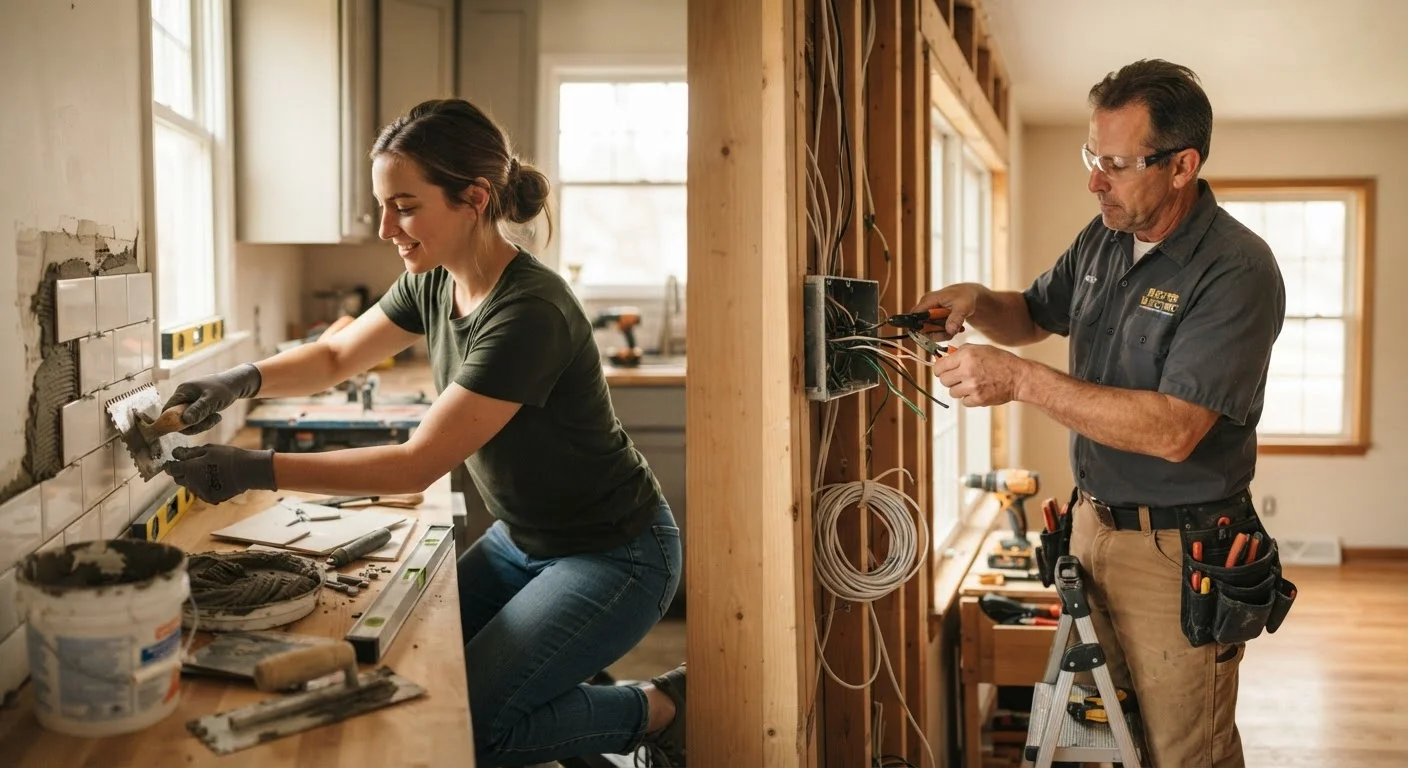
Key Takeaways
- Skill level, safety risk, and permit requirements are stronger decision factors than cost alone.
- Electrical, gas, structural, and load-bearing work almost always requires a licensed professional.
- DIY is most appropriate for finish-level tasks with low safety consequences if something goes wrong.
- Unpermitted work can complicate home sales and void homeowner's insurance coverage.
- An honest skills assessment upfront prevents costly mid-project contractor rescues.
Our Verdict
DIY and professional installation each have a legitimate place in home improvement - the key is matching the approach to the project's complexity, safety profile, and regulatory requirements. Finish-level work with forgiving margins is where DIY delivers real value; anything involving structural integrity, licensed trades, or life-safety systems warrants professional hands. The clearest-eyed homeowners treat this as a project-by-project analysis, not a blanket policy.
| Best for | Recommended |
|---|---|
| Finish-level cosmetic projects with low stakes | DIY |
| Electrical, plumbing, gas, or structural work | Professional Installation |
| Projects requiring permits or code inspections | Professional Installation |
| Experienced homeowners with verified relevant skills | DIY (with permit compliance) |
Why This Decision Is More Than a Budget Question
The instinct to frame DIY versus professional installation purely as a cost comparison is understandable - labor is often the largest line item in any renovation quote. But reducing the decision to dollars misses the variables that actually determine whether a project succeeds or creates a bigger problem than the one you started with.
Three factors consistently separate projects that belong in homeowner hands from those that don't: skill match, safety consequence, and regulatory requirement. A project that scores low on all three - painting a bedroom, replacing cabinet hardware, laying a floating floor - is a reasonable DIY candidate. One that scores high on even one of them deserves a harder look. As the renovation myths many homeowners hold show, assuming you can handle a task because you've watched enough tutorials is one of the more expensive beliefs in home improvement.
| DIY | Professional Installation | |
|---|---|---|
| Typical best use | Finish-level, cosmetic work | Structural, mechanical, life-safety work |
| Permit requirement | Rarely required | Often required and enforced |
| Consequence of error | Cosmetic redo, wasted materials | Safety hazard, code violation, costly repair |
| Skill threshold | General ability, patience, right tools | Licensed trade or verified expertise |
| Schedule control | Flexible, on your timeline | Dependent on contractor availability |
| Insurance / warranty impact | Low risk if finish work only | Unpermitted work can void coverage |
Where DIY Makes Genuine Sense
DIY delivers real value when the work is finish-level, the margin for error is forgiving, and a mistake doesn't compromise safety or require a licensed professional to undo. Painting, caulking, installing pre-hung interior doors, replacing light fixtures on existing circuits (with power off), laying click-lock flooring, and basic landscaping all fit this profile.
What these tasks share is a low consequence ceiling: if the paint color looks wrong, you repaint. If the flooring boards are slightly misaligned, you pull them up and reset. The correction cost is time and materials - not structural repair or emergency service calls.
Match the Tool to the Task
A common DIY setback isn't lack of skill - it's using the wrong tool and compensating with extra effort or workarounds. Before starting any project, verify you have the specific tools the job requires. Renting specialty equipment for a one-time project is almost always worth it compared to doing the work poorly or damaging materials with an inadequate substitute.
One underappreciated advantage of DIY on cosmetic work is schedule flexibility. You aren't coordinating around contractor availability, and smaller finish projects often stretch over weekends without disrupting the household. That flexibility has genuine value, even if it doesn't show up on a cost sheet.
When Professional Installation Is the Right Call
Certain categories of work are professionally handled not because homeowners lack ambition, but because the risk profile is simply different. Electrical panel work, gas line installation or repair, load-bearing structural modifications, and plumbing connections to the mains carry life-safety consequences if done incorrectly. In most jurisdictions, this work also requires licensed contractors and permits - meaning unpermitted work isn't just risky, it's potentially illegal.
Permits matter more than many homeowners realize. Unpermitted work can surface during a home sale, trigger insurance complications, and leave you personally liable if something goes wrong afterward. The hidden costs that derail renovation budgets frequently include exactly this scenario: a homeowner who skipped permits on a finished basement or electrical upgrade faces expensive remediation when the home is appraised or sold.
Complexity also scales. A bathroom remodel's sequencing logic - knowing what rough-in work must happen before tile, and why the order affects both quality and code compliance - is the kind of interdependency that professionals manage by training. Getting the sequence wrong as a DIYer can mean redoing finished work.
The Honest Skills Assessment Most Homeowners Skip
Before committing to either path, run a quick but honest skills inventory. Have you completed a similar project before, and did it pass inspection or hold up over time? Do you have the right tools - not just a reasonable substitute, but the actual tool the job requires? Can you troubleshoot mid-project if something unexpected surfaces (and it often does)?
If the answer to any of these is uncertain, that doesn't automatically rule out DIY - but it does argue for starting with a smaller test project or consulting a professional for at least the first phase. A hybrid approach works well for larger renovations: hire a licensed contractor for rough-in and structural work, then take over finish-level tasks yourself once inspections are complete. This is a common approach for projects like room additions or finishing unused space, where the structural and mechanical work is genuinely complex but the cosmetic finish is accessible to a capable homeowner.
The clearest signal that a project has crossed the DIY threshold: you're planning to hide or work around something rather than fix it correctly. That instinct - to tile over a moisture problem, to cap a wire rather than trace its source - is the moment to stop and call a professional.