

Key Takeaways
- Community college typically costs significantly less per credit hour than a four-year university.
- Many community colleges have articulation agreements that facilitate credit transfer to universities.
- Four-year universities offer broader campus resources, research opportunities, and residential life.
- Community college is often more accessible for students balancing work or family responsibilities.
- Neither path universally guarantees better outcomes - alignment with personal goals matters most.
Option A
Community College
The accessible, lower-cost entry point to higher education.
Best for: Learners who want to reduce upfront costs, earn transferable credits, or gain workforce credentials on a flexible schedule.
Option B
Four-Year University
The traditional, comprehensive pathway to a bachelor's degree.
Best for: Students seeking a full residential academic experience, specialized programs, and a direct four-year route to a bachelor's degree.
If you need to minimize educational debt before earning a bachelor's degree
Community College
Completing general education requirements at a community college before transferring can substantially reduce total tuition paid for a four-year degree.
If you want an uninterrupted, immersive undergraduate experience
Four-Year University
Universities offer a continuous academic environment with research access, campus life, and networking that begins from day one of enrollment.
If you are balancing work, family, or other significant obligations
Community College
Community colleges typically offer evening, weekend, and hybrid course formats that accommodate non-traditional schedules more readily.
If your intended major requires specialized labs, studios, or competitive programs
Four-Year University
Programs in engineering, fine arts, nursing, and similar fields often require specialized facilities and faculty cohorts most available at four-year institutions.
If you are still exploring possible career directions
Community College
Lower stakes and lower cost make community college a practical place to sample subjects and clarify goals before committing to a degree path.
The Core Difference: What Each Path Actually Is
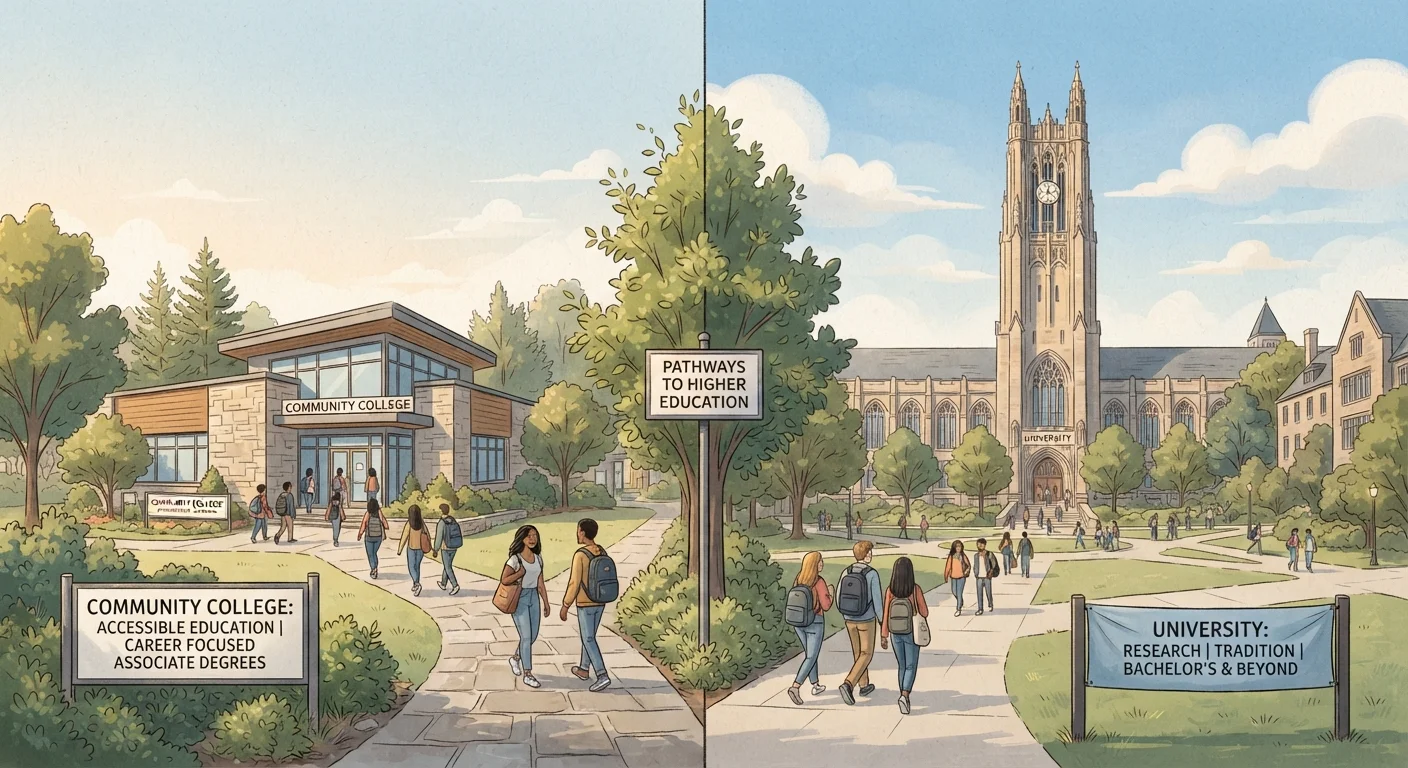
Community colleges - sometimes called two-year colleges - award associate degrees and certificates, typically in two years of full-time study. Four-year universities award bachelor's degrees and, at many institutions, graduate credentials as well. Both are accredited institutions of higher education, but they differ substantially in scope, cost structure, and the academic experience they provide.
It is worth noting that the two-year versus four-year label describes the degree, not necessarily how long any individual student takes. Many community college students attend part-time and complete programs in three or more years, while some university students graduate in fewer than four. Understanding this helps you evaluate each path on your own timeline rather than on an idealized one.
For readers weighing even broader alternatives, our comparison of online learning platforms and community college explores how non-campus routes differ in credential weight and structure.
Cost: Where the Numbers Actually Diverge
Tuition is the most cited difference, and the gap is substantial. According to the College Board's annual Trends in College Pricing reports, average annual tuition and fees at public two-year colleges are roughly one-third to one-fourth of those at public four-year universities, and an even smaller fraction of private university costs. Room and board - if applicable - adds considerably to four-year university expenses for residential students.
The transfer strategy is worth understanding here: students who complete an associate degree or a defined set of general education credits at a community college and then transfer to a state university to complete a bachelor's degree may pay significantly less overall than students who spend all four years at the university. However, this outcome depends on whether credits transfer cleanly, which is discussed in the next section.
~$3,990
Average public two-year college tuition per year
According to College Board's Trends in College Pricing data, this figure reflects tuition and fees only and excludes room, board, and other costs.
~$11,260
Average public four-year in-state tuition per year
College Board data shows public four-year in-state tuition and fees are roughly three times higher than public two-year college costs on average.
Over 40%
Share of U.S. undergraduates enrolled at two-year colleges
The American Association of Community Colleges reports that community colleges serve a large and diverse share of the undergraduate population nationwide.
Financial aid is available at both types of institutions. Pell Grants, federal loans, and many state grants apply at community colleges just as at universities. Community colleges also carry lower opportunity cost for students who cannot afford to stop working, since scheduling flexibility makes combining employment and coursework more feasible.
Transfer, Credit Portability, and Articulation Agreements
One of the most important - and least understood - factors in the community college path is how credits move. Articulation agreements are formal arrangements between a community college and a university that specify which credits will transfer and how they will count toward a bachelor's degree. Many state systems have strong statewide articulation frameworks, meaning an associate degree earned at any in-state community college guarantees junior-year standing at any in-state public university.
Where articulation agreements are weak or absent, students risk losing credits - effectively paying to retake coursework. Before enrolling in any community college with transfer intent, it is worth researching whether your target university has a published agreement with that college, and confirming which specific courses count toward your intended major.
| Criterion | Community College | Four-Year University |
|---|---|---|
| Average annual tuition (public) | Lower - roughly $3,000-$5,000 | Higher - roughly $10,000-$12,000+ |
| Degree awarded | Associate degree or certificate | Bachelor's degree (and beyond) |
| Typical time to credential | 2 years full-time | 4 years full-time |
| Schedule flexibility | High - evening, hybrid, weekend options common | Moderate - more structured semester schedules |
| Transfer pathway | Depends on articulation agreements | Not applicable (direct enrollment) |
| Campus resources | Core academic support services | Extensive - research, career, residential |
| Class sizes (introductory) | Generally small to mid-sized | Can be very large in first-year courses |
For a detailed walkthrough of the mechanics involved, see our guide on navigating the transfer process, which covers articulation timelines and application requirements.
Campus Experience, Resources, and Networking
Four-year universities typically offer a denser ecosystem of student services: research libraries, career centers with employer partnerships, internship pipelines, alumni networks, and residential communities. For students whose goals involve graduate school or fields where alumni connections matter - law, finance, academic research - this infrastructure can have real long-term value.
Community colleges have historically invested heavily in workforce development and student support services, including tutoring centers, transfer advising, and partnerships with local employers. The experience is generally less residential and less socially immersive, but that is not a drawback for every learner. Students who are older, employed, or locally rooted often find the community college environment a better fit for their actual lives.
It is also useful to consider how this decision relates to other learning choices you may face. Our analysis of self-directed versus structured learning can help you reflect on how much external accountability and structure supports your progress. And if a campus degree of any kind is on your radar, our framework for comparing online and campus degrees addresses flexibility and credential considerations in more depth.
Accreditation Applies to Both
Both community colleges and four-year universities can hold regional accreditation, which is the standard recognized by most employers and graduate programs. Before enrolling anywhere, verify that the institution holds accreditation from a recognized regional accrediting body. This matters especially if you plan to transfer credits or pursue graduate education later.