
Synchronous vs. Asynchronous Learning: What the Difference Actually Means for You

Key Takeaways
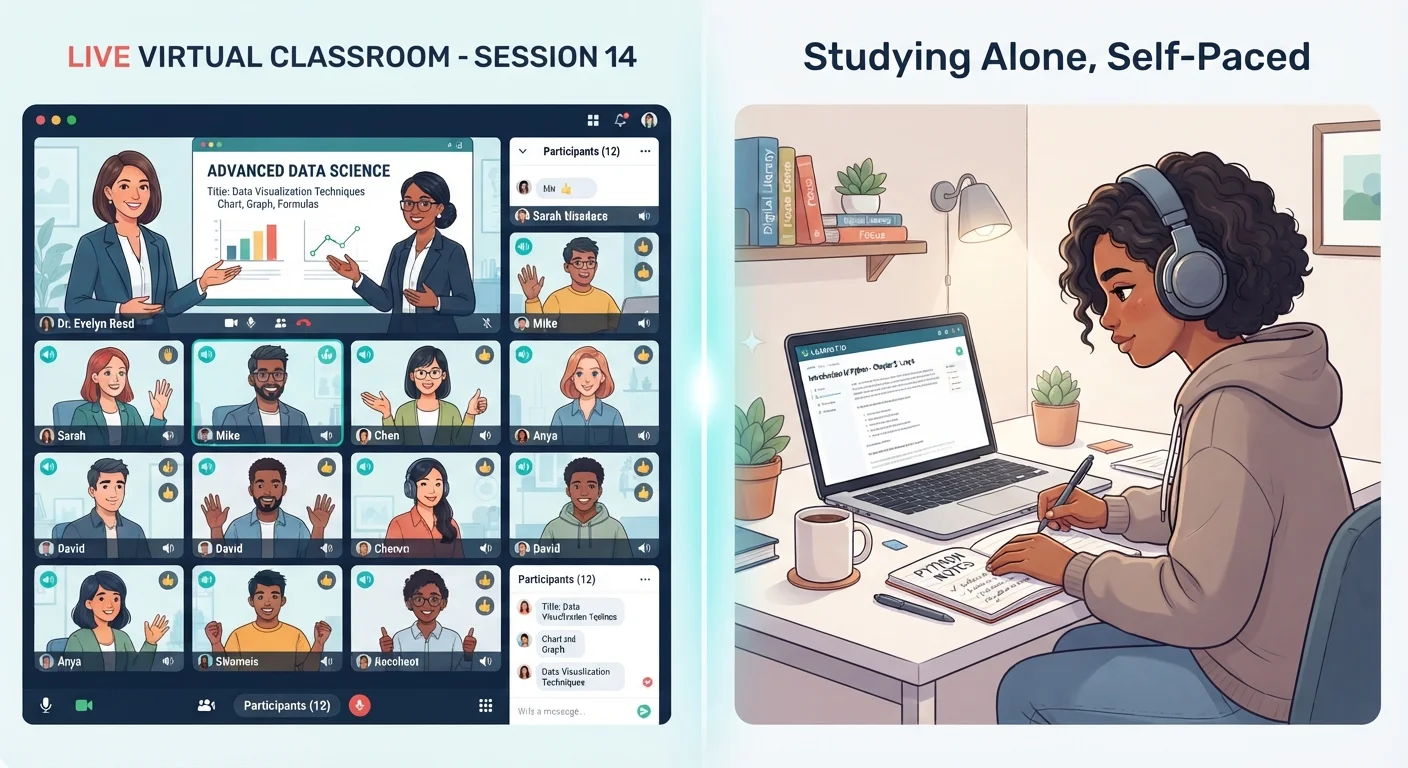
- Synchronous learning happens in real time - everyone logs in at the same scheduled moment.
- Asynchronous learning lets you access materials and complete work on your own timetable.
- Neither format is universally better; the right fit depends on your schedule, discipline level, and learning goals.
- Many modern programs blend both formats, using live sessions for key discussions and recorded content for foundational material.
- Asynchronous learners typically need stronger self-management skills to stay on track.
Option A
Synchronous Learning
The structured, real-time classroom experience.
Best for: Learners who benefit from live interaction, accountability, and immediate feedback from instructors or peers.
Option B
Asynchronous Learning
The flexible, self-directed study approach.
Best for: Learners who need to fit education around work, family, or time-zone differences and prefer setting their own pace.
If you thrive on real-time discussion and need external accountability
Synchronous Learning
Live sessions keep you on a structured schedule and allow you to ask questions, get immediate answers, and build rapport with instructors and classmates.
If you work full-time or manage caregiving responsibilities
Asynchronous Learning
Pre-recorded lectures and flexible deadlines let you engage with course material during windows that fit your daily life without missing live sessions.
If you are studying across a significant time-zone difference
Asynchronous Learning
Asynchronous formats remove the burden of joining live sessions at inconvenient hours, making global access to education more practical.
If you are new to online learning and want structured support
Synchronous Learning
Regular scheduled touchpoints reduce the isolation that many first-time digital students experience and provide a reliable learning rhythm.
If you want the benefits of both flexibility and community
Synchronous Learning
Look for blended or cohort-based programs that combine live group sessions with self-paced modules, giving you flexibility without sacrificing connection.
Defining the Two Formats
The words synchronous and asynchronous come from the Greek root meaning "time." In education, they simply describe when learning happens relative to everyone else in the course.
Synchronous learning requires all participants to be present at the same time. Think of a live video lecture, a real-time group discussion, or a scheduled office-hours session - you show up at 7 p.m. on Tuesday or you miss it. Asynchronous learning removes that shared clock. You watch recorded lectures, read posted materials, and submit work within a broader window - often days or even a full week - so timing is yours to control.
These are not new ideas. Traditional in-person classrooms are inherently synchronous. Correspondence courses from decades past were asynchronous. What has changed is scale: digital platforms now make both formats available to millions of learners simultaneously, often within the same program. For a broader look at how platforms organize these formats differently, see how major online learning platforms differ.
| Criterion | Synchronous Learning | Asynchronous Learning |
|---|---|---|
| Timing | Fixed schedule; real-time attendance required | Flexible; complete work within a set window |
| Feedback speed | Immediate, during live session | Delayed; via forums or instructor email |
| Accountability | Built-in through scheduled sessions | Self-generated; requires discipline |
| Community feel | Strong; spontaneous peer interaction | Variable; depends on course design |
| Time-zone suitability | Challenging across large differences | Highly compatible with any time zone |
| Best for | Structured, discussion-based learning | Learners with unpredictable schedules |
The Real Trade-Offs You Should Know
Choosing a format is not just a scheduling decision - it affects how you process information, build relationships, and stay motivated.
Engagement and Feedback
Synchronous environments allow you to raise your hand (virtually), get clarification in the moment, and observe how peers respond to the same material. That immediacy can deepen understanding. Asynchronous formats, by contrast, typically rely on discussion boards, written feedback, and email - all of which involve a delay. This is not inherently worse, but it requires you to articulate questions precisely in writing and tolerate waiting for answers.
Accountability and Discipline
A scheduled session creates natural accountability: the meeting exists whether you feel motivated or not. Asynchronous learners must generate that structure internally. Research in self-regulated learning - the ability to set goals, monitor progress, and adjust strategies independently - consistently shows this is a skill set that varies significantly among adult learners. If you are curious about the honest demands of self-directed study, self-paced learning carries hidden challenges worth understanding before you enroll.
70%+
Online learners who cite schedule flexibility as a top priority
Multiple surveys of adult online learners consistently find schedule flexibility ranks among the most important factors when choosing a course format.
~15%
Typical completion rate for self-paced MOOCs
Studies of massive open online courses (MOOCs) have generally found completion rates in the low-to-mid teens, underscoring the accountability challenge in fully asynchronous formats.
Community and Collaboration
Live sessions naturally produce the kind of spontaneous exchange - a tangential question, a peer's unexpected insight - that often produces the most memorable learning. Asynchronous formats can build community too, but it requires deliberate course design and active participation in forums. Cohort-based programs often blend both approaches specifically to preserve community while offering schedule flexibility.
How to Choose the Format That Works for You
Start by auditing your schedule honestly. Count the hours per week you can realistically protect for learning - not aspirationally, but based on the past month. If those hours are scattered and unpredictable, asynchronous is likely more sustainable. If you can reliably block the same two evenings each week, synchronous may serve you better.
Next, consider your learning history. Have you completed self-paced courses before, or do they tend to pile up unwatched? If you are exploring this question for the first time, the broader guide on starting out in online learning offers useful framing for first-time digital students.
Blended Formats Are Increasingly Common
Many programs today combine both approaches - using synchronous sessions for live discussions, Q&A, and group projects, while hosting recorded lectures and readings asynchronously. Before assuming a course is entirely one or the other, review the syllabus carefully. A course described as 'flexible' may still include required live components, and one labeled 'live' may archive sessions for later viewing.
Finally, think about your goal. If you want to develop a skill for career purposes - where demonstrating applied ability matters - consider whether the format provides opportunities for live practice and feedback. If you are building foundational knowledge at your own pace, asynchronous modules may be entirely sufficient. The comparison between self-directed and structured learning paths can help you think through this further.