
The Landscape of Online Learning Platforms: Key Differences Worth Knowing

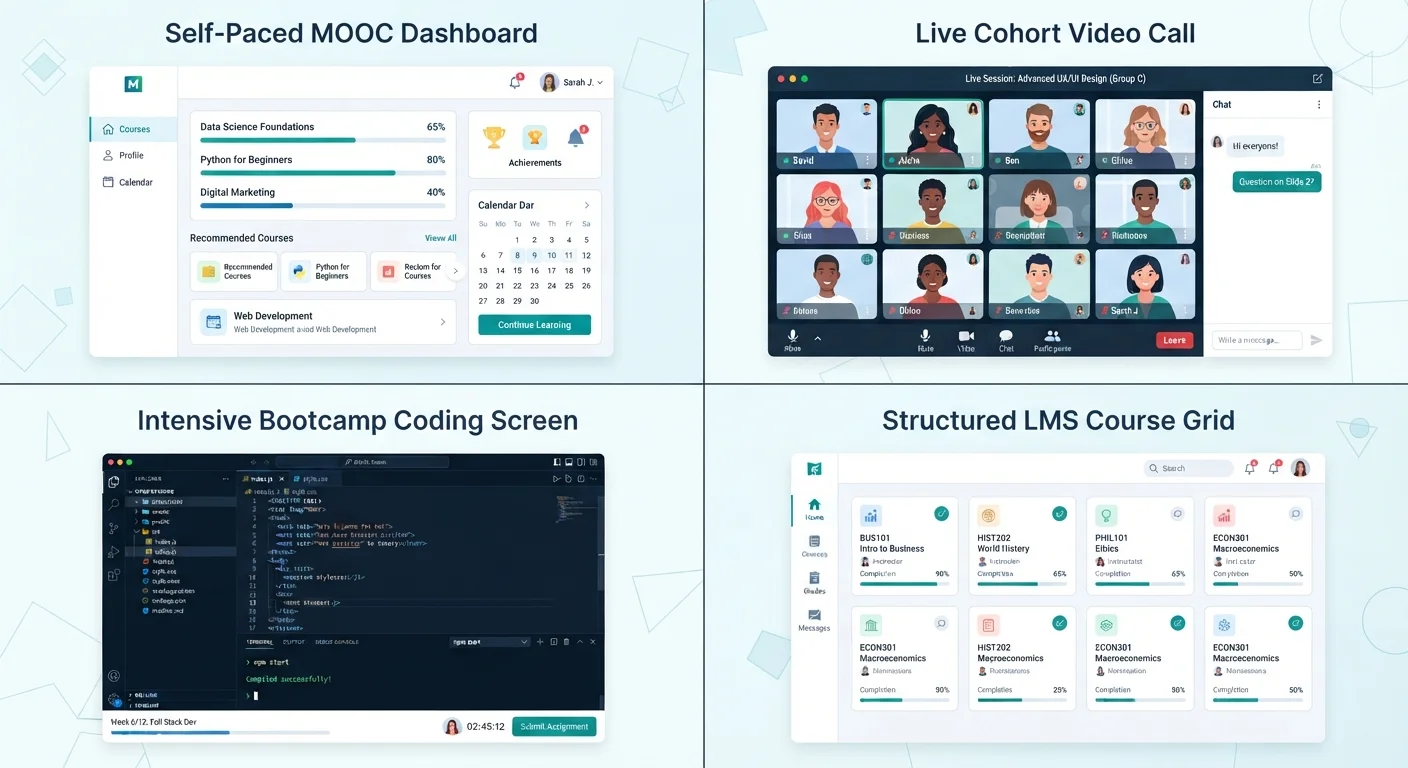
Key Takeaways
- MOOCs offer broad access and flexible pacing but typically have very low completion rates.
- Cohort-based courses provide community and accountability through structured, time-bound cohorts.
- LMS platforms are primarily institutional tools that power structured curricula for organizations or schools.
- Bootcamps prioritize fast, intensive skill acquisition and are often tied to specific career outcomes.
- Choosing a platform type should start with your learning goals, schedule, and preferred level of structure.
Our Verdict
No single platform model is universally superior - each is engineered for a different learner profile and goal. MOOCs suit self-directed explorers; cohort courses work for those who need community; LMS platforms serve institutional contexts; and bootcamps target rapid, job-focused skill building. Aligning your choice with your specific situation is far more important than chasing the most popular format.
| Best for | Recommended |
|---|---|
| Self-directed learners exploring topics at their own pace | MOOCs |
| Those who need peer accountability and structured deadlines | Cohort-Based Courses |
| Employees or students within an institutional setting | LMS Platforms |
| Career changers seeking intensive, job-ready skill training | Bootcamps |
Why the Platform Model Matters
When people talk about online learning, they often treat it as a single category. In practice, the phrase covers at least four meaningfully different delivery models - each with its own pedagogy, pacing expectations, cost structure, and target audience. Picking the wrong model is one of the most common reasons learners stall or disengage before finishing.
Understanding what distinguishes a MOOC from a cohort-based course, or a LMS platform from an intensive bootcamp, helps you make a deliberate choice rather than a default one. For a broader orientation to how digital learning works in practice, see our guide Online Learning From Scratch.
The Four Core Platform Models Compared
Each model below reflects a distinct philosophy about how people learn online - and who is most likely to succeed within it.
| MOOCs | Cohort-Based Courses | LMS Platforms | Bootcamps | |
|---|---|---|---|---|
| Pacing | Self-paced, on demand | Fixed schedule with group | Varies by institution | Intensive, fixed timeline |
| Accountability | Low - learner-driven | High - peer and instructor | Moderate - institutional | High - structured deadlines |
| Community | Minimal or optional | Central to the model | Varies by program | Cohort-based, limited |
| Typical duration | Hours to weeks | 4-12 weeks | Semester or module-based | 8-26 weeks |
| Cost range | Free to low-cost | Moderate to high | Institutional tuition | High upfront investment |
| Best use case | Exploration, sampling | Deep skill + community | Formal academic credit | Career transition |
For a deeper look at how time-structure shapes your experience within any of these models, see our explainer on synchronous vs. asynchronous learning.
MOOCs: Broad Access, Low Friction, Variable Outcomes
Massive Open Online Courses were designed to democratize education - making university-level content available to anyone with internet access. Platforms operating in this space typically host thousands of courses across every imaginable subject, available on demand with minimal enrollment barriers.
The tradeoff is well-documented. Research on MOOC completion rates consistently finds that a small minority of enrolled learners finish a course. Reasons range from unclear learning goals to the absence of deadlines and social accountability. Why so many online courses go unfinished explores the cognitive and motivational dynamics behind this pattern in detail.
MOOCs work well as exploration tools - useful for sampling a subject, supplementing another program, or earning a standalone certificate in a narrow skill area. They are less reliable as a primary vehicle for deep, durable learning without supplemental structure.
Set a Goal Before Choosing a Platform
Before enrolling anywhere, write down what you want to be able to do - not just what you want to know. A clear outcome (e.g., 'build a functional data dashboard' or 'understand contract law basics') helps you match the platform model to your actual need, rather than defaulting to whatever is most advertised. Exploratory goals may suit a MOOC; job-transition goals often require higher-structure formats.
Cohort-Based Courses and Bootcamps: Structure as a Feature
Cohort-based courses (CBCs) operate on a fundamentally different model. Learners enroll together, progress through material on a shared schedule, and interact through live sessions, discussion, and peer review. The built-in accountability and community address several of the dropout drivers that undermine self-paced formats. If you're new to this approach, our article on cohort-based learning offers a clear orientation.
Bootcamps share the intensity of CBCs but are typically shorter, more vocational, and organized around a specific job-readiness outcome - most commonly software development, data analysis, or UX design. Their value depends heavily on the quality of curriculum design and how well the credential is recognized by employers in a given field. For an honest evaluation of where bootcamp credentials hold weight and where they don't, see Bootcamps and Short-Form Credentials.
LMS Platforms: Institutional Infrastructure
A Learning Management System is not a course marketplace - it is infrastructure. Universities, corporations, and training organizations use LMS platforms to build, deliver, and track structured learning programs. Learners typically access an LMS because their school or employer has deployed one, rather than choosing it independently.
Within an LMS, course quality varies entirely based on who designed the content. The platform itself is neutral. What matters is the instructional quality layered on top of it - a distinction worth understanding before attributing outcomes to the technology. Our piece on what separates effective online courses from forgettable ones examines these design principles directly.
For learners considering structured credentials and longer academic routes, the Academic Pathways hub provides context on how different program types fit into broader educational planning. Similarly, those focused on applied skill development will find relevant guidance in the Skill Building hub.