

Key Takeaways
- The brain physically changes its structure each time you practice a new skill.
- Spaced repetition outperforms massed practice for long-term retention.
- Sleep is a critical and often undervalued phase of skill consolidation.
- Focused, feedback-driven effort accelerates learning more than mindless repetition.
- Adult brains retain significant neuroplasticity, making lifelong learning genuinely possible.
Skill Acquisition
Skill acquisition is the process by which the brain learns new behaviors, knowledge, or abilities through practice and experience. It involves forming new neural connections and strengthening existing ones over time. With the right conditions - repetition, feedback, and rest - these connections become faster, more reliable, and eventually automatic.
Neuroscientists describe this process through synaptic plasticity: the ability of synapses to strengthen or weaken in response to activity, summed up in Hebb's rule - 'neurons that fire together, wire together.'
What Happens in the Brain When You Learn
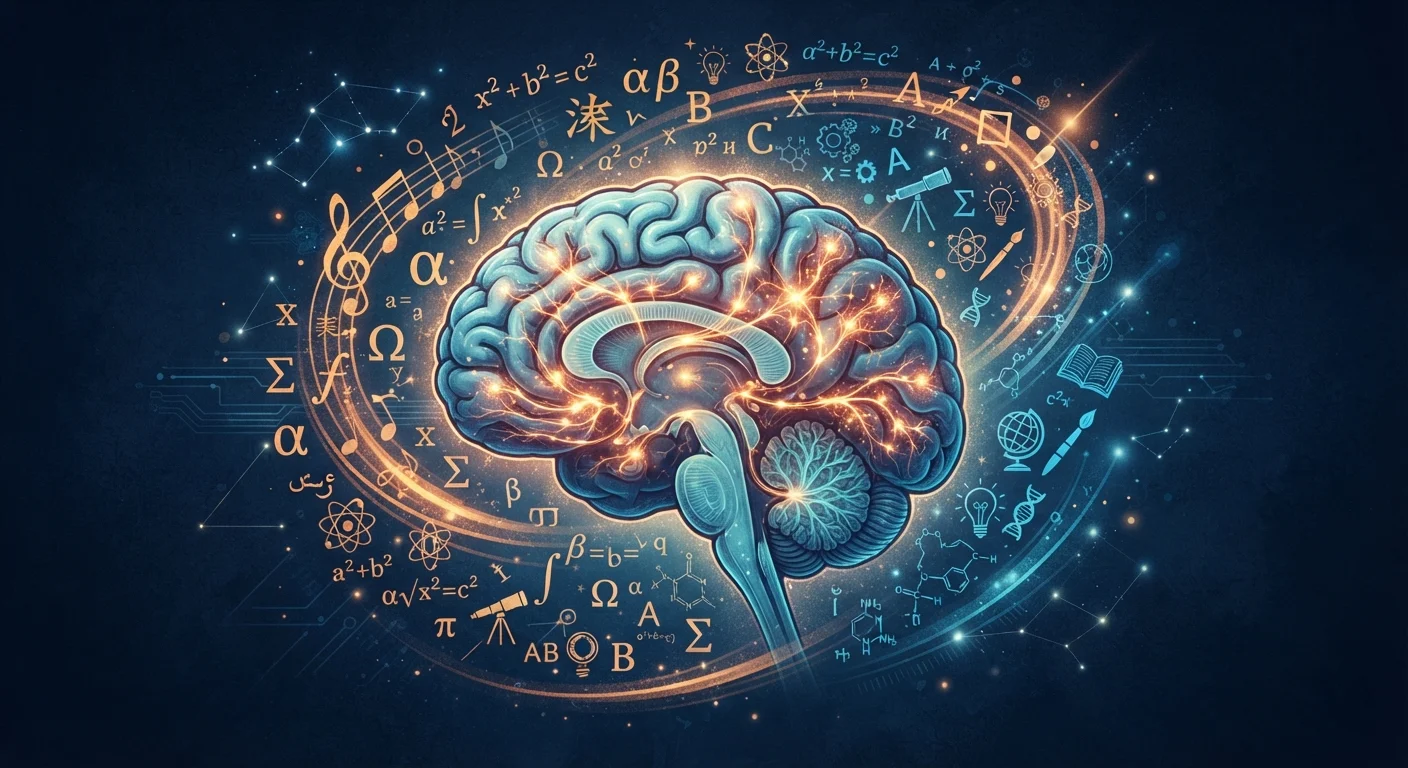
Every time you attempt a new skill - playing a chord on a guitar, solving a type of math problem, or navigating a new software tool - your brain responds by forming and reinforcing neural pathways. This process, called synaptic plasticity, is the biological foundation of all learning.
When neurons fire together repeatedly, the connections between them - called synapses - become more efficient. The signal travels faster and with less effort. Over time, repeated activation causes the brain to wrap certain nerve fibers in a fatty substance called myelin, which dramatically speeds up signal transmission. This myelination is one reason practiced skills start to feel automatic rather than laborious.
The brain structures most involved include the hippocampus (critical for forming new memories), the prefrontal cortex (involved in conscious, effortful learning), and the cerebellum and basal ganglia (which take over as skills become more automatic and procedural). Understanding this handoff explains why early learning feels mentally exhausting while later-stage performance becomes fluid.
Neuroplasticity Is Not Unlimited
While the adult brain retains meaningful plasticity throughout life, certain types of learning - such as acquiring a native-like accent in a second language - are generally easier during specific developmental windows in childhood. This does not mean adult learning is impossible or less valuable; it means the strategies that work best may differ. Adults often compensate with stronger metacognitive awareness and motivation.
The Three Stages of Skill Development
Cognitive psychologists Paul Fitts and Michael Posner proposed an influential model describing skill learning in three stages, which remains widely referenced in educational and sports science literature.
- Cognitive stage: The learner consciously thinks through each step, makes frequent errors, and requires significant mental effort. This is the most cognitively taxing phase.
- Associative stage: Errors become less frequent, movements or decisions become more fluid, and the learner begins to detect and self-correct mistakes. Practice is still deliberate but less mentally draining.
- Autonomous stage: The skill becomes largely automatic, requiring minimal conscious attention. The learner can now perform the skill while managing other cognitive tasks simultaneously.
Recognizing which stage you are in helps you calibrate your practice. Early-stage learners benefit most from slowing down and focusing on accuracy; later-stage learners may need to introduce new challenges to continue improving. For a structured approach to that challenge, see our guide on deliberate practice.
Identify Your Stage Before You Practice
Before each practice session, ask yourself: am I still making basic errors (cognitive stage) or refining an already functional skill (associative/autonomous)? The answer should guide how you structure that session. Early-stage learners benefit from slow, accurate repetition; later-stage learners need to introduce new complexity or constraints to keep improvement moving.
Why Spacing and Sleep Matter More Than You Think
One of the most robust findings in learning science is the spacing effect: distributing practice across multiple sessions over time produces significantly better long-term retention than the same total practice time crammed into a single block. The brain needs intervals of rest to consolidate new information into durable memory traces.
Sleep, in particular, plays an active role in this consolidation. During slow-wave and REM sleep, the brain replays and strengthens recently learned patterns. Studies have found that motor skills - like learning a finger-tapping sequence - show measurable overnight improvement without any additional waking practice.
20-40%
Performance gain from post-learning sleep
Research published in neuroscience journals has documented that sleeping after a motor learning session can improve next-day performance by this margin compared to waking rest alone.
2x
Retention advantage of spaced over massed practice
Meta-analyses of spacing effect studies consistently find that distributed practice roughly doubles long-term retention rates compared to equivalent time spent in a single session.
4 sessions
Minimum sessions for stable skill consolidation
Cognitive science research suggests that new procedural skills typically require at least several distributed practice sessions before neural consolidation becomes robust and resistant to interference.
The practical implication is straightforward: a 30-minute practice session repeated across four days is generally more effective for retention than a single two-hour marathon. This principle applies to language learning, musical instrument practice, professional skill development, and academic study alike. For strategies to build this into a sustainable routine, see our article on skill-building habits that hold up over time.
The Role of Feedback in Accelerating Learning
Practice without feedback is one of the most common - and costly - mistakes self-directed learners make. The brain requires error signals to calibrate and refine neural pathways. Without knowing what went wrong or why, the learner may simply be reinforcing imprecise or inefficient patterns.
Feedback can come from many sources: a coach, a recording of your own performance, a test score, or even the physical resistance of a tool or instrument. What matters is that the information arrives soon enough after the action to be linked to the right behavior and that it is specific enough to guide adjustment.
“For the vast majority of people, in virtually every domain of expertise, the right kind of practice over a sufficient period of time leads to improvement. There is no reason not to follow your ambitions.”
— K. Anders Ericsson, Psychologist and researcher, widely recognized for his work on expertise and deliberate practice
Building feedback loops into everyday learning practice is a skill in itself. Our companion article on how feedback loops accelerate learning explains how to structure this systematically - regardless of the domain you are working in.
The same principles that govern human skill learning are mirrored in animal training. If you are curious how these mechanisms appear outside formal education, the science of positive reinforcement training offers an illuminating parallel.