

Key Takeaways
- Positive reinforcement is grounded in operant conditioning, a well-researched behavioral science framework developed over decades.
- Rewards work because they trigger dopamine release in the brain, motivating dogs to repeat the behavior that earned them.
- Timing is critical — a reward must follow the desired behavior within one to two seconds to form a clear association.
- A marker word or click bridges the gap between behavior and reward, making timing more precise.
- Dogs of all breeds and ages can learn through reward-based methods — including senior dogs.
- What counts as a reward varies by individual dog; food, toys, and social praise can all be effective reinforcers.
Positive Reinforcement Training
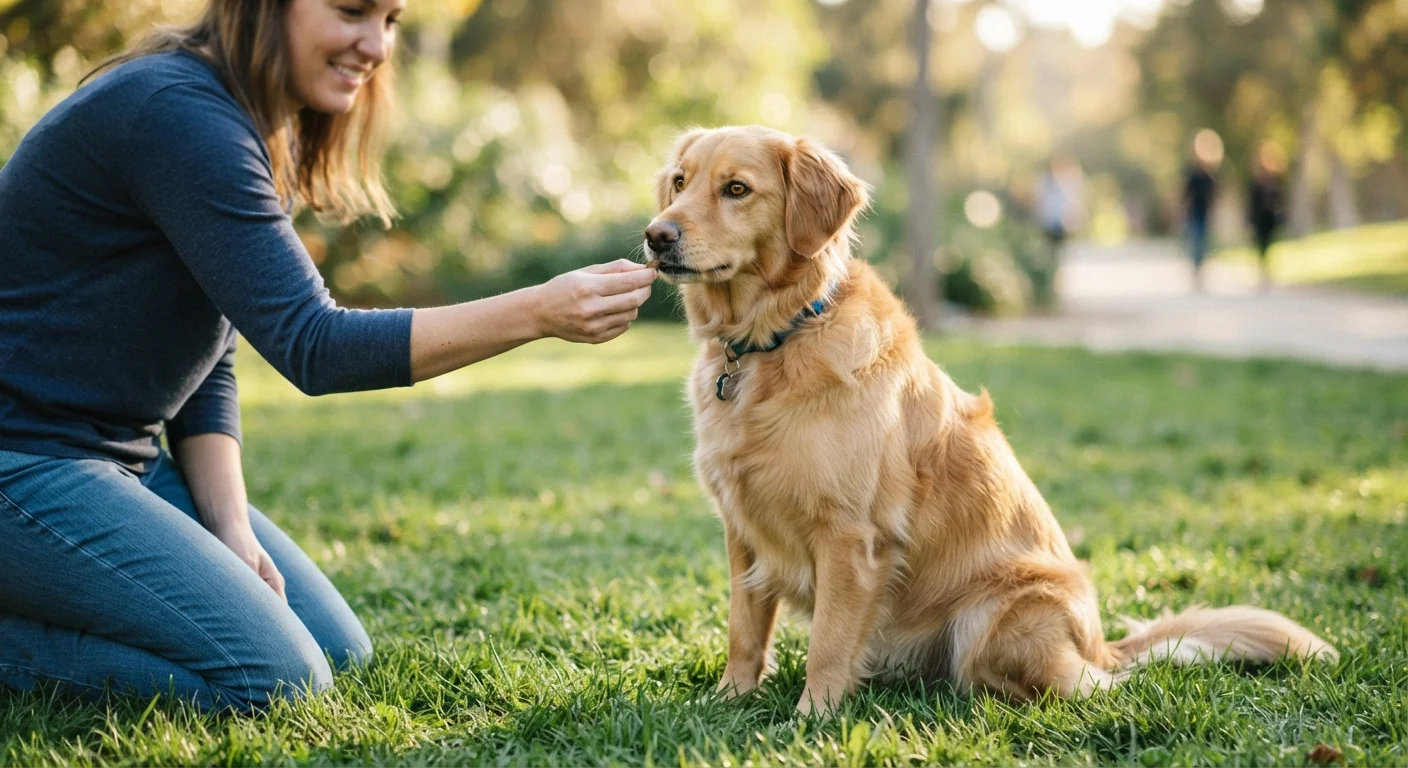
Positive reinforcement training is a method of teaching dogs by immediately rewarding the behaviors you want to see repeated. Grounded in a well-established branch of behavioral science called operant conditioning, it works by strengthening the connection between a specific behavior and a pleasant consequence — such as a treat, praise, or play. Over time, the dog learns to offer that behavior more readily because it reliably produces something desirable.
In operant conditioning terminology, "positive" means adding a stimulus to the situation, while "reinforcement" describes any outcome that increases the future frequency of a behavior. Together, they describe the precise mechanism of adding something the animal values in order to make a behavior more likely to recur.
Operant Conditioning: The Framework Underneath the Treat
Positive reinforcement is one quadrant of a broader behavioral framework called operant conditioning — a model developed through decades of psychological research, most famously advanced by psychologist B.F. Skinner in the mid-20th century. Operant conditioning describes how an animal's behavior is shaped by its consequences: behaviors that produce good outcomes tend to be repeated; behaviors that produce no outcome or an unpleasant one become less frequent over time.
The word "positive" here is not a value judgment — it's a technical term meaning something is added to the situation. "Reinforcement" describes any consequence that causes a behavior to occur more often. So positive reinforcement training means: add something the dog values immediately after a desired behavior, and that behavior becomes more likely to recur. It is a precise mechanism, not a permissive philosophy.
"Positive" Is a Technical Term, Not a Temperament
In behavioral science, "positive" and "negative" describe whether a stimulus is added to or removed from a situation — not whether an approach is lenient or strict. Positive reinforcement adds something the dog wants; positive punishment adds something aversive. Understanding this distinction helps owners recognize that reward-based training is a precise, evidence-informed tool. It shapes behavior by building a clear picture of what works, rather than simply suppressing what doesn't.
What Happens in Your Dog's Brain When You Reward Them
The neuroscience behind reward-based training helps explain its durability. When a dog performs a behavior and receives a reward — a food treat, a favorite toy, or enthusiastic praise — the brain releases dopamine, a neurotransmitter closely linked to anticipation and motivation. Over time, the dog's brain begins to associate the cue, the context, and the behavior itself with that dopamine signal, creating a powerful drive to seek out the rewarded behavior again.
This process is not unique to dogs. The same dopamine-driven learning loops underpin how humans acquire skills and habits — a principle explored in depth in the science of skill acquisition. In dogs, this neural reinforcement is particularly potent because canines have co-evolved alongside humans for thousands of years, making them acutely attuned to social cues and human-directed feedback.
1–2 seconds
Critical reinforcement timing window
Behavioral research in animal learning consistently identifies this narrow window as the point at which reward delivery most reliably strengthens the preceding behavior.
3–12 weeks
Primary puppy socialization window
Veterinary behaviorists widely recognize this developmental period as the most sensitive phase during which early positive experiences shape lifelong social and environmental responses in dogs.
Timing: The Make-or-Break Factor in Reward Training
A reward only reinforces what the dog is doing at the exact moment it is delivered. Offer a treat three seconds after a dog sits, and you risk reinforcing the sniff at the ground or the glance away that followed — not the sit itself. Behavioral research in animal learning consistently identifies a narrow critical window of roughly one to two seconds after the target behavior occurs as the most effective moment for reward delivery.
This is why many trainers use a marker — a sharp, consistent sound such as a click from a clicker device or a short verbal cue like "yes" — to mark the exact instant of the desired behavior, before the physical reward can be delivered. The marker functions as a conditioned reinforcer: the dog learns it reliably predicts something good, effectively bridging any gap between behavior and treat. Building reliable behaviors through this kind of consistent, predictable reinforcement reflects the same evidence-backed principles that govern long-term habit formation across species.
Start Small and Mark the Exact Moment
When beginning positive reinforcement training, focus on one clear, observable behavior at a time and keep sessions short — three to five minutes is often enough, especially for puppies. Practice your marker the instant the behavior occurs, then follow with the reward. Consistency in that sequence matters far more than the size or frequency of the reward.
Breed Differences, Life Stages, and What Stays the Same
Positive reinforcement works across all dog breeds and life stages, though what a particular dog finds rewarding will vary. High-drive working breeds such as Border Collies or Belgian Malinois may respond just as enthusiastically to a game of tug as to food. Scent hounds may need higher-value treats to compete with environmental distractions. Senior dogs — contrary to the common misconception that they can't learn new behaviors — retain the capacity for reward-based learning throughout their lives; the neural pathways for dopamine-driven reinforcement do not simply switch off with age.
Puppyhood remains the life stage where strategic positive reinforcement pays the biggest long-term dividends. The early socialization period is when a puppy's brain is most malleable and receptive to new associations. Pairing novel experiences with positive reinforcement during this window shapes confident, adaptable adult behavior. Our guide to dog socialization explains why that developmental period closes sooner than most owners realize — and how to use it well.