

Key Takeaways
- Use net (take-home) income - not gross - as the foundation of your budget.
- Separate fixed expenses from variable ones before setting any spending limits.
- Assign every dollar of income a category before the month begins.
- Build in a small buffer category to absorb irregular or forgotten costs.
- Review and adjust your budget after the first month - it rarely works perfectly on the first try.
What you will need
Why Building a Budget from Scratch Works Better Than Adapting a Template
Pre-made budget templates are useful visual guides, but they can create a false sense of progress. Filling in someone else's categories without first understanding your own spending patterns often produces a budget that looks complete but doesn't reflect your actual life - and falls apart within two weeks.
Building your budget from scratch, using your own income data and real expense history, forces you to confront your cash flow honestly. It also means your category limits are grounded in your behavior, not someone else's average. The result is a plan you can actually follow rather than one you abandon when reality diverges from the template.
What you will need
This process is general financial education and is not personalized financial advice. For decisions specific to your situation, consider consulting a qualified financial professional.
What You'll Need Before You Start
Having the right materials on hand before you begin saves time and keeps the process honest. The most important inputs are your income records and recent spending history - without those, you're estimating rather than planning.
Bank and credit card statements
Provide accurate records of past spending to inform realistic category limits.
Pay stubs or income records
Confirm your actual net (take-home) monthly income before building the budget.
Spreadsheet or budgeting app
Organize income and expense categories, do the math, and track progress through the month.
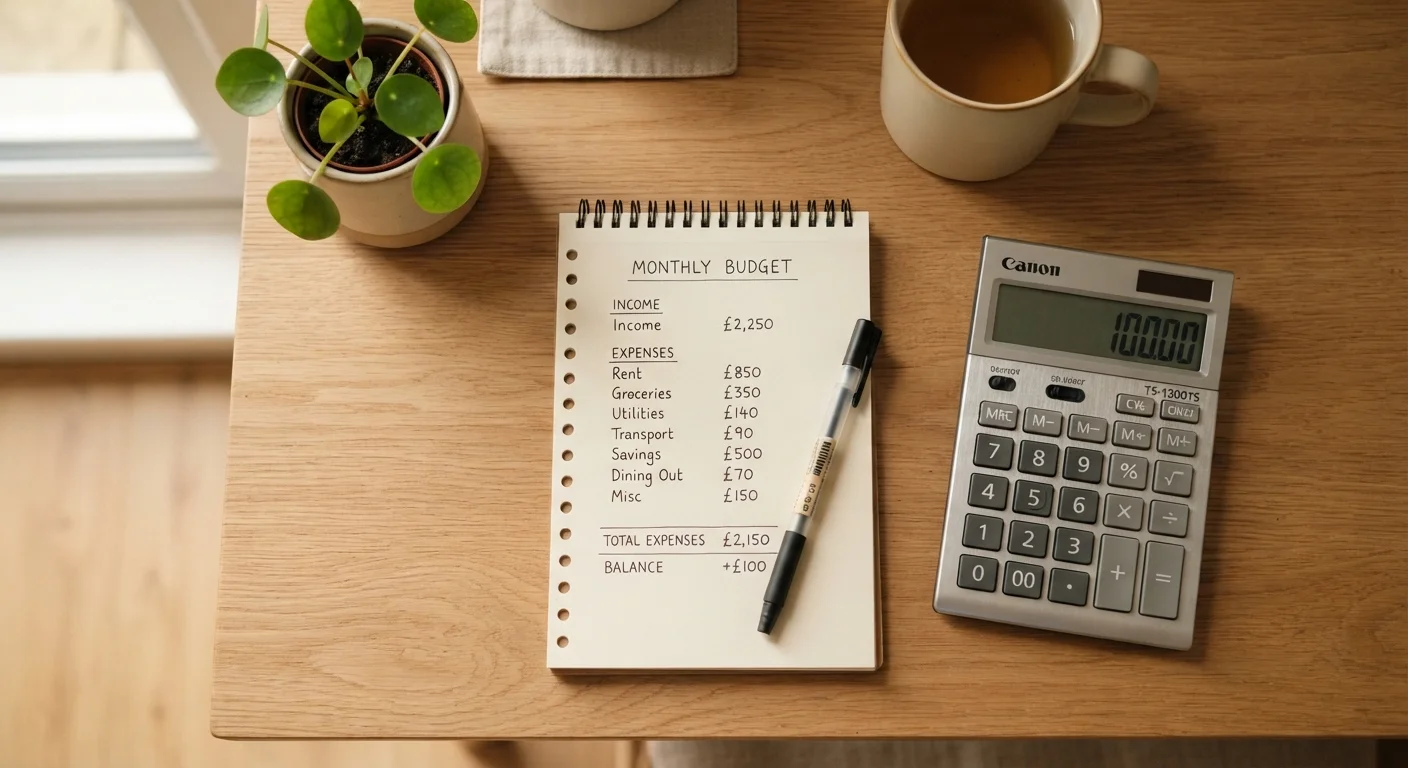
Calculator
Verify totals and quickly convert annual or irregular costs to monthly amounts.
Use Real Numbers, Not Estimates
One of the most common first-budget mistakes is guessing at income and expenses rather than looking them up. Pull your last two to three bank and card statements before starting. Working from actual figures - even imperfect ones - produces a far more useful budget than working from memory.
Once you have these materials ready, work through the steps below in order. Each one builds on the previous, so skipping ahead tends to produce gaps in your final budget.
Step-by-Step: Building Your Monthly Budget
Don't Overlook Irregular Expenses
Annual costs like car registration, insurance renewals, or holiday spending can blow up a budget if they aren't planned for. Divide each annual or semi-annual cost by 12 and include that monthly amount as a dedicated savings category - sometimes called a sinking fund. If you're unfamiliar with that term, the personal finance glossary covers it in plain language.
Calculate your true monthly net income
Start with what actually lands in your bank account each month - your net income (after taxes, benefits deductions, and any retirement contributions already withheld). Do not use your gross salary, which overstates how much you have to work with.
If your income varies month to month - freelance work, hourly shifts, or gig income - use a conservative average from the past three months. It's safer to budget against a lower figure and have a small surplus than to overspend against an optimistic one.
List every fixed expense
Fixed expenses are costs that stay the same amount each month: rent or mortgage, car payment, student loan minimums, insurance premiums, and recurring subscriptions. Write out each one and its exact amount.
Add them up. This total represents the non-negotiable floor of your monthly spending - money that is already committed before you make a single discretionary choice.
Identify and estimate variable expenses
Variable expenses change month to month: groceries, dining out, gas, utilities, clothing, entertainment, and personal care. Use your bank statements to find realistic averages for each category rather than guessing.
Group these into broad buckets - needs (groceries, utilities, transportation) and wants (restaurants, streaming, hobbies) - so you can see clearly where flexibility exists when you need to make adjustments.
Set aside savings and debt payments
Before allocating the rest of your money, carve out amounts for savings goals and any debt payments beyond the minimums. Treating savings as a fixed line item - rather than 'whatever's left' - is what turns budgeting into actual financial progress.
A common starting framework is to direct at least a small amount toward an emergency fund if you don't have one. For practical guidance on doing this even when money is tight, see building an emergency fund from zero. You can explore additional saving and debt strategies through the Saving & Debt hub.
Assign limits to every remaining category
Subtract your fixed expenses, savings, and debt payments from your net income. What remains is your discretionary pool. Divide it across your variable expense categories with specific dollar limits - not ranges, not mental notes, but written numbers.
This is the core idea behind approaches like zero-based budgeting, where every dollar is assigned a purpose so nothing is spent by default. If single-income constraints make this especially tight for your household, budgeting approaches for one-income households may be worth reviewing.
Add a small buffer category
Every budget benefits from a miscellaneous or buffer category - typically $50 to $100 - that absorbs small, unplanned costs: a parking fee, a birthday card, a co-pay. Without this, any surprise expense forces you to rob another category, which can trigger a cascade of overspending.
This is different from your emergency fund; it's simply realistic planning for the small randomness of everyday life.
Review and recalibrate after month one
At the end of your first full budget month, compare what you planned against what you actually spent in each category. Most first budgets have at least two or three categories that were off - that's normal and expected, not a failure.
Use those gaps to adjust your category limits for month two. Budgeting improves with iteration. If you find your budget consistently breaking down mid-month, understanding the reasons budgets fall apart can help identify what's going wrong and how to fix it.
Track for One Month Before Restricting
If you've never tracked spending before, consider spending the first month only recording what you spend - without hard limits - to get an honest baseline. This makes your second-month budget far more realistic. For a fuller orientation to this approach, see what to expect as a first-time budgeter.
Checking Your Budget Math
When you're finished, your budget should follow one simple equation: Total Income − Total Expenses − Savings − Buffer = $0. Every dollar should be accounted for. If you have a positive remainder, assign it - to savings, debt paydown, or a future goal. If you have a negative remainder, go back to your variable categories and find where you can trim.
A budget that assigns all income deliberately - rather than leaving an untracked remainder - is the difference between a plan and a guess. If this zero-sum approach is new to you, explore how zero-based budgeting works in practice for a deeper look at the method.
This article is for general informational and educational purposes only and does not constitute personalized financial, tax, or legal advice. Consult a qualified financial professional for guidance specific to your circumstances.