

Key Takeaways
- Higher potential returns almost always require accepting a greater chance of loss.
- Risk tolerance varies by person - age, income stability, and goals all play a role.
- Time horizon is a key factor: longer investing windows can help absorb short-term losses.
- Diversification can help manage risk without necessarily sacrificing expected returns.
- No investment is completely without risk - even cash loses purchasing power to inflation.
Risk-Return Trade-Off
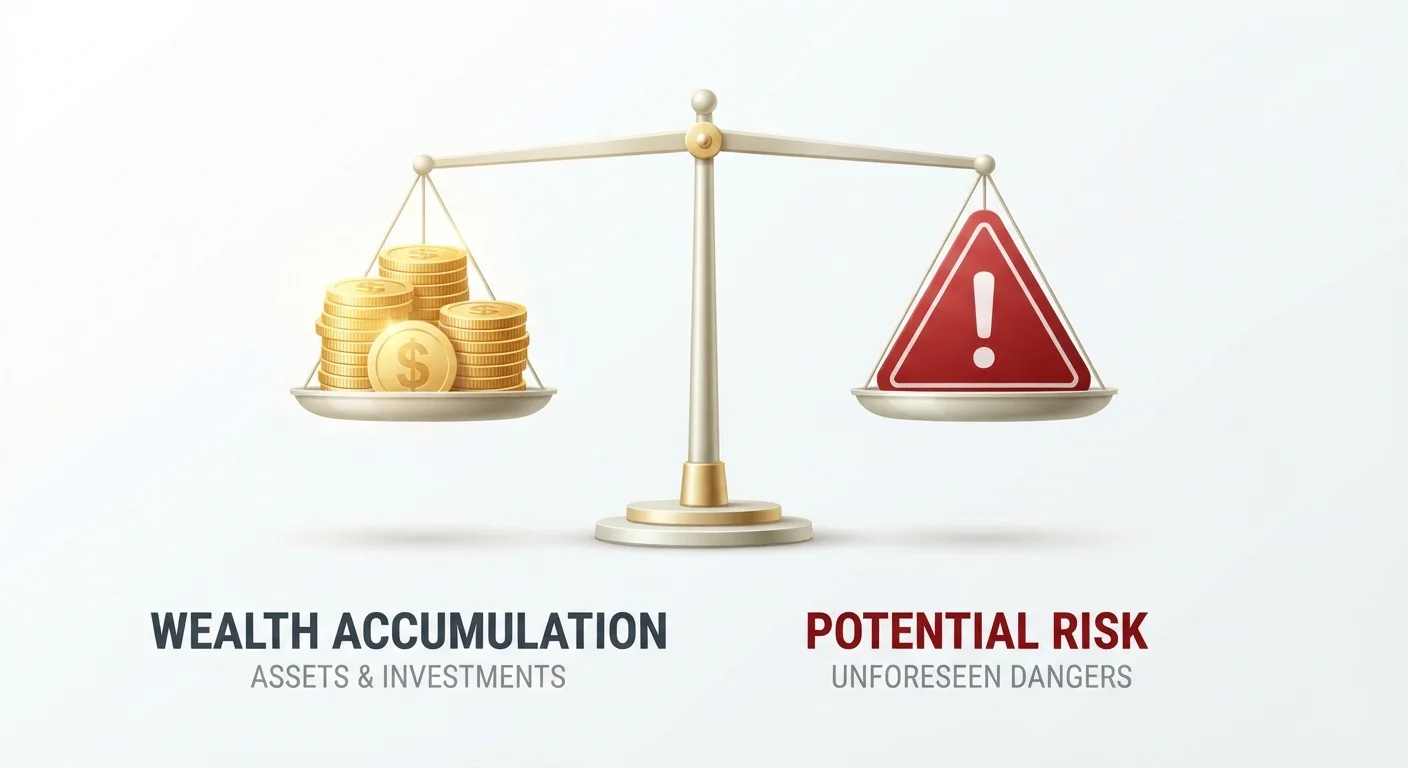
The risk-return trade-off is the principle that higher potential investment returns generally come with higher potential for loss. In other words, if you want the chance to earn more, you typically have to accept more uncertainty about what you'll actually get back. This relationship is one of the most foundational ideas in personal investing.
In finance, this relationship is often quantified using metrics like standard deviation (volatility) and the Sharpe ratio, which measures return earned per unit of risk taken.
The Core Idea: You Can't Have It Both Ways
Imagine two scenarios. In the first, you lend $1,000 to the federal government by purchasing a Treasury bond. You'll almost certainly get your money back with modest interest. In the second, you invest the same amount in a young startup. The company could become enormously valuable - or it could fail entirely. That contrast captures the essence of the risk-return trade-off.
Every investment exists somewhere on a spectrum from low risk / low potential return to high risk / high potential return. This isn't a flaw in the system - it's how rational markets work. If a risky investment offered the same return as a safe one, no one would choose the safe option, and prices would shift until the returns reflected the difference in risk.
Understanding this trade-off is a prerequisite for making sense of almost any investing decision. Before diving into specific strategies, it's worth building a solid foundation with key investing terms that show up throughout this topic.
~10%
Average annual US stock market return (historical)
The S&P 500 has averaged roughly 10% annually before inflation over the long run, though individual years vary widely - including significant negative years.
0%
Guaranteed return investments offering market-level gains
No investment vehicle offers both guaranteed principal protection and stock-market-level returns - the trade-off between safety and growth is a fundamental market reality.
What 'Risk' Actually Means in Investing
In everyday language, risk means danger. In finance, it means something more precise: uncertainty about outcomes. An investment is considered risky not just because it might lose money, but because its future value is hard to predict.
Investors generally face several distinct types of risk:
- Market risk: The value of investments can fall due to broad economic events, regardless of how sound an individual investment is.
- Inflation risk: Returns that don't outpace inflation erode purchasing power over time - even if the dollar amount grows.
- Liquidity risk: Some investments are difficult to sell quickly without taking a loss.
- Concentration risk: Putting most of your money into one asset or sector magnifies potential losses.
Recognizing which types of risk apply to a given investment helps you compare options more honestly. Spreading investments across different asset types is one of the most practical tools for managing concentration and market risk.
Start By Knowing Your Timeline
Before evaluating any investment's risk level, clarify when you'll need the money. A five-year timeline calls for a very different risk approach than a twenty-year one. Your time horizon is one of the most reliable guides to how much volatility you can reasonably absorb. Avoid common beginner assumptions that can lead to mismatched risk decisions.
Your Risk Tolerance and Time Horizon
Two people can look at the same investment and reach different conclusions about whether it's appropriate - and both can be right. That's because risk tolerance is personal. It's shaped by how long you plan to stay invested (your time horizon), how stable your income is, what you're saving for, and how you'd emotionally respond to watching your balance drop temporarily.
A 28-year-old saving for retirement has decades to ride out market downturns. A 62-year-old planning to retire in three years may not be able to wait for a recovery. Same asset, different contexts, different suitability.
Fees are another factor that often gets overlooked when weighing risk and return. Our guide on understanding investment fees explains how costs compound over time and quietly erode returns - a form of drag that affects net outcomes just as much as market volatility.
This article is for general informational and educational purposes only and does not constitute personalized financial, investment, tax, or legal advice. Please consult a qualified, licensed financial adviser before making decisions about your own situation.