

Reading Between the Fur: Why Body Language Is Your Cat's First Language
Cats are largely non-verbal communicators. Unlike dogs — whose social evolution favored expressive vocalizations — cats developed a rich visual and postural language that operates continuously, whether they're greeting you at the door or choosing to disappear under the bed. Learning to read these signals accurately helps you respond to your cat's actual needs rather than projecting human interpretations onto feline behavior.
Cat body language works as a system, not a single-cue checklist. A tail held straight up with a relaxed posture signals confidence and friendly intent; that same tail, held rigidly and accompanied by flattened ears, signals something entirely different. Reading the combination of signals — tail, ears, eyes, whiskers, and overall muscle tension together — is the foundation of feline literacy. Early, consistent behavioral shifts can also be among the first indicators that something is medically wrong. See which symptoms typically warrant prompt vet attention to know when to act.
Tails, Ears, and Eyes: The Core Signals Explained
Piloerection
The involuntary raising of fur along the back, shoulders, or tail, triggered by fear, threat, or intense arousal. It is a reflexive nervous system response that makes the cat appear physically larger to a perceived threat.
Slow Blink
A deliberate, unhurried closing and reopening of the eyes used by cats as a trust and affiliation signal. Returning a slow blink to your cat may help reinforce a sense of calm social connection between you.
Bunting
The behavior of pressing or rubbing the face, chin, or forehead against a person, animal, or object. It deposits scent from the cat's facial glands and functions as both a social bonding gesture and a territorial marker.
Airplane Ears
An informal term for ears rotated laterally to the sides of the head, signaling uncertainty, discomfort, or early defensive arousal. This posture often precedes a more escalated stress response if the stressor is not removed.
Kneading
Rhythmic, alternating pressure applied with the front paws against a soft surface. Rooted in nursing behavior from kittenhood, kneading in adult cats typically signals comfort and contentment.
Displacement Behavior
An apparently irrelevant action — such as sudden grooming, yawning, or stretching — performed during a tense or conflicted situation. It signals internal stress or uncertainty and may indicate that a cat is feeling pressured or socially conflicted.
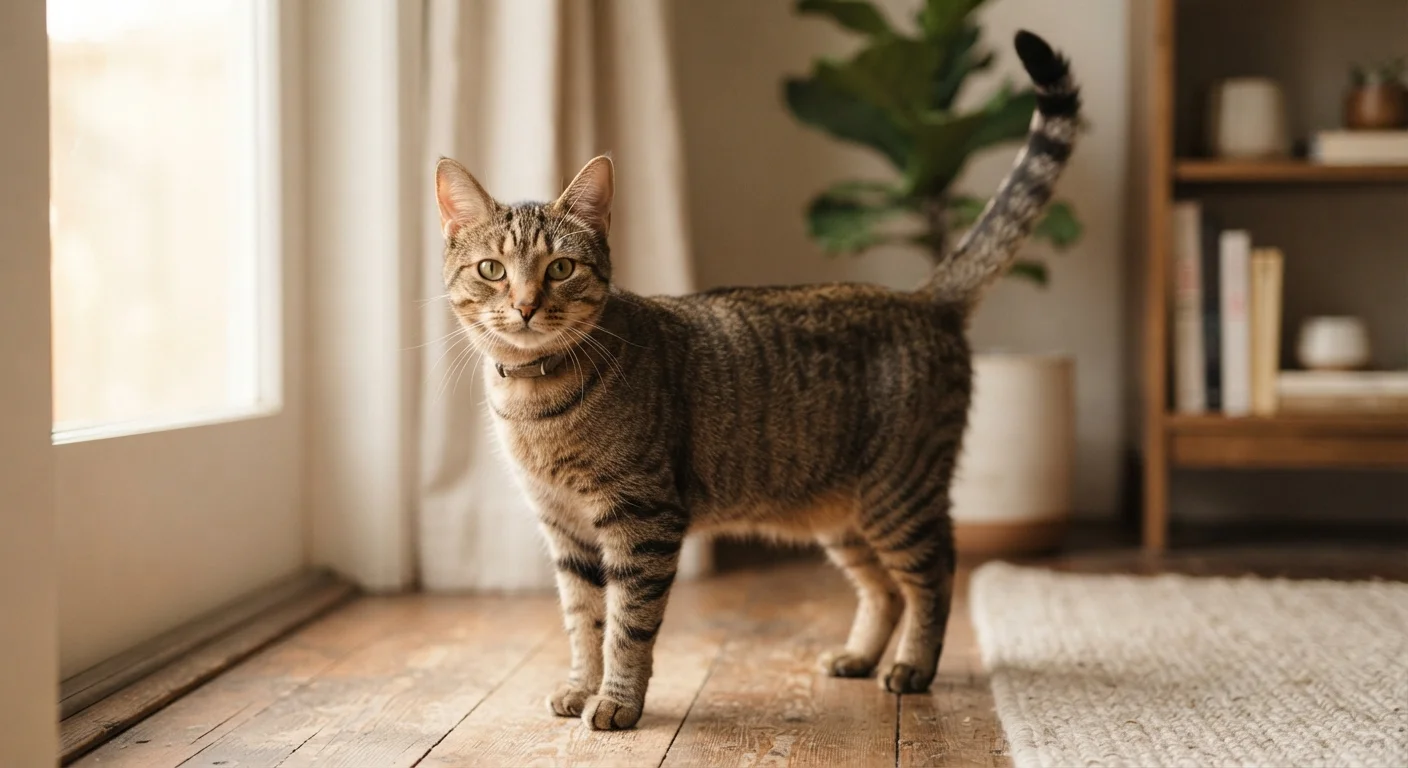
The tail is one of the most readable communication channels in feline body language:
- Tail straight up, relaxed: Confident, friendly approach — the feline equivalent of an open greeting.
- Tail puffed (piloerection): Fear or intense agitation; a reflexive attempt to appear larger to a perceived threat.
- Tail tucked beneath the body: Submission, anxiety, or physical discomfort.
- Tail lashing side to side: Commonly misread as excitement — more reliably indicates irritation or overstimulation.
Ear position layers on additional information. Forward ears indicate alert, engaged attention. Ears rotated to the sides — commonly called airplane ears — signal uncertainty or early irritation and often precede a defensive response. Ears flattened against the skull signal fear or defensive aggression.
Eye signals complete the picture. A slow blink — a deliberate, unhurried eye closure — is a widely recognized trust signal in cats. Dilated pupils can reflect excitement, fear, or simply low light conditions, so context is always required for accurate interpretation. A hard, unblinking stare with constricted pupils signals challenge or intense predatory focus. For comparison, see how dogs communicate through posture and gesture — the differences between species are instructive.
Posture, Touch Behaviors, and Whole-Body Reading
Every Cat Has an Individual Baseline
The signals described here reflect general feline patterns, but individual variation is real. A cat raised with extensive early socialization may tolerate direct eye contact comfortably; a more reclusive cat may perceive the same contact as threatening. Breed tendencies, early life experiences, and household environment all shape how a cat expresses and interprets signals. Use these patterns as a starting framework, then invest time observing your specific cat's habits and responses to build a more accurate picture.
Full-body posture integrates the smaller signals into a more complete picture:
- Loaf position (compact body, paws tucked under): Typically relaxed and content — though cats may also adopt this posture when mildly unwell, making context important.
- Belly display: Primarily a trust signal, not an invitation to touch. Many cats will swipe at a reaching hand because the gesture communicates security, not a preference for belly contact.
- Hunched posture with lowered head: Distinct from the loaf — this often reflects pain or illness and warrants closer attention.
- Bunting (rubbing the face or head against you): Social bonding and scent-marking — a clear affiliative signal from a comfortable cat.
Kneading — the rhythmic, alternating paw-pressing behavior sometimes called making biscuits — is rooted in nursing behavior from kittenhood. In adult cats, it typically indicates comfort and contentment. For another layered feline signal worth understanding, purring carries considerably more meaning than most owners assume.
When Body Language Signals More Than Mood
Persistent shifts in body language — sustained hiding, prolonged hunching, reluctance to move, or unusual stillness — can reflect pain or illness rather than a passing emotional state. Cats are instinctively inclined to mask vulnerability, which means subtle postural changes are often among the earliest available indicators that something is medically wrong.
Individual personality shapes communication style, too. A naturally reserved cat retreating after a household disruption is different from that same cat hiding persistently without any apparent cause. Knowing your cat's individual baseline is what makes deviations meaningful rather than ambiguous.
If your cat's body language changes noticeably and consistently without a clear explanation, a veterinary evaluation is the appropriate next step — not a wait-and-see approach. For a broader foundation in feline care, The Complete Cat Owner's Handbook brings together health, behavior, and daily routines in one comprehensive reference.
This article is for general informational purposes only and does not constitute veterinary advice. If you have concerns about your cat's health or behavior, consult a licensed veterinarian.