
Rewarding the Wrong Thing: Training Habits That Accidentally Reinforce Bad Behavior

Key Takeaways
- Attention — even negative attention — can reinforce unwanted behaviors like barking or jumping.
- Timing is critical: rewards delivered even seconds late can strengthen the wrong behavior.
- Inconsistency across family members is one of the most common reasons training stalls.
- Ignoring a behavior entirely is often more effective than reacting, but requires patience.
- Understanding why a behavior works for your dog is the first step to changing it.
Why Good Intentions Can Teach the Wrong Lessons
Most dogs aren't misbehaving out of stubbornness or spite — they're doing what has worked before. From a dog's perspective, any behavior that reliably produces attention, movement, food, or access to something desirable is worth repeating. The problem is that owners frequently provide these rewards without realizing it, in the middle of behaviors they're actively trying to eliminate.
Understanding how reinforcement actually works changes how you interpret your dog's behavior. A dog that jumps every single time guests arrive isn't being dominant — it's reporting what history has taught it: jumping gets a reaction, and reactions feel rewarding.
Attention Is a Powerful Reinforcer
Dogs do not distinguish between positive and negative attention the way humans do. Scolding, pushing away, or even making eye contact during an unwanted behavior can function as a reward if the dog is seeking engagement. If your dog repeats an annoying behavior every time you react, your reaction may be the reason why.
The good news is that once you can see your responses through your dog's eyes, the pattern often becomes obvious — and correctable.
Common Training Mistakes That Reinforce Bad Behavior
The mistakes below span everyday scenarios that trip up even attentive owners. Each one involves a gap between the owner's intention and the message the dog actually receives.
Comforting a dog that is barking or whining out of anxiety or demand.
Why it happens: Owners naturally want to soothe a distressed pet, but many instances of barking are demand-driven rather than fear-based, making comfort a direct reward.
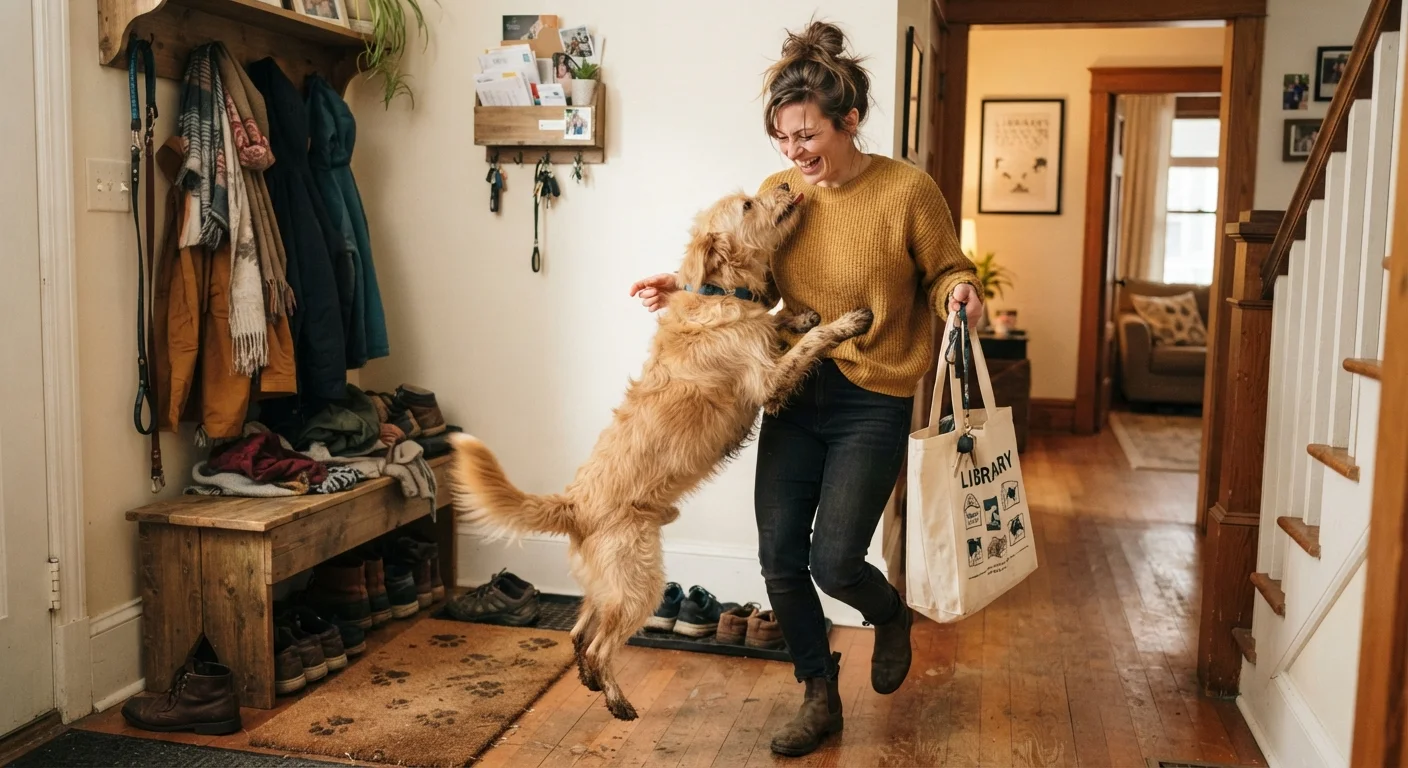
Letting a dog greet people by jumping up, then only discouraging it when guests are wearing nice clothes.
Why it happens: Owners enjoy the enthusiasm in casual moments and only enforce the rule selectively, teaching the dog that jumping works most of the time.
Rewarding a dog with a treat too late, after it has already moved on to a different behavior.
Why it happens: Reaching for a treat takes time, and a few extra seconds is enough for a dog to have shifted position or started sniffing — meaning the treat reinforces the new behavior, not the intended one.
Giving in to leash pulling because it gets you both to the destination faster.
Why it happens: Forward movement is an immediate, powerful reward for pulling. Every time the dog pulls and you follow, the leash pressure itself becomes a conditioned cue to pull harder.
Using the crate as punishment after a misbehavior, undermining its role as a safe space.
Why it happens: When a dog chews something or has an accident, frustrated owners often send the dog to its crate as a consequence. Dogs then associate the crate with conflict rather than rest.
Early socialization shapes how receptive a dog is to training in the first place. A dog that missed key experiences during puppyhood may respond differently to new rules and environments — for context on that window, see Dog Socialization: The Window That Closes Earlier Than Most Owners Realize.
Building Habits That Send the Right Signal
Correcting accidental reinforcement isn't about being stricter — it's about being clearer and more consistent. Dogs thrive with predictable rules. When the same behavior produces the same outcome every time, they learn quickly. When rules shift depending on who's in the room or how tired you are, progress stalls.
Inconsistency Undermines Every Training Session
If one family member allows a behavior that another discourages, the dog learns that the rule is optional — not absent. Dogs trained under inconsistent rules often become more persistent, not less, because intermittent reinforcement (being rewarded only sometimes) is the most powerful schedule for cementing behavior. Align your household before starting any new training protocol.
~4 seconds
Maximum effective reward delay in dog training
Animal behaviorists generally cite a window of roughly three to four seconds within which a reward must follow a behavior to be clearly associated with it.
Variable ratio
Reinforcement schedule that most strongly maintains behavior
Operant conditioning research shows that variable ratio reinforcement — rewarding behavior unpredictably — produces the most persistent behavior, which is why inconsistent rules backfire.
Training consistency is a habit in itself. The principles behind skill-building habits that hold up over the long term apply to dog owners as much as anyone: short, frequent, reliable practice beats sporadic intense sessions. A five-minute daily reinforcement of the behaviors you want is far more effective than an hour of frustrated correction after the behavior is already entrenched.
If a particular behavior persists despite consistent effort, consult a certified professional dog trainer or veterinary behaviorist. Some behaviors have medical or anxiety-related roots that require a different approach than standard training alone can address.