

Key Takeaways
- Small pets experience stress from everyday household events that owners often consider harmless.
- Prey animals like rabbits, guinea pigs, and hamsters are hardwired to hide distress, making problems easy to miss.
- Cage placement, handling frequency, sound levels, and routine consistency all directly affect a small pet's well-being.
- Chronic stress in small animals can suppress immunity and lead to serious health consequences.
- Simple environmental adjustments can meaningfully reduce a small pet's daily stress load.
Why Small Pets Are Especially Vulnerable to Stress
Rabbits, guinea pigs, hamsters, birds, chinchillas, and similar small animals are prey species. Their evolutionary instinct is to appear healthy even when they're suffering — showing weakness in the wild signals vulnerability to predators. In your home, this same instinct makes it easy for owners to miss chronic stress until it has already taken a toll on health and behavior.
Stress in small animals isn't just behavioral discomfort. Prolonged exposure to stressors can suppress immune function, disrupt digestion, reduce appetite, and — in extreme cases — contribute to conditions like GI stasis in rabbits or feather-destructive behavior in birds. Understanding the overlooked triggers is the first step toward a calmer, healthier environment for these animals. You can also read our guide on signs your small pet may be unwell to recognize when stress may have crossed into illness.
High-Frequency and Sudden Sounds
Small animals have hearing ranges that extend well beyond human perception. Hamsters and rabbits can detect ultrasonic frequencies that humans never register — meaning the hum of certain appliances, the whine of electronics, or even a nearby TV on high volume can be a constant source of disturbance.
Sudden loud sounds — slamming doors, raised voices, vacuum cleaners — trigger acute stress responses in prey animals. Their heart rate spikes, muscles prime for flight, and stress hormones flood their system. Placing enclosures in quieter rooms away from TVs, speakers, and high-traffic kitchen appliances can make a meaningful difference.
Hamsters and rabbits can detect ultrasonic frequencies from common household appliances that humans never notice.
Incorrect or Excessive Handling
Being picked up is inherently stressful for most small prey animals, particularly early in their time with a new owner. Being grabbed from above mimics the approach of a bird of prey — one of their natural predators. Even well-intentioned handling that is too frequent, too rough, or done incorrectly can cause chronic fear responses.
Rabbits should be supported fully under the hindquarters to prevent kicking injuries — to themselves as much as the handler. Guinea pigs generally respond better to being scooped up from the side rather than approached from above. Building trust gradually through hand-feeding before attempting to hold an animal is a widely recommended behavioral approach.
Being grabbed from above mimics a bird-of-prey attack — a hardwired terror response in most small mammals.
Poor Cage Placement
Where an enclosure sits in your home has a significant impact on your pet's stress levels. Cages placed in direct sunlight can cause dangerous overheating, while drafty areas near windows or air vents create temperature instability. Being positioned at ground level in a home with dogs or cats — even if those pets never enter the room — exposes small animals to the scent and sound of predators constantly.
Most small animals feel more secure with their enclosure elevated slightly and positioned against a wall, giving them at least one side with no open approach. Avoid placing enclosures in high-traffic hallways where movement is unpredictable throughout the day and night.
The scent of a cat or dog in the room is enough to keep a rabbit or guinea pig in a near-constant state of vigilance.
Disrupted Daily Routines
Small animals — especially prey species — rely on predictable schedules to feel safe. Irregular feeding times, inconsistent light cycles, and erratic interaction patterns interfere with their natural rhythms. Hamsters are crepuscular (most active at dawn and dusk); waking them during the day to interact is disorienting and stressful. Rabbits establish strong circadian patterns and can become anxious when their environment changes unexpectedly.
Consistent wake times, feeding windows, and handling routines reduce anticipatory stress. Even something as simple as a stable light/dark cycle — rather than lights flipping on and off unpredictably — contributes to a calmer baseline state for these animals.
Waking a hamster mid-day to play is the equivalent of someone shaking you awake at 3 a.m. — disorienting and distressing.
Insufficient Hiding Spaces and Enrichment
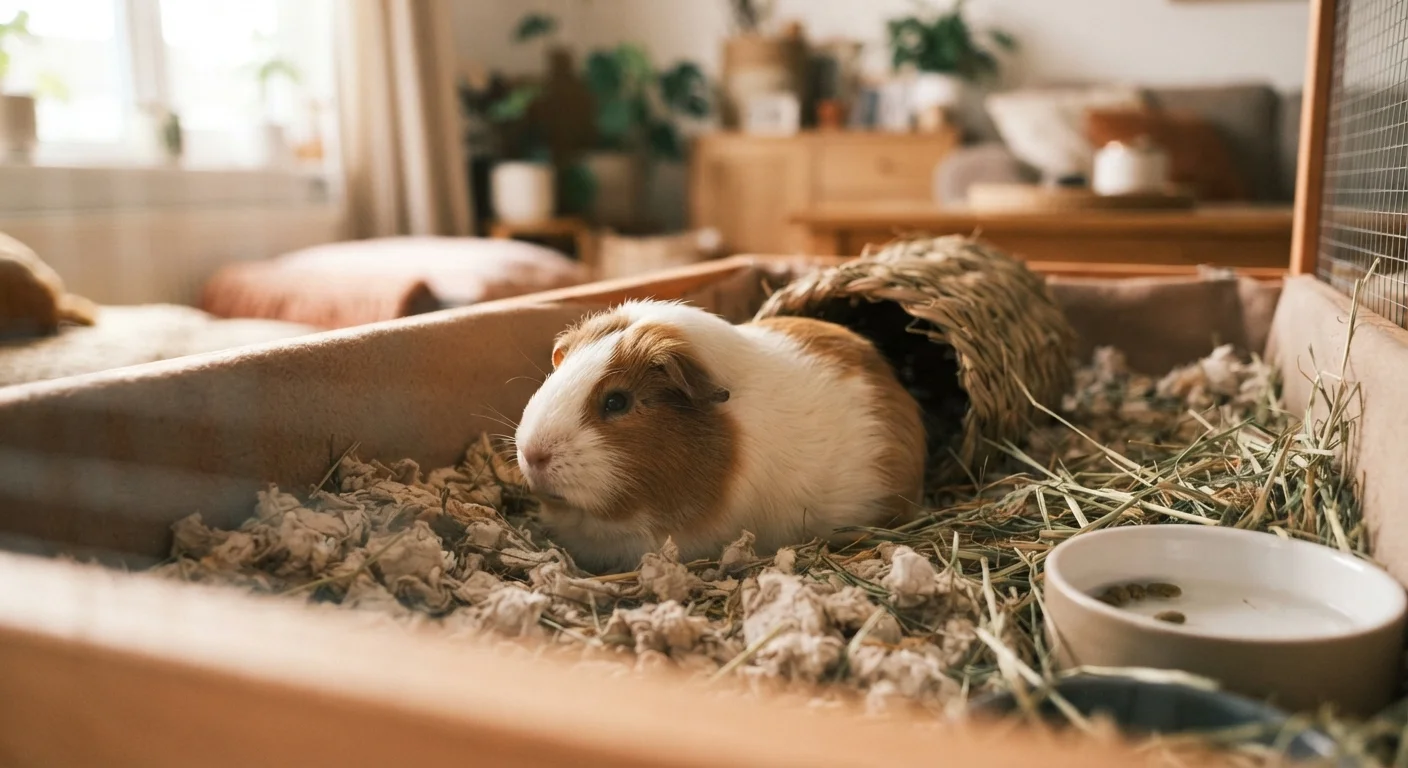
Prey animals need places to hide — not as a luxury, but as a psychological necessity. A rabbit or guinea pig with no enclosed hiding spot in its enclosure has no option to feel safe when threatened. The chronic inability to retreat is a recognized source of ongoing stress in captive small animals.
Equally, boredom itself is a stressor. Hamsters are driven to run miles each night in the wild; a wheel that is too small or absent causes frustration and repetitive stress behaviors. Rabbits need space to run and objects to investigate. Chinchillas require vertical space and climbing structures. Providing species-appropriate enrichment addresses both the instinct to hide and the need for mental stimulation. This mirrors principles explored in enrichment strategies for indoor cats — the behavioral science applies broadly across species.
A hiding spot isn't optional enrichment — for prey animals, it's a fundamental psychological need.
The Presence of Other Pets in the Home
Cats and dogs don't have to physically threaten a small pet to cause stress. Persistent scent marking near an enclosure, dogs barking in an adjacent room, or a cat sitting and staring at a cage for extended periods are all significant stressors. Small animals interpret these signals as predator presence, which can keep them in a state of prolonged low-grade fear.
Practical steps include keeping small pet enclosures in rooms that dogs and cats do not access, using baby gates or closed doors consistently, and ensuring that human interaction with small pets happens in a space where the scent and sound of predator species are minimized. Note that stress in cats — as discussed in stress in cats — can similarly escalate from environmental triggers owners overlook.
A cat staring at a guinea pig's cage for an hour creates genuine predator stress — even if the cage is secure.
Building a Lower-Stress Life for Your Small Pet
Many of these stressors are fixable with modest adjustments — repositioning a cage, setting consistent feeding times, or teaching household members how to approach animals calmly. The key is recognizing that small pets experience their world very differently from dogs or cats. What feels routine to a human can feel alarming to a prey animal with acute senses and limited escape options.
Start with Observation Before Intervention
Before rearranging your pet's entire environment, spend a few days watching their behavior at different times of day. Note when they hide, when they eat, and what household events precede any visible agitation. Targeted changes based on observed patterns are more effective — and less disruptive — than wholesale reconfigurations. If you're unsure what you're seeing, a small animal veterinarian or a certified animal behaviorist can help interpret specific signs.
If your small pet is already showing behavioral changes — hiding more than usual, refusing food, or appearing lethargic — these can signal that stress has become a health issue. Pair environmental changes with a veterinary checkup, and explore our companion piece on common feeding myths for small pets to rule out diet as a contributing factor.