
Traveling Internationally with Prescription Medications: Rules and Documentation

Key Takeaways
- Some medications that are legal in the US are controlled substances or outright prohibited in other countries.
- Always verify destination-country rules through official embassy or government sources before you travel.
- Carry a signed letter from your prescribing physician and original pharmacy-labeled containers.
- Quantities allowed through customs vary widely — check limits for each country on your itinerary.
- Declaring medications at customs is almost always safer than staying silent, even when not required.
What you will need
Why Medication Rules Vary So Dramatically by Country
A medication your doctor prescribes without a second thought in the United States can land you in serious legal trouble in another country. Japan, for example, restricts common cold remedies containing pseudoephedrine. The United Arab Emirates maintains strict controls over opioids, many sleep aids, and certain antidepressants. Indonesia has been known to classify some ADHD medications as controlled narcotics. These aren't edge cases — they're well-documented realities that catch unprepared travelers off guard every year.
The root cause is simple: every country sets its own drug scheduling and customs rules independently of the US Food and Drug Administration or the Drug Enforcement Administration. A Schedule IV controlled substance in the US may be a Schedule I equivalent abroad, or completely unregulated, depending on where you're headed. Countries also update these lists periodically, which means information that was accurate last year may not reflect current law.
This is why the only reliable approach is verifying rules directly with the destination country's embassy in the US or its official customs authority — not travel forums, not general travel blogs. For a broader overview of how to track down what documentation different destinations require, see our field guide to travel document requirements.
Some Medications Are Prohibited Outright
Certain medications commonly prescribed in the US — including some opioids, stimulants, and even specific cough syrups — are completely prohibited in certain countries, with no permit process available. If your medication falls into this category, consult your physician well in advance about safe alternatives for your travel period. Do not assume a valid US prescription provides legal protection abroad.
What to Gather Before You Pack
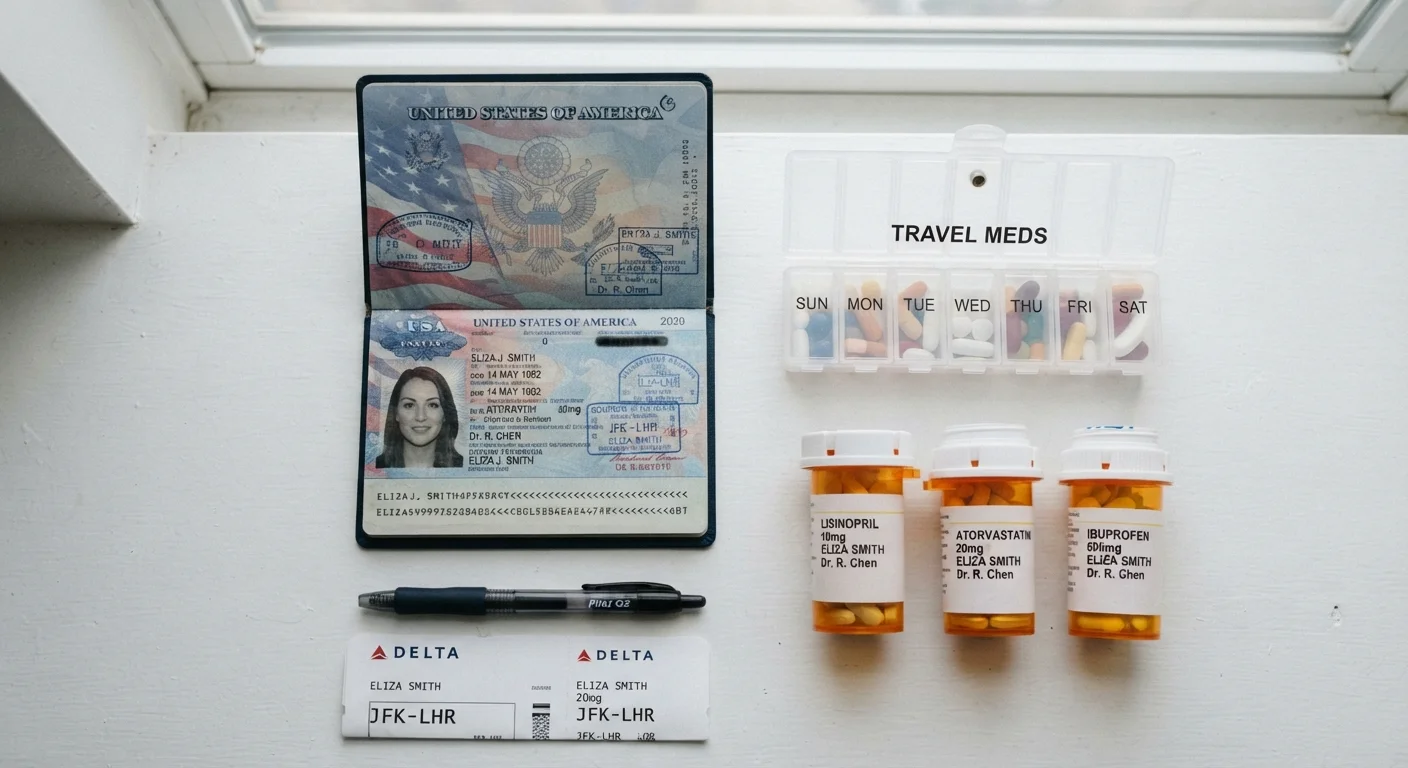
Once you've confirmed your medication is allowed at your destination, preparation comes down to documentation and packaging. Here's what to assemble:
What you will need
If you take a controlled substance — such as an opioid pain reliever, a stimulant for ADHD, or a benzodiazepine — many countries additionally require an import permit issued by their health ministry before you arrive. Applications can take weeks, so build this into your pre-trip timeline. Check our pre-departure checklist for international travelers to make sure medication prep fits into your overall planning schedule.
Step-by-Step: Getting Your Documentation in Order
Follow these steps methodically — ideally starting at least four to six weeks before departure for any trip involving controlled substances.
Identify every prescription medication you plan to bring
List each medication by its generic name (not just the brand name), dosage, and the condition it treats. Some countries look up substances by generic name in their controlled substance schedules, so having both names available prevents confusion at customs.
Check each medication against your destination country's rules
Contact the embassy of each country on your itinerary — not just your final destination. If you have a layover lasting several hours, you may technically be subject to that country's rules as well. Embassy websites and the US State Department's country-specific travel pages are your most reliable starting points.
Request a physician's letter at least three weeks before departure
Ask your prescribing doctor for a signed letter on official letterhead that includes: your full name, the medication's generic and brand names, dosage and dosing schedule, the medical condition being treated, and a statement that the medication is necessary for your health. Some countries require this letter to be notarized or apostilled — check the specific requirement.
Apply for any required import permits
Countries such as Japan, Singapore, and several Gulf states require formal import permits for specific controlled substances. Applications typically go through the destination country's health ministry or narcotics control board. Processing can take two to four weeks, so don't wait until the week before your trip.
Pack medications in original, pharmacy-labeled containers
The original container with the pharmacy label — showing your name, the prescribing physician, the medication name, dosage, and dispensing date — is your primary evidence that the medication is legitimately prescribed. Pill organizers alone do not provide this documentation. Bring only the quantity you need for your trip plus a reasonable buffer for delays.
Organize all documents together in your carry-on
Keep your physician's letter, copies of prescriptions, any import permits, and the medications themselves in one accessible section of your carry-on bag. If a customs officer asks to inspect them, you'll want to produce everything quickly and calmly. Make digital copies as well, stored in a secure cloud location you can access offline.
At the Border: What to Expect
Even with perfect documentation, customs encounters can feel stressful. Knowing what to expect helps. Keep all medications in your carry-on luggage rather than checked bags — this prevents loss and keeps your documentation and medication together if an officer asks questions. When in doubt, declare. Most countries' customs declaration forms ask whether you're carrying medications, and marking yes with documentation ready is the safest approach. Attempting to conceal medications — even accidentally — can result in confiscation, fines, or more serious consequences.
Quantity limits matter too. Many countries allow a 30-day supply; others cap it at 15 days or require documentation for anything beyond a one-month supply. If your trip is longer, research whether your medication can be legally obtained in-country, and confirm this with both your doctor and the destination's health authority before departure.
Returning to the US, note that US Customs and Border Protection (CBP) requires declaration of all medications. For a full picture of what's involved when you come home, our guide on what US travelers can legally bring back covers declaration requirements in detail.
Build a Medication Travel Card
Consider creating a wallet-sized card listing each medication by generic name, dosage, and treating condition. This is especially useful if you need urgent medical care in a country where your usual pharmacy labels may not be understood. Your prescribing physician or pharmacist can often help you format one. Keep it with your passport, not just in your bag.
This article provides general travel information only and is not medical or legal advice. Always consult your prescribing physician and verify current rules with official embassy, government, and customs sources before traveling with any prescription medication. Rules change; confirm them as close to your departure date as possible.