
Mountain West vs. Pacific Northwest: Choosing Your Next Outdoor Adventure Region

Key Takeaways
- The Mountain West offers drier, sunnier conditions ideal for summer hiking, skiing, and high-altitude exploration.
- The Pacific Northwest delivers unmatched biodiversity — rainforests, volcanoes, tide pools — often in a single road trip.
- Altitude acclimatization is a real planning concern in the Mountain West, especially above 8,000 feet.
- Pacific Northwest weather is highly seasonal; summer offers the most predictable outdoor windows.
- Both regions have world-class national parks but differ sharply in crowd patterns, access, and terrain type.
- Your trip format — road trip, basecamp, or fly-in — significantly shapes which region works better logistically.
Option A
Mountain West
The high-altitude, sun-drenched wilderness of peaks and plateaus.
Best for: Travelers who want big skies, dry trails, and elevation-fueled adventure across states like Colorado, Utah, Wyoming, and Idaho.
Option B
Pacific Northwest
The dramatic, moss-draped edge of the continent.
Best for: Travelers drawn to volcanic peaks, temperate rainforests, rugged coastlines, and cooler, moody landscapes in Washington and Oregon.
If you want reliable sunshine and high-mileage hiking
Mountain West
Colorado, Utah, and Wyoming average significantly more sunny days per year than the Pacific Northwest, making trail conditions more predictable across a longer outdoor season.
If lush scenery, waterfalls, and coastal access matter most
Pacific Northwest
The combination of temperate rainforest, volcanic peaks like Rainier, and dramatic Pacific coastline is simply unmatched anywhere else in the continental US.
If you're a first-time high-altitude traveler
Pacific Northwest
Most iconic PNW destinations sit at lower elevations, so altitude sickness is rarely a factor — unlike destinations such as Rocky Mountain National Park or the Colorado Rockies.
If you want world-class skiing or winter mountain access
Mountain West
Utah, Colorado, and Wyoming host some of North America's most celebrated ski terrain, with reliable snowpack and well-developed resort infrastructure.
If you're combining a city break with wilderness
Pacific Northwest
Portland and Seattle offer vibrant urban bases with Mt. Hood, Olympic National Park, and the Cascades each within a short drive.
What Defines Each Region
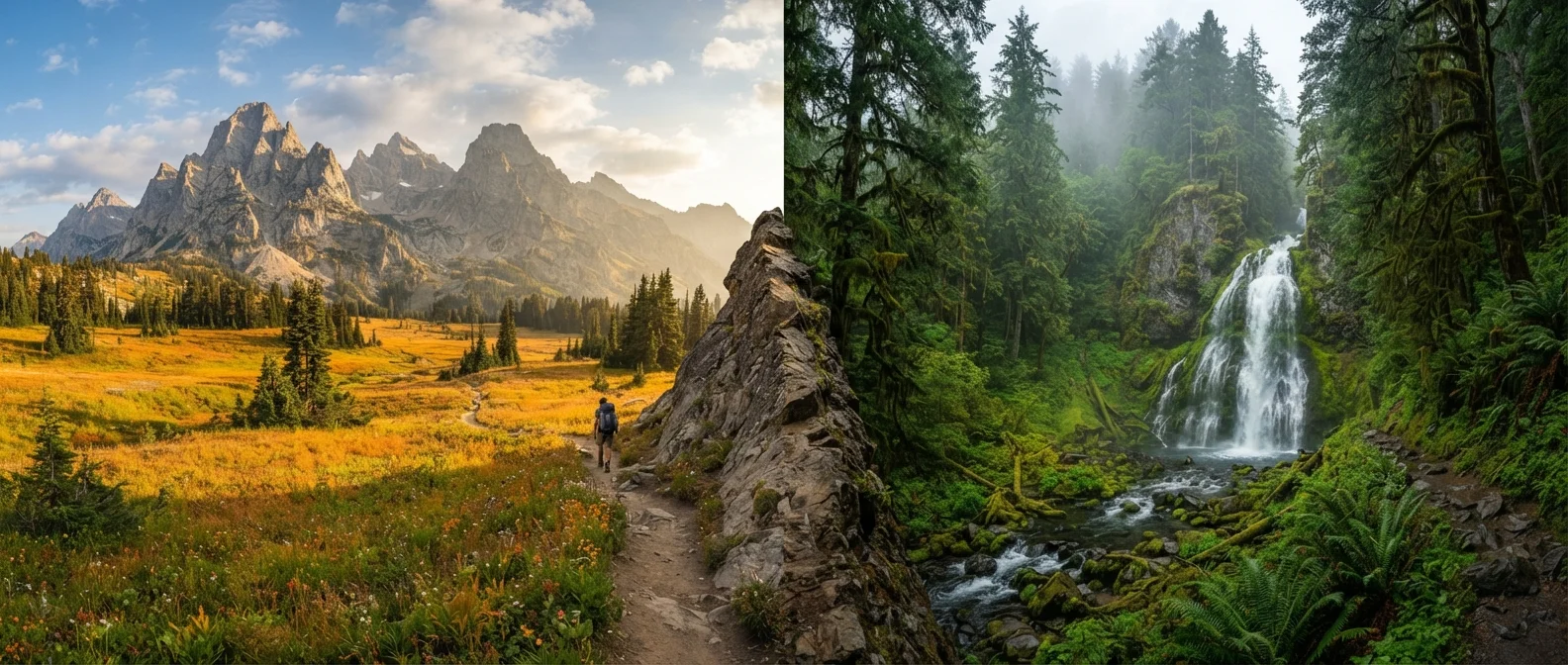
The Mountain West is a sprawling high-altitude interior — think Colorado's 14,000-foot peaks, Utah's surreal red-rock canyon country, Wyoming's geothermal wonderlands, and Idaho's wild river corridors. It's a sun-flooded, largely arid landscape where the air is thin and the views stretch forever. The region rewards travelers who enjoy open exposure, big climbs, and dramatic elevation change.
The Pacific Northwest, by contrast, is shaped by moisture. Prevailing Pacific winds dump rainfall on western Washington and Oregon, creating the Hoh Rainforest on the Olympic Peninsula — one of the few temperate rainforests on Earth. Volcanic giants like Mt. Rainier, Mt. Hood, and the Cascades dominate the horizon, while the rugged coastline offers tide pools, sea stacks, and dramatic cliff-side vistas. It's a greener, moodier, and arguably more varied landscape compressed into a drivable corridor.
For travelers weighing a city break versus a national park trip, both regions offer compelling mixes of urban and wilderness options — but the Pacific Northwest makes that combination especially seamless.
| Criterion | Mountain West | Pacific Northwest |
|---|---|---|
| Typical summer weather | Dry, sunny, warm with afternoon storms | Mild and mostly dry (June–Sept) |
| Elevation range | Often 6,000–14,000+ feet | Sea level to 14,411 ft (Rainier) |
| Altitude sickness risk | High — especially in Colorado/Wyoming | Low for most popular destinations |
| Dominant landscape type | Peaks, canyons, desert plateaus | Rainforest, volcanoes, coastline |
| Drive distances between parks | Often 3–6 hours between highlights | Highlights more closely clustered |
| Best season to visit | May–October (varies by elevation) | Late June–September |
| Urban gateway cities | Denver, Salt Lake City, Boise | Seattle, Portland |
| Crowd intensity | Very high at Zion, Yellowstone, RMNP | High at Rainier, Crater Lake in peak season |
Planning Realities: Terrain, Weather, and Access
Weather is the biggest practical variable between these two regions. Mountain West summers are generally dry, warm, and predictable — afternoon thunderstorms are common above treeline but rarely derail a full day. The Pacific Northwest's summer window (roughly late June through September) is genuinely excellent, but shoulder seasons bring persistent overcast skies and rain, especially west of the Cascades.
Altitude deserves serious respect in the Mountain West. If you're flying into Denver and heading straight to Rocky Mountain National Park, your body hasn't had time to adjust. Common symptoms — headaches, fatigue, disrupted sleep — can dampen any trip. Before visiting a high-elevation destination, review what altitude actually demands of your body and plan an acclimatization day into your itinerary.
Access is another key difference. The Mountain West is vast, and distances between major parks are significant — a road trip here often requires serious mileage. The Pacific Northwest's highlights cluster more tightly, making it well-suited to loop itineraries. For either region, the choice between driving and flying shapes your entire experience. Our road trip vs. fly-and-explore comparison lays out how to think through that decision based on your priorities.
300+
Sunny days per year in Denver, CO
The National Oceanic and Atmospheric Administration notes Denver averages more annual sunny days than Miami, highlighting the Mountain West's striking aridity.
~140
Annual rainfall inches in Hoh Rainforest, WA
The Hoh Rainforest on Washington's Olympic Peninsula is one of the wettest places in the contiguous US, according to Olympic National Park data.
14,411 ft
Summit elevation of Mt. Rainier
Mt. Rainier in Washington's Cascades is the highest volcanic peak in the contiguous US, per the National Park Service.
Who Belongs Where
Neither region is universally better — they suit different travelers and different trip goals. The Mountain West is the stronger pick for those chasing iconic western wilderness: Zion, Bryce, Grand Teton, Yellowstone, and the Colorado Rockies all sit here. If you want maximum elevation drama, reliable trail conditions in summer, and the kind of wide-open landscapes that define the American West in the popular imagination, this is your region.
The Pacific Northwest wins on sheer ecological diversity. Within a single week, you can walk through ancient temperate rainforest, climb a volcano's lower slopes, watch gray whales from a coastal bluff, and kayak among sea otters. That layering of ecosystems — and the region's relatively compact geography — makes it exceptional for travelers who want variety without huge daily driving distances.
If you're curious about the continent's more extreme outdoor edges, Alaska's outdoor scene is often misunderstood as inaccessible — many common assumptions about logistics and timing don't hold up. And for those exploring the full spectrum of US landscapes, lesser-known desert regions provide a striking contrast to both the Mountain West and the Pacific Northwest.
Ultimately, if the Mountain West or Pacific Northwest are both serious contenders for you, consider which landscape speaks to your travel identity — and then commit fully. Both reward preparation and deliberate exploration far more than a hurried checklist approach.
National Park Reservations Have Changed
Many popular parks in both regions — including Zion, Rocky Mountain, and Olympic — now require timed-entry permits or advance reservations for parking and certain trailheads during peak season. Always check the official National Park Service site well ahead of your trip dates. Policies can change year to year, and conditions vary by specific area within each park.