

Key Takeaways
- Your travel goals — rest, culture, adventure, or connection — matter more than destination prestige.
- City breaks offer flexibility and low logistical overhead; national parks demand more advance planning.
- Budget, group size, and physical readiness all shift the calculation significantly.
- The two formats can complement each other — many great parks sit within hours of major cities.
Our Verdict
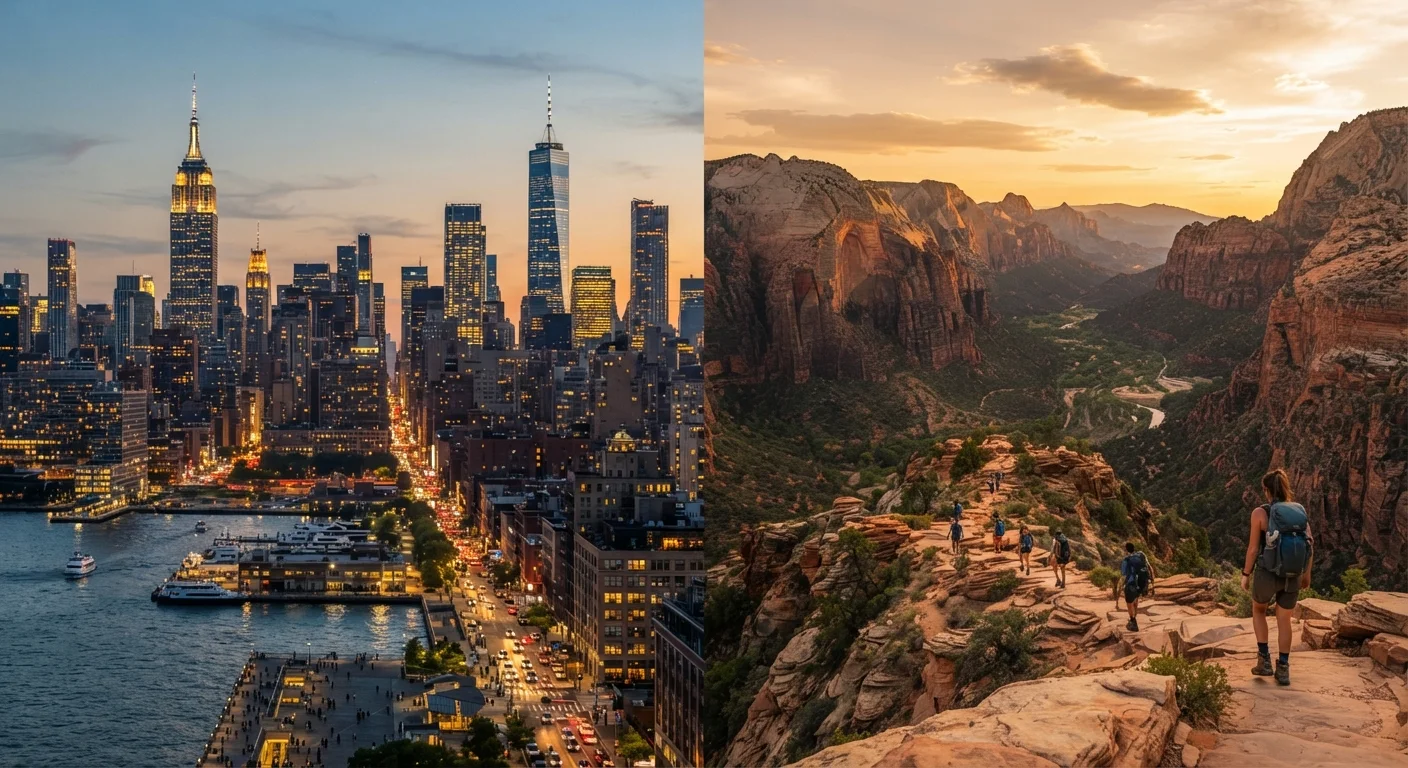
Neither a city break nor a national park trip is objectively better — the right choice depends on what you're genuinely trying to get out of your time away. City trips reward spontaneity, culinary curiosity, and cultural immersion with minimal gear or advance booking. Park trips deliver solitude, physical renewal, and landscapes you simply cannot find inside city limits, but they require more preparation to go well.
| Best for | Recommended |
|---|---|
| Travelers seeking cultural immersion, dining, and low-overhead logistics | City Break |
| Those craving outdoor adventure, solitude, and dramatic natural scenery | National Park Trip |
| Families or groups with mixed interests and varied fitness levels | City Break |
| Experienced outdoors travelers with flexible schedules and the right gear | National Park Trip |
Start With What You Actually Want From This Trip
Before comparing destinations, interrogate your real motivation. Are you chasing genuine rest, a change of scenery, physical challenge, meaningful time with family, or cultural stimulation? The clearest path forward almost always comes from answering that honestly rather than defaulting to whichever option sounds more impressive to describe later.
City breaks excel when you want variety on demand — world-class restaurants, museums, live music, and neighborhoods that reward wandering. National park trips shine when you want space, quiet, and an environment that genuinely requires you to put the phone down. If you're unsure which mode you're in, consider what drained you most recently: overstimulation points toward parks; understimulation or monotony often points toward a city.
See our solo travel planning guide if you're deciding on your own — the calculus around safety and logistics shifts noticeably when you're traveling without a group.
How the Two Formats Compare Across Key Factors
Laying the two approaches side by side across practical dimensions helps cut through the appeal of each and focus on what will actually define your experience.
| City Break | National Park Trip | |
|---|---|---|
| Booking lead time | Days to weeks for most trips | Months ahead for popular parks |
| Gear requirements | Minimal — everyday clothing sufficient | Significant — hiking, camping, weather gear |
| Physical demand | Low to moderate; self-paced | Moderate to high; terrain-dependent |
| Group flexibility | High — diverse interests catered for | Lower — requires shared fitness level |
| Weather sensitivity | Lower — most activities are indoor-accessible | High — weather can close trails or campsites |
| Solitude and nature access | Limited without leaving city | Core feature of the experience |
| Spontaneity | High — plans can shift easily | Low — permits and reservations constrain flexibility |
A few factors deserve extra attention. Booking lead time is the most underestimated: popular national parks like Yosemite, Zion, and Glacier require timed-entry reservations or campsite bookings that can sell out months in advance. City trips, by contrast, tend to be far more forgiving of shorter planning windows. For more on what to expect before your first park visit, the US National Park System primer is worth reading before you commit.
Budget: Where the Real Differences Appear
On the surface, national parks can appear much cheaper than city trips — entry fees are modest, and camping costs a fraction of a hotel rate. But the full picture is more nuanced. Camping and hiking gear, bear canisters, permit fees, and the cost of driving to remote trailheads add up quickly. If you're flying in and renting a vehicle, that alone can rival a city hotel stay.
City breaks can range from genuinely affordable to eye-watering depending on destination and accommodation choices. Staying in walkable neighborhoods, cooking some meals, and leaning on free museums or public parks can keep costs reasonable. Neither format is inherently cheaper — it depends entirely on how you travel within each.
Look for the Overlap Before You Decide
Before committing to either format, check whether your shortlisted city has a notable state or national park within two to three hours. Many travelers find that a combined itinerary — urban first, then nature — satisfies more of their competing interests than a pure choice would. This approach also gives you a natural fallback if weather or logistics disrupt one portion of the trip.
For a broader view of how your transport choice shapes overall trip cost, road trip vs. fly-and-explore breaks down the real trade-offs between driving and flying to your destination.
Group Dynamics, Fitness, and the Planning Reality
Group composition is one of the most decisive factors people overlook. A group with wide age ranges, varying fitness levels, or members who have no interest in hiking faces real friction on a park trip. Cities offer something for nearly everyone within a small radius, making them more naturally accommodating of mixed groups.
National park trips also require more honest self-assessment. Altitude, trail difficulty, and exposure to weather are real variables. If your group includes people with mobility limitations or you haven't built up to multi-mile hikes recently, the experience can go sideways fast. The common reasons national park trips go wrong covers permit confusion, gear gaps, and weather misjudgments that catch first-timers off guard.
Once you've settled on a direction, building a flexible itinerary helps ensure the plan holds up when reality intervenes — a skill that matters equally in a city or a canyon.
The Hybrid Option Worth Considering
Many of the most satisfying domestic trips combine elements of both formats. Several major US cities sit close to significant outdoor landscapes — Denver within an hour of Rocky Mountain National Park, Seattle within reach of North Cascades, and Phoenix near the Sonoran Desert's edge. Spending two days in a city followed by two in a park gives you cultural depth and wilderness access without forcing a choice.
If you're drawn to nature but not ready to commit to a full backcountry experience, urban state parks near major US cities can offer a compelling middle ground that's easy to underestimate. For those leaning toward a more expansive outdoor itinerary, Mountain West vs. Pacific Northwest helps narrow down which outdoor region suits your travel style.