

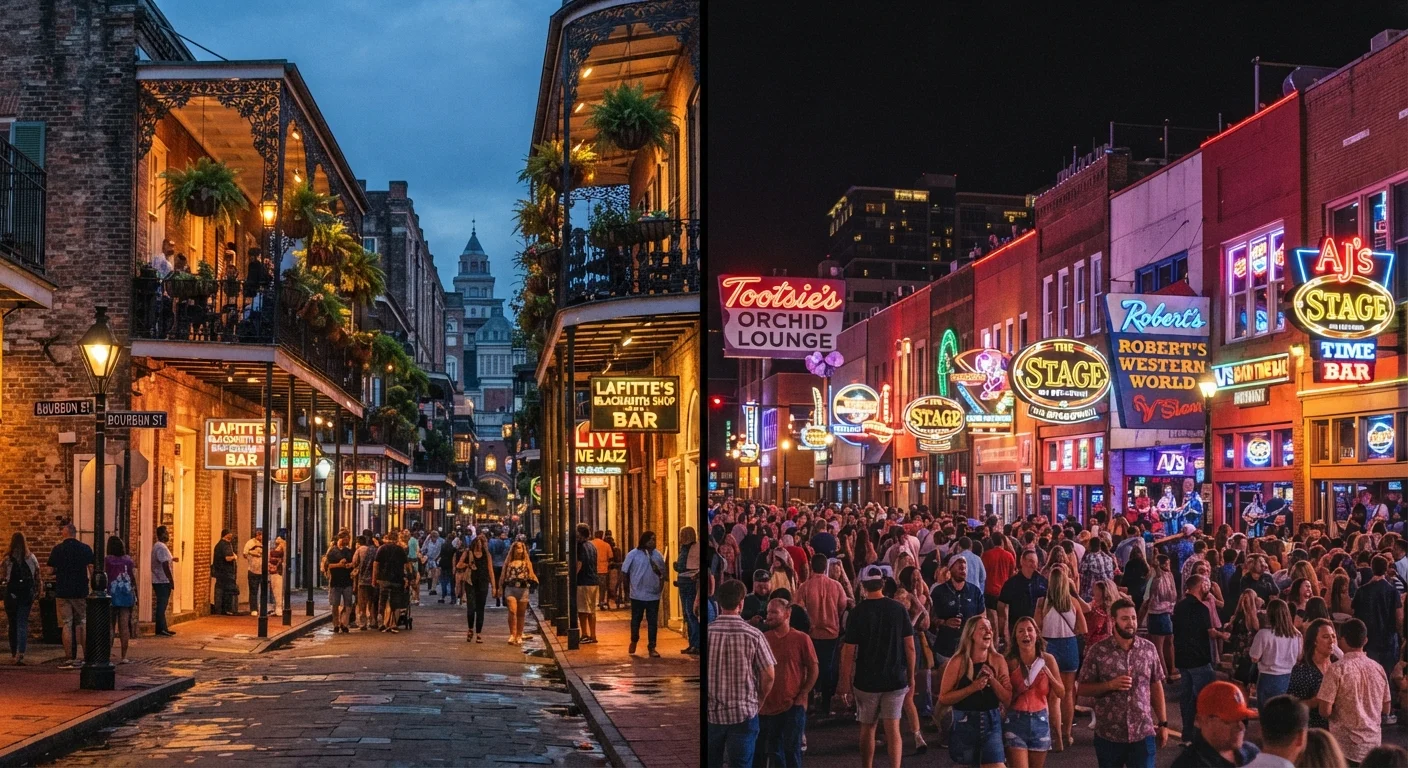
Key Takeaways
- New Orleans offers deeper historical and cultural layers; Nashville delivers high-energy, accessible nightlife.
- Both cities are strong food destinations, but their culinary traditions are entirely distinct.
- Timing matters: both cities have major event peaks that significantly affect crowds and accommodation costs.
- New Orleans rewards slow, exploratory travel; Nashville suits a tightly packed long weekend.
- Each city has a living musical tradition — not just a backdrop, but a defining identity.
Option A
New Orleans
The atmospheric, culturally layered original.
Best for: Travelers who want deep historical immersion, world-class Creole cuisine, and a musical culture that feels genuinely lived-in.
Option B
Nashville
The energetic, fast-growing Southern upstart.
Best for: Travelers who want high-energy nightlife, easy logistics, and a packed long-weekend experience with broad group appeal.
If you want deep cultural and historical immersion
New Orleans
Three centuries of Creole, African, French, and Caribbean influence are woven into every neighborhood, dish, and jazz set. New Orleans is a city you absorb, not just visit.
If you want high-energy nightlife with minimal planning
Nashville
Lower Broadway's honky-tonks run all day and night, the downtown is compact, and the city is genuinely built to welcome visitors right off the plane.
If extraordinary food history is your top priority
New Orleans
Creole and Cajun cuisine represent one of America's most original and complex culinary traditions — hard to rival anywhere in the country.
If you're traveling with a mixed group and want crowd-pleasing variety
Nashville
Country music, hot chicken, rooftop bars, and walkable neighborhoods give groups something for everyone in a compact footprint.
Two Cities, One Big Question
Both cities deliver live music, distinctive food, and neighborhoods worth wandering — but they do it with very different personalities. New Orleans is the elder statesman: moody, layered, impossibly atmospheric. Nashville is the boom-town upstart: energetic, accessible, and expanding fast. If you're weighing a domestic city break, these two destinations represent genuinely different kinds of fun. If you're still deciding whether a city trip is even the right call for your next getaway, our guide to choosing between a city break and a national park trip offers a useful framework before you dive in.
Sound & Soul: The Music Scene
New Orleans invented much of American popular music as we know it. Jazz, blues, brass band, and R&B were born or deeply shaped here, and you'll hear it live — not as a curated performance, but as a way of life — on street corners, in neighborhood bars, and along Frenchmen Street in the Marigny. The city's musical culture feels organic, spontaneous, and emotionally resonant in a way that's genuinely hard to manufacture.
Nashville wears its country music heritage proudly and has diversified well beyond it. The honky-tonks along Lower Broadway pulse with live bands from morning until well past midnight, seven days a week. The experience is high-energy, accessible, and genuinely fun — and that's a real virtue, not a consolation prize.
Food, Flavors & Culinary Identity
In New Orleans, eating is practically a spiritual act. Creole and Cajun traditions — built on French, West African, Spanish, and Indigenous influences — produce a cuisine unlike anything else in America. Gumbo, red beans and rice, po'boys, and beignets aren't tourist attractions here; they're daily rituals. Gulf seafood, particularly shrimp and oysters, shows up everywhere with absolute confidence.
Nashville's culinary identity is anchored by hot chicken — the cayenne-forward, spice-rubbed fried chicken that has become a national obsession — but the city's food scene runs much deeper. Meat-and-three diners (a Southern lunch tradition built around one protein and three sides) anchor everyday food culture, and an expanding independent restaurant scene has added considerable range in recent years.
History, Neighborhoods & Vibe
New Orleans carries roughly 300 years of tangled, layered history in its architecture and street grid. The French Quarter's iron-lace balconies, above-ground cemeteries, neighborhood Mardi Gras traditions, and the enduring cultural imprint of African, Creole, and Caribbean communities give the city a depth that rewards slow, exploratory travel. It can feel haunted in the best possible way.
Nashville's history runs through the Civil War era, the Grand Ole Opry, and a postwar recording industry that helped shape American pop culture broadly. Its neighborhoods — from East Nashville's creative corridor to the redeveloped Gulch — reflect a city actively reimagining itself without abandoning its roots.
| Criterion | New Orleans | Nashville |
|---|---|---|
| Musical tradition | Jazz, blues, brass band, R&B | Country, rock, honky-tonk |
| Food identity | Creole & Cajun cuisine | Hot chicken & Southern comfort |
| Historical depth | 300+ years, highly layered | Civil War era through mid-20th century |
| Core nightlife zone | Frenchmen Street & French Quarter | Lower Broadway honky-tonks |
| Walkability | Concentrated in French Quarter & Marigny | Compact downtown core |
| Comfortable travel season | Spring & fall | Spring & fall |
| Major crowd peaks | Mardi Gras, Jazz Fest | CMA Fest, New Year's Eve |
Planning Your Visit
New Orleans is walkable within its core — the French Quarter, Marigny, and Garden District are all manageable on foot — though summers are brutally hot and humid. Spring (roughly March through May) and fall (October through November) offer more comfortable conditions. Major events like Mardi Gras and Jazz Fest draw enormous crowds and push accommodation costs up significantly; book well in advance if those dates are on your radar.
Nashville's downtown is compact and easy to navigate. Spring and fall are pleasant; summers bring outdoor festival activity alongside the heat. Both cities have busy airports with broad domestic connections, making them easy to reach from most of the country.
Check Local Events Before You Book
Both cities host major annual events that transform the visitor experience — and the accommodation market. In New Orleans, Mardi Gras, Jazz Fest, and French Quarter Festival each draw large crowds and push prices up considerably. Nashville's Lower Broadway stays lively year-round, but events like CMA Fest (typically held in June) create significant hotel demand spikes. Checking the event calendar for your target dates before booking can save real frustration — and help you decide whether you want to be in the thick of the crowds or comfortably ahead of them.