

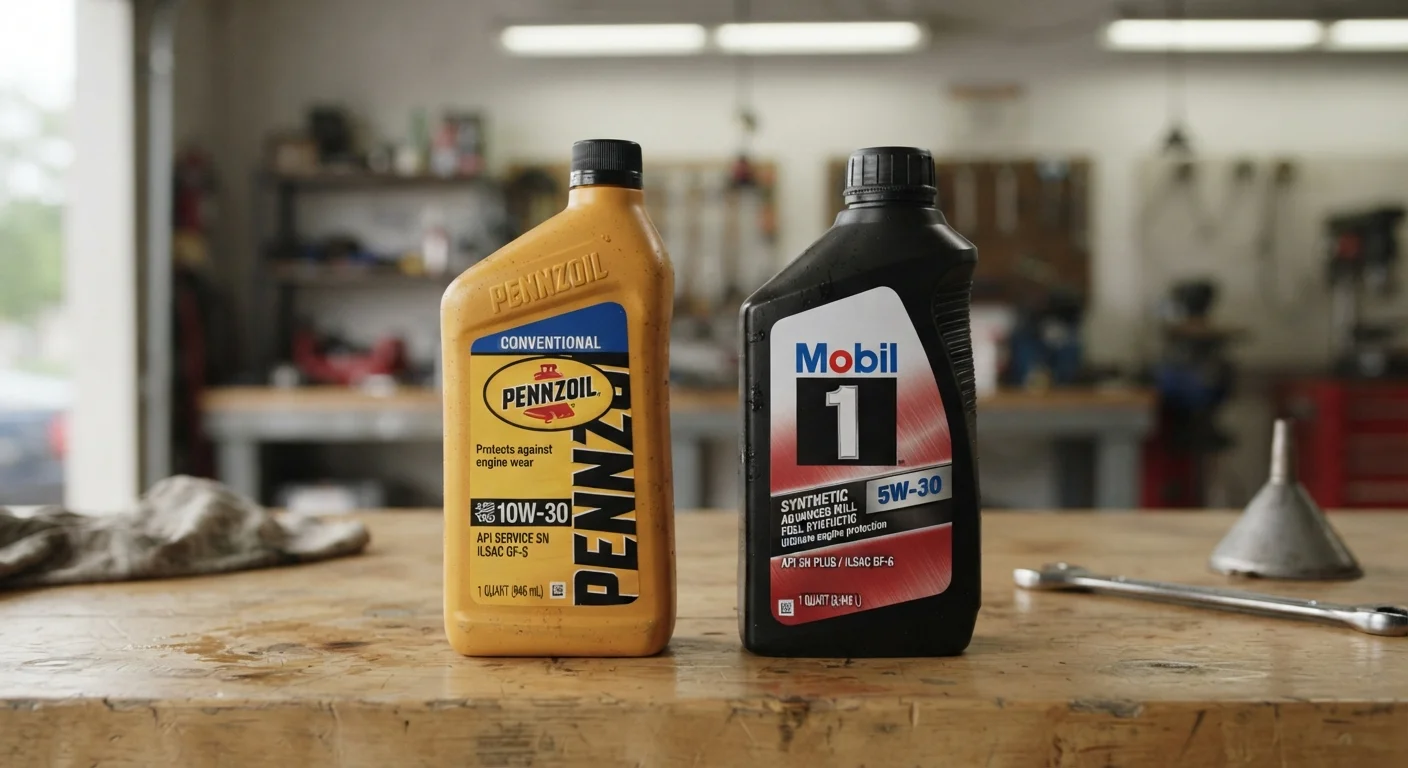
Key Takeaways
- Synthetic oil is chemically engineered for more uniform molecules, giving it better stability under high heat and cold starts.
- Conventional oil works adequately for many older engines but breaks down faster under stress than synthetic.
- Synthetic oil typically costs more per quart but may allow longer change intervals, affecting total cost over time.
- Your owner's manual - not marketing - should determine which oil type your engine actually requires.
- High-mileage vehicles require careful consideration before switching from conventional to synthetic.
Option A
Conventional Motor Oil
The long-established, widely available standard.
Best for: Older vehicles, low-mileage drivers, or engines with manufacturer specifications that don't require full synthetic.
Option B
Synthetic Motor Oil
The engineered, performance-oriented alternative.
Best for: Modern engines, extreme climates, high-mileage vehicles, or drivers who prioritize longer intervals between oil changes.
If you drive an older vehicle with moderate annual mileage
Conventional Motor Oil
Many older engines were designed around conventional oil tolerances; switching isn't always beneficial and may not be specified by the manufacturer.
If you drive a modern vehicle in extreme heat or cold climates
Synthetic Motor Oil
Synthetic oil maintains viscosity more reliably across temperature extremes, protecting engine components during cold starts and sustained high-heat operation.
If you want to extend time between oil changes
Synthetic Motor Oil
Synthetic formulations resist thermal breakdown longer, which is why many manufacturers specify extended change intervals when synthetic is used - though always follow your owner's manual.
If you own a high-mileage vehicle already running on conventional oil
Conventional Motor Oil
Engines with significant wear may rely on conventional oil's slightly thicker film; consult a qualified mechanic before switching, as changes in oil behavior can affect aged seals.
What Makes These Two Oils Fundamentally Different
Motor oil - whether conventional or synthetic - serves the same core purpose: lubricating moving engine parts to reduce friction, carry away heat, and suspend contaminants until your next oil change. The critical difference lies in where the base oil comes from and how it's processed.
Conventional motor oil is refined directly from crude petroleum. The refining process removes many impurities, but the resulting molecules are still irregular in size and shape. That inconsistency matters: under extreme heat or cold, differently sized molecules behave differently, which can cause the oil to thin out or thicken in ways that reduce protection.
Synthetic motor oil is either built from scratch using chemical synthesis or derived from heavily processed petroleum bases. The goal is a more uniform molecular structure. That uniformity translates to more predictable behavior across a wider range of temperatures and operating conditions.
Neither type is magic. Both break down over time and require changing. But how quickly they degrade - and under what conditions - is where the real trade-offs emerge. See our guide to oil change intervals for how those degradation timelines affect your maintenance schedule.
Performance, Protection, and Real-World Conditions
The performance gap between conventional and synthetic oil widens most noticeably at temperature extremes. On a cold winter morning, thinner-flowing oil reaches critical engine components faster - synthetic typically flows more freely at low temperatures, reducing the brief but damaging period after a cold start when parts are insufficiently lubricated.
Under sustained high heat - think towing, stop-and-go traffic on a hot day, or high-performance driving - synthetic oil's resistance to thermal breakdown gives it a measurable edge. Conventional oil can oxidize and form sludge more readily under these conditions, which can restrict oil passages over time.
| Criterion | Conventional Oil | Synthetic Oil |
|---|---|---|
| Base origin | Refined crude petroleum | Chemically engineered or heavily processed |
| Molecular consistency | Variable molecule sizes | Uniform molecular structure |
| Cold-start performance | Slower flow in extreme cold | Flows more freely at low temps |
| High-heat stability | Breaks down faster under sustained heat | More resistant to thermal breakdown |
| Typical change interval | 3,000-5,000 miles (varies) | 5,000-10,000+ miles (varies) |
| Cost per quart | Generally lower | Generally higher |
| Sludge resistance | More prone to oxidation sludge | Better resistance to sludge formation |
That said, for a driver covering mostly highway miles in a moderate climate with a well-maintained older vehicle, conventional oil can perform adequately within its specified change intervals. The chemistry matters, but so does how you actually use your vehicle. For drivers managing an aging car, our breakdown of high-mileage vehicle maintenance addresses how oil choice fits into the broader cost picture.
Cost, Intervals, and What You Actually Pay Over Time
Synthetic oil typically costs noticeably more per quart than conventional oil - the premium can be substantial depending on the grade and brand. However, the raw price per quart doesn't tell the whole story.
2-4×
Typical synthetic oil cost premium over conventional
Per-quart pricing varies by viscosity grade and formulation; the gap is well-established across the industry, though exact figures differ by product.
~5,000-10,000 mi
Common synthetic oil change interval range
Many automakers specify extended intervals for full synthetic; always defer to your owner's manual rather than a generic recommendation.
Many vehicle manufacturers specify longer oil change intervals when full synthetic is used - sometimes up to 7,500 to 10,000 miles or more, depending on the vehicle and driving conditions. If synthetic allows you to change oil half as often, the per-change cost advantage of conventional may narrow or disappear. The precise math depends on your vehicle's specifications, your actual driving conditions, and labor costs if you use a shop rather than changing oil yourself.
One important caution: longer intervals don't mean skipping the dipstick. Checking oil level and condition between changes remains good practice regardless of which oil type you use. If you're weighing whether to handle oil changes yourself, our comparison of DIY vs. shop maintenance can help frame that decision.
How to Make the Right Call for Your Engine
The single most reliable guide is your vehicle's owner's manual. Manufacturers specify oil type and viscosity grade based on actual engine design and testing - not generalized advice. If your manual calls for synthetic, use it. If it specifies conventional, that's the starting point, though using synthetic typically won't cause harm.
A few situations deserve particular attention:
- Turbocharged engines almost universally benefit from synthetic due to the extreme heat generated around the turbocharger.
- High-mileage engines (generally over 75,000 miles) may have worn seals that have adapted to conventional oil's characteristics - switching to synthetic isn't automatically advisable without a mechanic's input.
- New or recently rebuilt engines sometimes call for a conventional break-in period before switching; always check the manufacturer's guidance.
Understanding your engine's fundamentals - including how long-term components like the timing system relate to maintenance decisions - is part of being a prepared vehicle owner. Our overview of timing belt vs. timing chain considerations illustrates how one maintenance decision connects to others.
When 'Synthetic Blend' Enters the Picture
You'll often see 'synthetic blend' oils on the shelf - these mix conventional base oil with a portion of synthetic. They typically offer better thermal resistance than straight conventional at a lower price point than full synthetic. They can be a reasonable middle ground for some drivers, but the same rule applies: check what your manufacturer actually specifies before making a choice based solely on price or label language.