

Key Takeaways
- Timing belts require proactive replacement - typically every 60,000 to 100,000 miles - before they fail.
- Timing chains are metal and generally designed to last the engine's lifetime with proper lubrication.
- Ignoring a timing belt interval risks catastrophic engine damage that can cost far more than the replacement itself.
- Chain-equipped engines are not maintenance-free - neglected oil changes can accelerate chain wear.
- Checking your owner's manual is the only reliable way to know which system your vehicle uses.
Option A
Timing Belt
The scheduled-replacement component with a firm expiration date.
Best for: Drivers who want to budget predictably for a known service interval and stay ahead of a failure.
Option B
Timing Chain
The metal alternative engineered to last the life of the engine.
Best for: Drivers prioritizing lower long-term maintenance overhead, provided the engine receives consistent oil changes.
If you own a vehicle with a known belt-equipped engine
Timing Belt Replacement
Proactive replacement on schedule is the lowest-cost path. Waiting for symptoms dramatically increases the risk of engine damage.
If you're evaluating a used car purchase and want lower long-term service overhead
Timing Chain
A chain-equipped engine typically eliminates one major scheduled interval, though consistent oil maintenance remains essential.
If you're a high-mileage driver who wants to minimize surprise repair bills
Timing Chain
Chains don't follow a mileage countdown, so they tend to suit drivers who accumulate miles quickly and want fewer time-sensitive deadlines.
If you're keeping an older vehicle long-term and the belt is due soon
Timing Belt Replacement
Replacing the belt - and the associated tensioners and water pump while the engine is open - is usually far cheaper than an interference-engine repair after failure.
What Each Component Actually Does
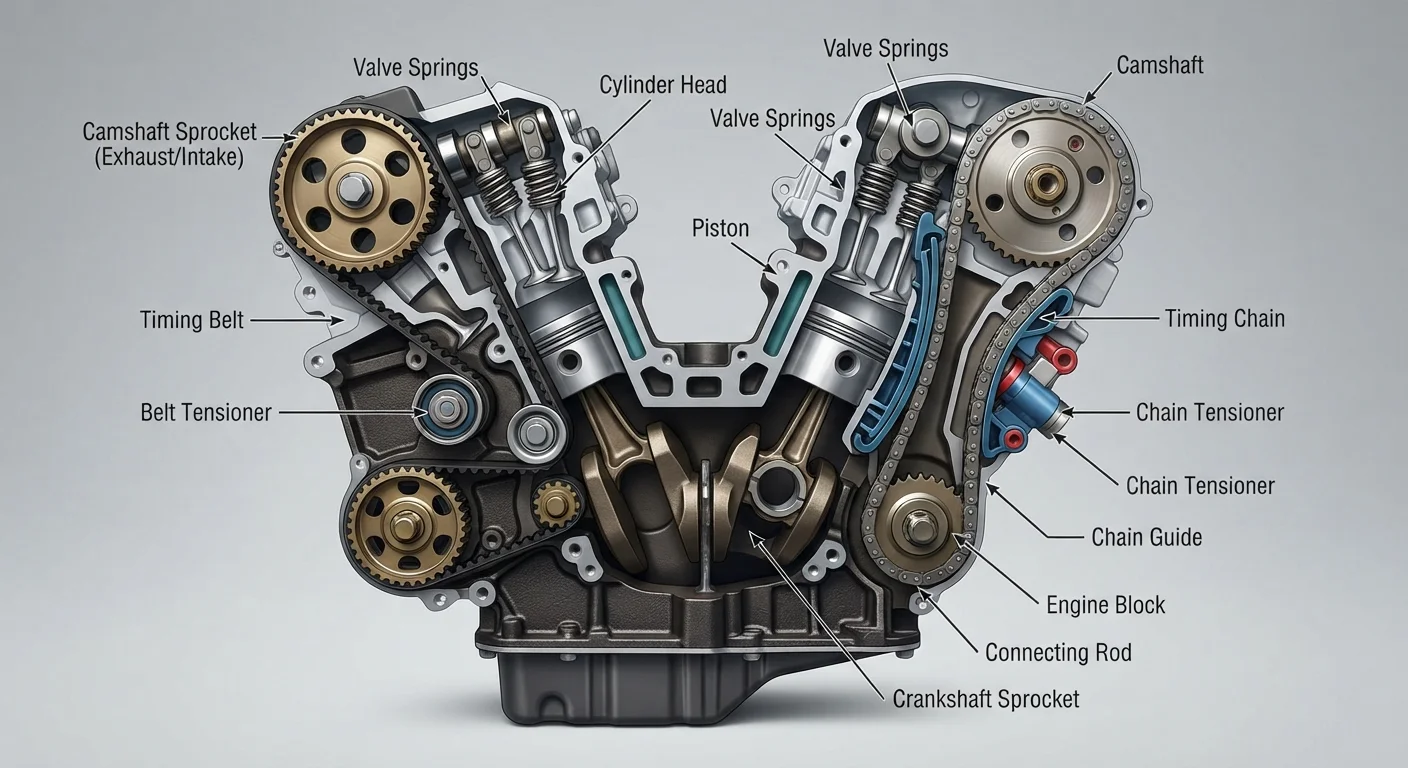
Both the timing belt and timing chain perform the same fundamental job: synchronizing the crankshaft and camshaft so the engine's valves open and close at precisely the right moment relative to the pistons. Get that timing wrong - even briefly - and the engine won't run. Let it fail completely in a so-called interference engine (one where the valves and pistons occupy overlapping space at different points in the cycle), and pistons can physically collide with open valves, causing severe internal damage.
The difference between belt and chain is purely in the material and engineering approach. A timing belt is a toothed rubber band reinforced with fibers. It runs quietly, requires no lubrication, and is typically housed behind a protective cover. A timing chain is a metal roller chain - similar in concept to a bicycle chain - that runs inside the engine bathed in oil. It's heavier and can produce slightly more noise, but metal simply outlasts rubber under normal operating conditions.
Whether your engine uses a belt or chain is a design decision made by the manufacturer. You generally cannot swap one for the other; the engine's architecture dictates which system it was built around. Consult your owner's manual or a trusted mechanic to confirm what's under your hood. This matters because your maintenance strategy should follow from that answer. See our maintenance schedule guide for help interpreting what your manual is actually telling you.
The Core Difference: Scheduled vs. Lifetime
This is where the financial stakes diverge sharply.
Timing belts have a finite service life. Manufacturers specify replacement intervals - commonly in the range of 60,000 to 100,000 miles, though the exact figure varies by make, model, and engine - and those intervals exist because rubber degrades with heat, age, and mechanical stress regardless of how the car looks or drives. A belt can appear intact right up until it snaps. There's rarely a dramatic warning. This is why the replacement schedule is non-negotiable: you're not waiting for symptoms; you're replacing a component before it can fail.
Timing chains, by contrast, are engineered to last the engine's usable lifetime under normal conditions. They don't carry a mileage countdown. What they do depend on is consistent, clean engine oil - the chain, its guides, and its tensioner are all lubricated by the engine's oil system. Skipping oil changes or running low on oil accelerates wear on these components and can eventually cause chain stretch or guide failure, which produces a rattling noise on startup and, left unaddressed, real damage.
| Criterion | Timing Belt | Timing Chain |
|---|---|---|
| Material | Reinforced rubber | Metal roller chain |
| Expected service life | 60,000-100,000 miles (varies) | Typically engine lifetime |
| Scheduled replacement required | Yes - mandatory interval | No scheduled interval |
| Lubrication needed | No - runs dry | Yes - engine oil dependent |
| Failure warning signs | Rarely any before failure | Rattling on startup if worn |
| Interference engine risk | High if belt snaps | Present if chain fails |
| Noise level | Very quiet | Slightly louder |
| Key maintenance action | Replace on schedule | Maintain oil change intervals |
For a broader look at how this fits into your vehicle's overall upkeep, our car maintenance schedule explainer walks through how these intervals interconnect.
The Real Cost of Getting It Wrong
Timing belt replacement is not cheap - labor is significant because the component is buried, and a thorough job usually includes new tensioners, idler pulleys, and often the water pump (which is accessible at the same time). Depending on the vehicle, you might expect a repair order in the several-hundred-dollar range. That's a real expense, but it's a predictable one you can plan for.
A snapped belt in an interference engine is a different category of problem entirely. Repair costs in those scenarios can reach into the thousands, and in some cases the damage makes an older vehicle a total loss from a financial standpoint.
60K-100K
Typical timing belt replacement interval (miles)
Manufacturer intervals vary significantly - always verify the specific figure for your vehicle in the owner's manual.
~$500-$1,000+
Typical timing belt service cost (parts and labor)
Cost varies by vehicle complexity; labor is the dominant factor since access requires significant engine disassembly.
Thousands
Potential engine repair cost after belt failure
In interference engines, a snapped belt can cause piston-to-valve contact, resulting in repair bills that sometimes exceed the vehicle's value.
Chain failures are less common but not unknown. Worn guides, stretched chains, or failed tensioners can cause timing errors that range from rough running to serious internal damage. The pattern is similar: deferred maintenance (in this case, neglected oil changes) is typically the precursor.
If you're weighing the cost of ongoing maintenance against whether to keep an aging vehicle at all, our article on keeping a high-mileage vehicle running lays out the financial framework for that decision. And if a used car purchase is in view, weighing the new vs. used trade-offs is worth reading alongside this one - a vehicle's belt or chain status, and its service history, are legitimate evaluation factors.
Not All Engines Are Interference Engines
In a non-interference engine, a broken timing belt stalls the car but does not cause internal damage - the pistons and valves never share the same space. However, many modern engines are interference designs, and you cannot assume yours is not without checking. A mechanic or a quick look at your vehicle's service documentation can clarify this, and it's worth knowing before you decide how urgently to act on an overdue belt.
What to Do With This Information
Step one is simply knowing what your vehicle has. Check the owner's manual under the maintenance schedule or engine specifications. If you're uncertain, a mechanic can confirm it in minutes during any routine visit.
If your vehicle has a timing belt, find out the manufacturer's replacement interval and where you currently stand relative to it - in both mileage and years, since rubber also degrades with age even on low-mileage vehicles. If you're approaching or past that interval, scheduling the service soon is the straightforward move. This is not a task that benefits from delay.
If your vehicle has a timing chain, the action item is less urgent but just as clear: protect it by maintaining your oil change schedule. The oil that lubricates your engine is the same oil keeping the chain system functional. Our guide to conventional vs. synthetic oil covers how oil quality and change intervals interact with engine wear - relevant reading if you want to understand how routine maintenance decisions compound over time.
Timing work, whether belt replacement or chain diagnosis, is firmly in the category of jobs for a qualified mechanic. The components are deep in the engine, the tolerances are precise, and the consequences of errors are severe. For a practical framework on deciding which maintenance tasks belong in a shop versus your driveway, see our DIY vs. shop guide.