

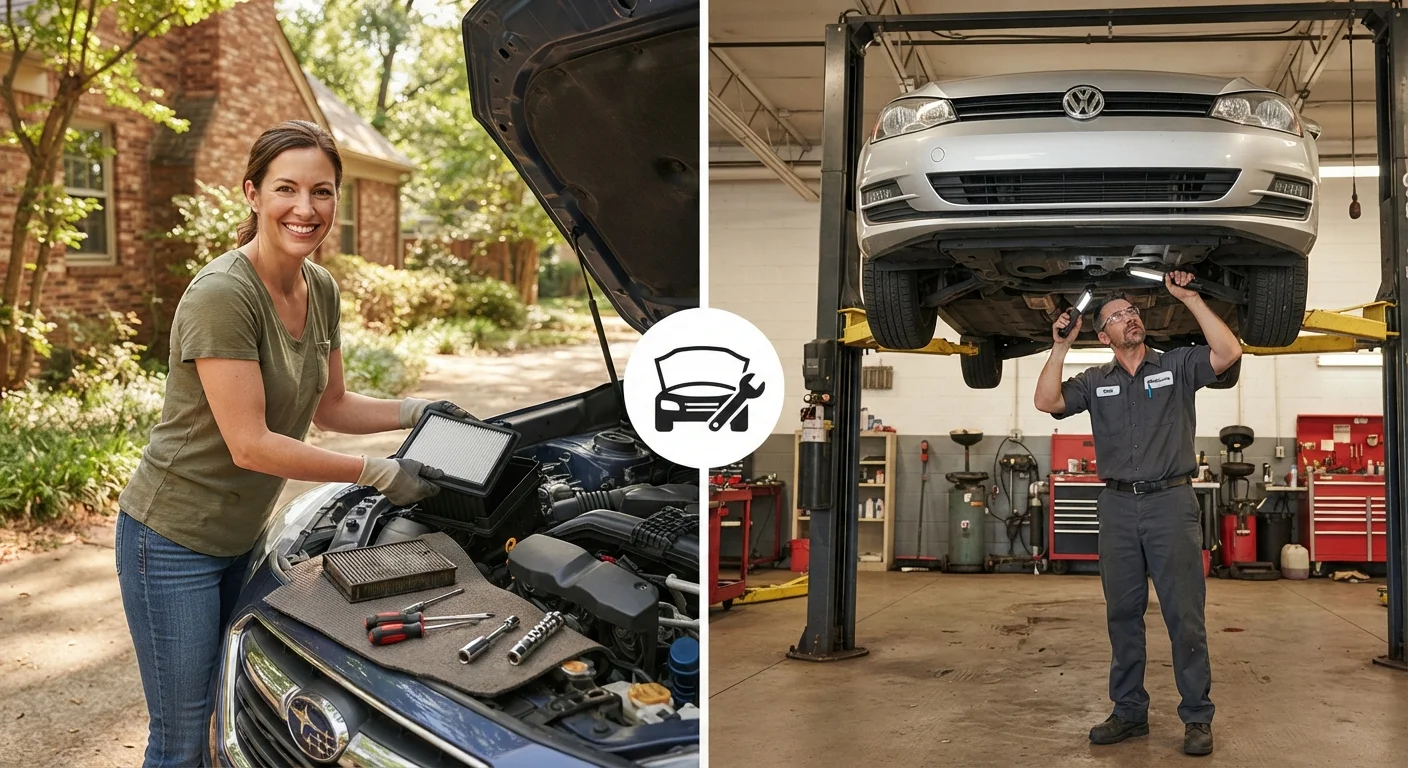
Key Takeaways
- DIY maintenance can meaningfully reduce costs for simple, low-risk tasks like oil changes and air filter swaps.
- Some jobs - brake hydraulics, suspension components, airbag systems - carry real safety risk if done incorrectly.
- Your owner's manual is the authoritative guide to service intervals; match tasks to your actual skill level.
- Shops offer diagnostic tools and professional accountability that most home mechanics cannot replicate.
- The DIY-or-shop decision is best made task by task, not as a blanket rule.
Significant cost savings on labour
Labour is often the largest component of a shop invoice. Handling routine tasks yourself eliminates that charge entirely, which adds up meaningfully over a vehicle's lifetime.
Builds genuine mechanical familiarity
Performing your own maintenance helps you understand how your vehicle works, making it easier to identify problems early and communicate accurately with mechanics when you do visit a shop.
Flexible scheduling on your own timeline
DIY work happens when it's convenient for you - no appointment waiting, no leaving the car for a day, and no coordination around shop hours.
Full control over parts and fluid quality
You choose exactly which oil, filter, or component goes into your car, allowing you to match manufacturer specifications precisely rather than accepting whatever a shop stocks.
Safety risk on complex or critical systems
Errors on brakes, steering, or suspension can have serious consequences. These systems demand proper tools, torque specifications, and experience that most home mechanics don't yet have.
Upfront tool and equipment investment
A basic toolkit, jack stands, drain pans, and specialty sockets represent real upfront cost - one that may not be recovered quickly if you only perform occasional maintenance.
No professional diagnostic capability
Shops use professional-grade scan tools to read fault codes, live sensor data, and calibration requirements that consumer-grade OBD readers often can't fully access.
Mistakes carry no warranty protection
Licensed shops stand behind their work; if a repair fails, recourse exists. A DIY error has no such backstop, and fixing it may cost more than the original shop bill would have.
Modern vehicles add complexity
Advanced driver-assistance systems (ADAS), hybrid powertrains, and integrated electronics mean many contemporary repairs require recalibration steps that go well beyond basic mechanical work.
Our Verdict
DIY maintenance is a genuinely smart choice for routine, low-risk tasks - provided you have the right tools, a safe workspace, and reliable instructions. For anything that affects braking, steering, or structural integrity, professional service is the safer and often more cost-effective path once you factor in the risk of an error. The most practical approach treats these two options as complementary, not competing.
Drivers with basic mechanical confidence, appropriate tools, and the patience to research tasks properly will get the most out of selective DIY - while still knowing when to hand the keys to a qualified mechanic.
Where the Line Between DIY and Professional Service Actually Falls
The question isn't really should you do your own car maintenance - it's which tasks are appropriate for a home setting. That distinction matters because the consequences of getting it wrong vary enormously depending on the job. A poorly installed cabin air filter is a minor nuisance; an incorrectly bled brake system is a safety emergency.
A useful starting framework: separate tasks by what's at stake if something goes wrong. Routine consumables - oil, filters, wiper blades, bulbs - sit at one end. Safety-critical systems - brakes, suspension, steering, airbags - sit at the other. Most drivers can confidently handle the first category with some research and patience. The second category generally warrants professional attention, not because the work is necessarily complex, but because precision and proper tooling are non-negotiable.
See our breakdown of your car's maintenance schedule for a clear picture of which services come up most often and what each one involves.
Significant cost savings on labour
Labour is often the largest component of a shop invoice. Handling routine tasks yourself eliminates that charge entirely, which adds up meaningfully over a vehicle's lifetime.
Builds genuine mechanical familiarity
Performing your own maintenance helps you understand how your vehicle works, making it easier to identify problems early and communicate accurately with mechanics when you do visit a shop.
Flexible scheduling on your own timeline
DIY work happens when it's convenient for you - no appointment waiting, no leaving the car for a day, and no coordination around shop hours.
Full control over parts and fluid quality
You choose exactly which oil, filter, or component goes into your car, allowing you to match manufacturer specifications precisely rather than accepting whatever a shop stocks.
The Real Drawbacks of Going It Alone
DIY enthusiasm can sometimes outpace preparation. Without the right lift equipment, for example, working underneath a vehicle on jack stands carries genuine risk - one that's easy to underestimate. Similarly, modern vehicles increasingly rely on electronic systems that require professional scan tools to calibrate after certain repairs; simply swapping a part isn't always enough.
Cost savings can also evaporate if a job is done incorrectly. A misapplied torque spec on a wheel bolt or a pinched brake line can lead to repair costs far exceeding what a shop would have charged. And unlike a licensed shop, DIY work carries no warranty and no professional accountability if something fails.
Safety risk on complex or critical systems
Errors on brakes, steering, or suspension can have serious consequences. These systems demand proper tools, torque specifications, and experience that most home mechanics don't yet have.
Upfront tool and equipment investment
A basic toolkit, jack stands, drain pans, and specialty sockets represent real upfront cost - one that may not be recovered quickly if you only perform occasional maintenance.
No professional diagnostic capability
Shops use professional-grade scan tools to read fault codes, live sensor data, and calibration requirements that consumer-grade OBD readers often can't fully access.
Mistakes carry no warranty protection
Licensed shops stand behind their work; if a repair fails, recourse exists. A DIY error has no such backstop, and fixing it may cost more than the original shop bill would have.
Modern vehicles add complexity
Advanced driver-assistance systems (ADAS), hybrid powertrains, and integrated electronics mean many contemporary repairs require recalibration steps that go well beyond basic mechanical work.
If you're newer to car ownership, this guide for new drivers outlines which checks and habits to build before attempting any hands-on work.
Tasks Well-Suited to Each Approach
In general, the following tasks are widely considered manageable for a careful, informed home mechanic:
- Engine air filter replacement - typically tool-free and straightforward on most vehicles
- Windshield wiper blades - simple swap, no mechanical risk
- Cabin air filter - usually behind the glove box; instructions vary by model
- Oil and oil filter change - requires proper disposal of used oil and knowing your vehicle's oil spec; see our oil comparison guide for help choosing the right type
- Battery replacement - generally manageable, though some vehicles require a memory saver to preserve electronic settings
Tasks that typically warrant professional service include brake pad and rotor replacement (especially caliper or line work), suspension components, timing belt service, and anything requiring alignment afterward. For context on why alignment matters, our tire services explainer covers the distinctions clearly.
Always Verify With Your Owner's Manual
Vehicle-specific instructions matter far more than generic online guides. Torque specs, fluid types, filter part numbers, and service intervals all vary by make, model, and year. Your owner's manual - or a manufacturer-sourced service document - should be your primary reference for any maintenance task, DIY or otherwise.
Owners of higher-mileage vehicles should weigh DIY decisions carefully - see the maintenance math on aging cars for a practical framework.
~$500-$700
Typical annual DIY savings estimate
Industry estimates suggest drivers who handle basic routine maintenance themselves can save several hundred dollars annually compared to shop rates, though actual savings vary by vehicle, region, and task frequency.
2 of 3
Vehicle problems linked to deferred maintenance
Research from vehicle inspection programmes consistently finds that a significant majority of roadside failures and premature repairs trace back to skipped or delayed routine maintenance.