

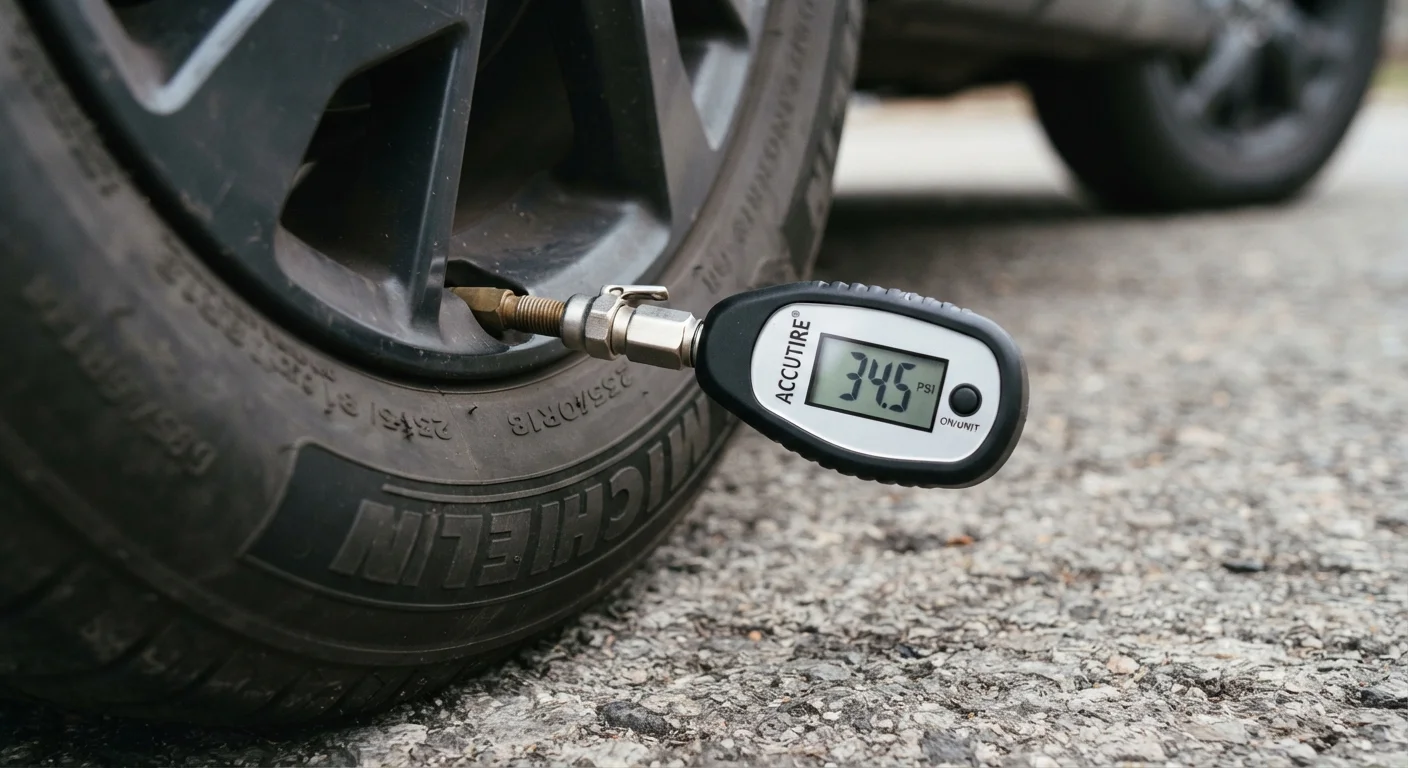
Key Takeaways
- Your vehicle's correct tire pressure is listed on the door jamb placard, not on the tire sidewall.
- Underinflated tires can reduce fuel economy by up to 0.2% for every 1 PSI drop across all four tires.
- The TPMS warning light only triggers when pressure drops 25% below recommended - don't rely on it as your only check.
- Tire pressure should be checked when tires are cold, before driving more than a mile.
- Both under- and overinflation cause uneven tread wear, reducing tire lifespan.
Tire Pressure (PSI)
Tire pressure refers to the amount of air inside a tire, measured in pounds per square inch (PSI). Maintaining the correct PSI keeps your tires functioning as designed - supporting the vehicle's weight, gripping the road evenly, and lasting as long as they should. Every vehicle has a manufacturer-specified PSI range, and staying within it matters for safety, fuel economy, and tire longevity.
PSI measures gauge pressure - the pressure above ambient atmospheric pressure. Tire pressure fluctuates roughly 1 PSI for every 10°F change in temperature, which is why cold-weather checks often reveal lower readings.
What PSI Actually Means - and Where to Find the Right Number
PSI stands for pounds per square inch, a unit that describes how much air pressure is inside your tire. Think of it as measuring how "full" the tire is relative to what the vehicle needs to perform correctly.
The most common mistake drivers make is reading the PSI off the tire sidewall. That number - often printed as "Max Press. 44 PSI" or similar - is the tire's maximum structural tolerance, not what your car actually needs. Your vehicle's correct pressure is found on the door jamb placard, typically on the driver's side door edge or door frame. This number is set by the vehicle manufacturer based on weight distribution, suspension design, and intended handling characteristics.
Front and rear recommended pressures are sometimes different, so it's worth checking both. Most passenger vehicles fall in the 32-36 PSI range, though trucks, SUVs, and performance vehicles may vary significantly.
Always Check Pressure on Cold Tires
Tire pressure readings rise as tires heat up from driving, which can give you a falsely high reading. For an accurate measurement, check pressure before you've driven more than a mile - ideally first thing in the morning. If you must check after driving, add roughly 4 PSI to your reading as a rough correction, then recheck when the tires are cold to confirm.
How Tire Pressure Connects to Fuel Economy
There's a direct mechanical reason why underinflated tires hurt fuel efficiency: rolling resistance. When a tire is soft, more of its sidewall flexes and deforms with each rotation. That flexing consumes energy - energy that comes from burning fuel.
The U.S. Department of Energy has noted that tire pressure is one of the most cost-effective fuel economy factors within a driver's direct control. A tire that's low by just a few PSI across all four wheels adds measurable drag over thousands of miles.
Up to 3%
Fuel economy improvement from proper tire inflation
According to the U.S. Department of Energy, keeping all four tires at the correct PSI can improve gas mileage by up to 3% compared to underinflated tires.
25%
Pressure drop required to trigger TPMS warning light
Federal TPMS standards require a warning only when tire pressure drops 25% below the vehicle manufacturer's recommended level - a significant deficit before any alert appears.
1 PSI
Pressure lost per 10°F temperature drop
The Rubber Manufacturers Association notes that tires lose approximately 1 PSI for every 10-degree Fahrenheit drop in ambient temperature.
Conversely, overinflating tires doesn't improve efficiency in any meaningful way and creates its own problems - a harsher ride, reduced traction, and accelerated center-tread wear. The goal is always the manufacturer's specified range, not the highest number you can reach.
Understanding Your TPMS - and Its Limits
Since 2008, federal law has required all new passenger vehicles sold in the U.S. to include a Tire Pressure Monitoring System (TPMS). This system uses sensors inside each wheel to track pressure in real time and alert you when it drops too low.
The catch: TPMS is calibrated to warn you only when pressure falls to 25% below the recommended level. For a tire with a 35 PSI recommendation, that means the light won't trigger until you're around 26 PSI - already well into underinflated territory.
That's why TPMS should be treated as a safety net, not a maintenance tool. Relying solely on the warning light means your tires could be operating below optimal pressure for weeks or months before you're alerted. For a plain-language explanation of what your TPMS icon and other dashboard symbols mean, see our dashboard warning lights guide.
Manual monthly checks with an inexpensive gauge remain the most reliable way to stay on top of pressure.
Tread Wear, Temperature, and Long-Term Tire Health
Tire pressure has a direct effect on how your tread wears - and uneven wear shortens tire life significantly. Underinflated tires tend to wear faster on the outer edges because the tire bows outward under load. Overinflated tires wear down the center strip more quickly because the contact patch narrows.
Temperature is another factor that catches drivers off guard. Air contracts in cold weather, which means a tire that reads 35 PSI on a warm afternoon might read 32-33 PSI after an overnight freeze. In northern climates, it's worth checking pressure every few weeks during winter months.
Proper tire pressure works alongside other maintenance tasks like rotation, balancing, and alignment. If you're unsure how those services differ and how often they're needed, our article on tire rotation, balancing, and alignment breaks each one down clearly.
For drivers managing older, higher-mileage vehicles, staying disciplined about tire pressure is one of the lower-cost ways to extend the life of components across the whole vehicle. Learn more about the broader picture in our guide on keeping a high-mileage vehicle running.
Nitrogen vs. Air: Is There a Difference?
Some tire shops offer nitrogen inflation as an alternative to regular air. Nitrogen molecules are slightly larger than oxygen molecules and escape through rubber more slowly, which means pressure stays stable for longer periods. However, the practical difference for everyday drivers is modest - regular air (which is already about 78% nitrogen) checked monthly performs well for most use cases. If nitrogen is convenient and reasonably priced, it's a fine option, but it's not a requirement.