

Key Takeaways
- Healthy soil is roughly 45% minerals, 25% water, 25% air, and 5% organic matter by volume.
- Soil texture - the ratio of sand, silt, and clay - determines drainage, aeration, and nutrient retention.
- Organic matter is the most improvable component of soil and has an outsized effect on plant health.
- A simple jar test or home soil test kit can reveal your soil's basic texture and pH without lab equipment.
- Compost, cover crops, and reduced tilling are among the most effective ways to build soil health over time.
Soil Health
Soil health refers to the continued capacity of soil to function as a living ecosystem - supporting plant growth, filtering water, cycling nutrients, and sustaining biological activity. Healthy soil is not just a growing medium; it's a complex mix of minerals, organic matter, air, water, and countless living organisms working together. When that system is in balance, plants grow more vigorously with less intervention.
Soil scientists often assess health using indicators like bulk density, aggregate stability, microbial biomass, and cation exchange capacity (CEC) - a measure of how well soil holds onto plant-available nutrients.
The Four Ingredients in Every Handful of Soil
Pick up a handful of garden soil and you're holding four things at once: mineral particles, organic matter, water, and air. In a well-functioning soil, these components exist in rough proportion - about 45% minerals, 25% water, 25% pore space filled with air, and 5% organic matter. That 5% organic fraction is deceptively small. It drives microbial life, binds soil into workable clumps, and determines how well your plants access nutrients.
Mineral particles come in three sizes - sand (the largest), silt (medium), and clay (the finest). Their ratio defines your soil's texture, which affects nearly everything else. Sandy soils drain fast but struggle to hold nutrients. Clay soils hold water and nutrients well but can become waterlogged and compacted. Silty soils are naturally fertile but prone to crusting. Most productive gardens sit somewhere in the middle - a balanced mix called loam.
~1 billion
Bacteria per teaspoon of healthy soil
Soil scientists estimate that a single teaspoon of productive garden soil can harbor up to one billion bacteria representing thousands of species.
5%
Organic matter in ideal garden soil
While organic matter makes up only about 5% of healthy soil by volume, it has a disproportionate influence on fertility, structure, and water retention.
6.0-7.0
Optimal pH range for most vegetables
According to university extension soil science resources, most common vegetables and flowers perform best within this slightly acidic to neutral pH range.
Soil Structure: Why Texture Alone Isn't the Whole Story
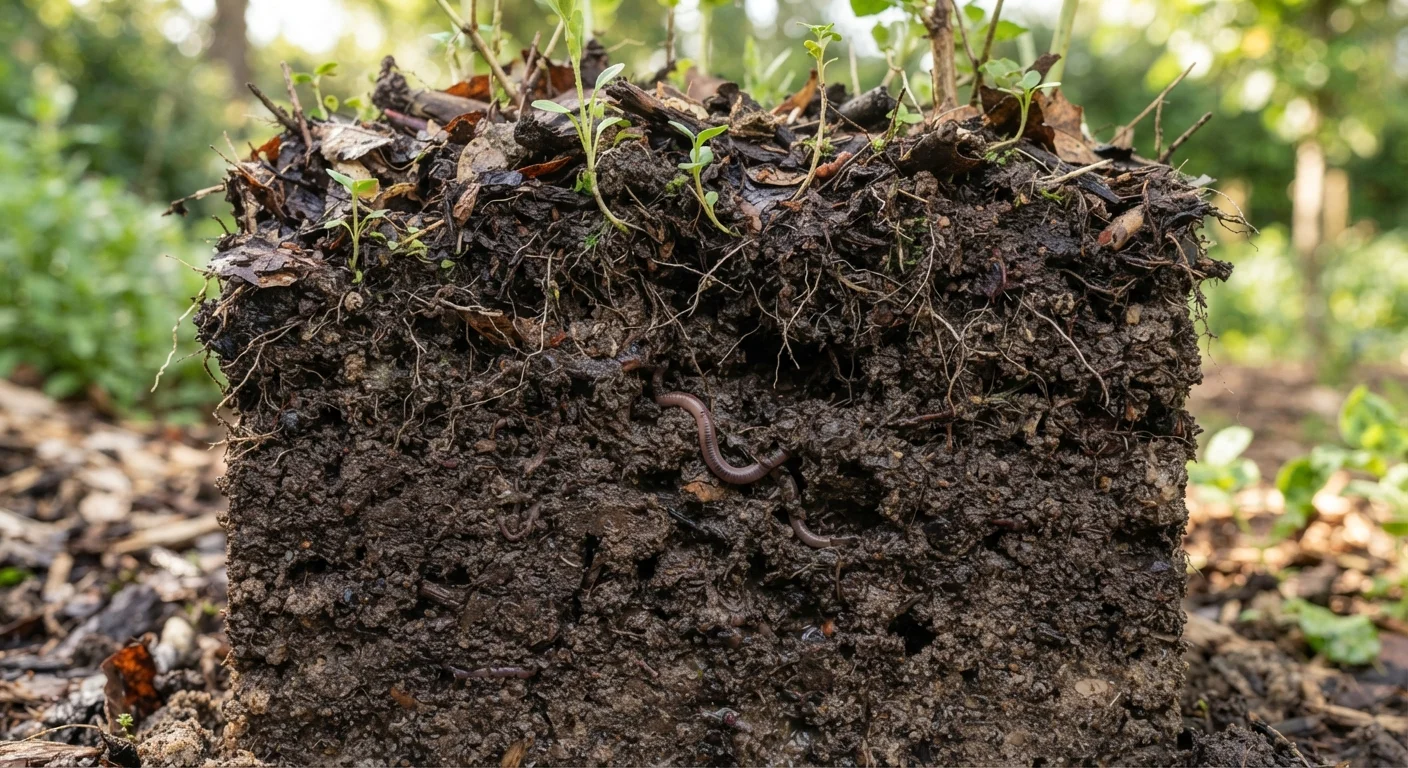
Texture tells you what your soil is made of; structure tells you how those particles are arranged. Healthy soil forms aggregates - small clumps of mineral particles bound together by organic glues, fungal threads, and microbial activity. These aggregates create a porous network that lets roots penetrate easily, allows excess water to drain, and holds enough air for roots to breathe.
Compacted soil loses this structure. Foot traffic, heavy equipment, and repeated tilling collapse the pore spaces between aggregates, leaving plants struggling to push roots through dense, airless ground. A simple test: push a pencil into moist (not wet) soil. If it resists after the first inch or two, compaction is likely limiting your plants' root depth and your garden's potential.
Test Before You Amend
It's tempting to add lime, sulfur, or fertilizer based on how your plants look, but visible symptoms often have multiple causes. A basic soil test - available through many university cooperative extension services or garden centers - gives you pH and primary nutrient levels for a few dollars. Knowing what's actually in your soil helps you amend purposefully rather than guessing.
The Living Layer: Soil Biology and Organic Matter
A single teaspoon of healthy garden soil can contain millions of bacteria, thousands of fungal strands, and a web of microorganisms that most gardeners never think about. These organisms are not incidental - they are the engine that converts raw organic matter into plant-available nutrients, suppresses some soil-borne pathogens, and cements mineral particles into stable aggregates.
Organic matter feeds this living community. As microbes break down fallen leaves, decomposing roots, and added compost, they release nitrogen, phosphorus, and trace minerals in forms plants can absorb. This is why composting at home is so valuable - finished compost delivers both the organic material and the microbial inoculants that soil needs to function well.
Soil pH sits at the center of this chemistry. When pH drifts too far from the 6.0-7.0 range most plants prefer, nutrients become chemically bound in forms roots can't access - even if those nutrients are technically present in the soil. A basic soil test is the most direct way to check pH and identify which amendments, if any, will help.
How to Start Reading - and Improving - Your Own Soil
You don't need a laboratory to get useful information about your soil. The jar test is a reliable starting point: fill a glass jar one-third with soil, add water to the top, shake vigorously, and let it settle for 24 hours. Sand drops first, silt settles in the middle layer, and clay stays suspended longest, forming the top layer. The relative thickness of each layer approximates your soil's texture.
From there, improvement comes down to consistent habits rather than dramatic one-time fixes. Adding compost each season builds organic matter gradually. Keeping soil covered - with mulch or cover crops - protects structure from rain compaction and erosion. Reducing tilling preserves the fungal networks that bind aggregates together. And if you're debating whether to build raised beds or work with your existing ground, understanding your native soil first makes that decision clearer - see our comparison of raised beds vs. in-ground planting for a fuller breakdown.
Soil improvement is measured in seasons, not weekends. But even modest gains in organic matter and structure translate directly into stronger plants, better water retention during dry spells, and a garden that needs fewer inputs over time. That's a return worth the patience.