

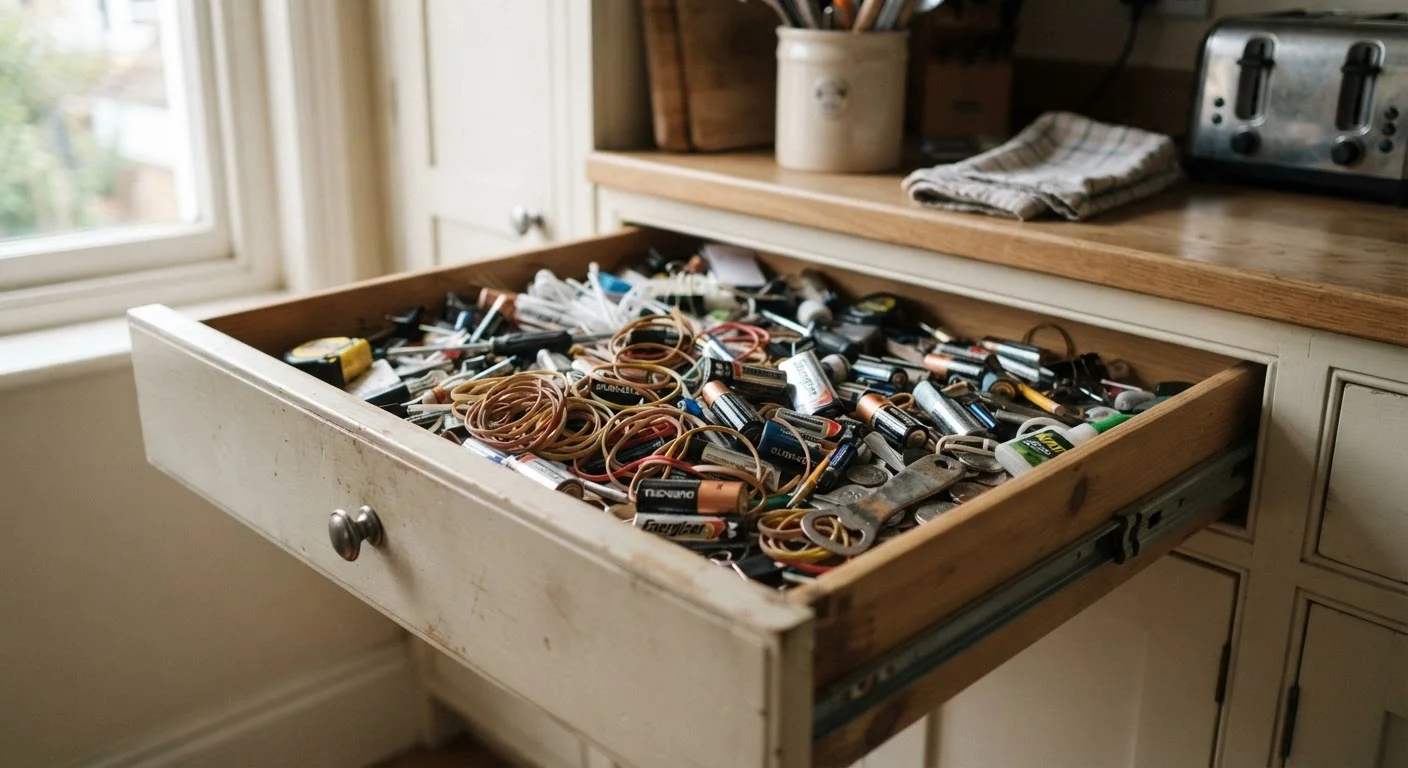
Key Takeaways
- The junk drawer is a symptom of missing homes for items, not a permanent organizational necessity.
- Most items in junk drawers belong in specific, already-existing categories elsewhere in the home.
- Small, deliberate systems prevent miscellaneous clutter from accumulating in the first place.
- Emptying a junk drawer is only useful if you replace it with a functional alternative system.
- Households of any size can eliminate the catch-all drawer by auditing what actually lands there.
Why the Junk Drawer Exists in the First Place
The junk drawer isn't born messy - it starts as a reasonable temporary solution. An item arrives in the home without an obvious destination, a decision gets deferred, and the drawer absorbs it. Repeat that sequence a few hundred times and the drawer becomes a fully formed problem.
Understanding this origin matters because it reframes the fix. You're not solving a storage problem; you're solving a decision-deferral problem. Items end up in junk drawers because the home hasn't been set up to make the right destination obvious and reachable in the moment of deposit.
This is closely related to how paper clutter accumulates - both are driven by inflow systems that never quite close the loop. Addressing the junk drawer means designing that loop intentionally.
Myth
Every household needs at least one junk drawer - it's just a fact of life.
Fact
Junk drawers persist because of absent systems, not because they're genuinely necessary.
The belief that a junk drawer is inevitable treats a symptom as if it were a structural requirement. In reality, a junk drawer fills up because the items in it have no designated home - not because those items inherently lack one. Batteries, pens, takeout menus, twist ties, and spare keys are all real categories of objects. Each can be stored intentionally in a specific location.
When you audit what's actually in a junk drawer, you typically find that 80% of the contents belong somewhere that already exists: a tool kit, a stationery drawer, a kitchen utility shelf, or even the recycling bin. The drawer doesn't reflect a universal truth about household complexity - it reflects a gap in the intake system.
Myth
Cleaning out a junk drawer once a year is a good enough maintenance strategy.
Fact
Annual purges treat the overflow, not the cause - the drawer refills because the underlying habit stays intact.
Periodic cleanouts feel productive, but if the system that feeds the drawer remains unchanged, the drawer returns to its original state within weeks. The issue isn't accumulation - it's the decision-making habit that deposits unclassified items into a single catchall space rather than routing them to a proper location in the moment.
Effective organization works at the point of entry: when an item arrives in the home or when you set something down. Building a brief sorting habit - even just a designated tray and a weekly five-minute reset - is more durable than an annual overhaul. Recurring clutter in other zones follows the same logic: the space re-clutters because the habit, not just the stuff, went unaddressed.
Myth
Junk drawers save time because everything miscellaneous is in one place.
Fact
A single mixed-category drawer actually slows retrieval because nothing is findable without digging.
The efficiency argument for junk drawers assumes that proximity equals accessibility. It doesn't. A drawer containing 40 unrelated items requires visual scanning and physical sorting every single time you need something from it. Studies in environmental psychology suggest that cluttered environments increase cognitive load, meaning the search itself takes mental effort beyond the physical time spent.
Contrast this with a small, labeled organizer tray containing only batteries, one with only takeout menus, and a hook designated for spare keys. Each lookup is immediate. The apparent convenience of the junk drawer is largely illusory - it front-loads ease (drop it anywhere) and back-loads effort (find it later).
Myth
You need to buy special organizers before you can tackle a junk drawer.
Fact
The first step is categorization, not purchasing - and most categories can be housed with what you already own.
Product-forward thinking is one of the most common reasons organization projects stall. People wait until they find the perfect insert, tray, or bin before beginning - which means they never begin. In practice, a sorted pile of like items on a counter tells you more about what storage shape you actually need than any pre-purchase guess.
Start by emptying the drawer and grouping everything by type. You'll often find that one group is large enough to warrant its own container, several groups can share a repurposed box or divided tray, and a meaningful portion of items can simply be discarded or relocated. A clear decision framework helps move through that sorting step quickly and without second-guessing.
Myth
Junk drawers are only a problem in large, disorganized households.
Fact
Catch-all clutter accumulates in small spaces and tidy homes alike - square footage isn't the driver.
The impulse to deposit unclassified items somewhere out of sight is a behavioral habit, not a function of home size. In fact, small apartments can suffer disproportionately from junk drawers because limited storage space means every drawer is more consequential. One overloaded drawer in a studio can meaningfully reduce the usable organization of the entire kitchen.
Small-space organization depends heavily on every storage zone having a clear, single-category purpose. When one drawer becomes miscellaneous, the constraint ripples outward. The fix - intentional categories and a simple routing habit - scales to any household size.
Building a System That Replaces the Drawer
Once you've emptied and sorted the drawer's contents by category, the goal is to assign each category a permanent home - and to make that home more convenient than the drawer ever was. A few principles make this practical:
- Frequency drives location. Items used daily belong at arm's reach. Items used monthly can live in less accessible spots. Spare batteries used occasionally can go on a shelf in a utility closet; the tape used weekly should stay in a desk drawer with other stationery.
- One category per zone. Resist the urge to create a "miscellaneous" compartment in the new system. If something doesn't have a category, that's a signal to either create one deliberately or ask whether the item belongs in the home at all.
- Label everything at first. New systems need reinforcement. Labeling a tray or shelf edge makes the routing decision automatic for every household member, not just the person who set it up.
If you're building your first real organizational system, the former junk drawer is actually a good starting point - it surfaces every category of item the household actually deals with, which informs how to structure the rest of the home.
Don't Reorganize Without Discarding First
A common mistake is sorting junk drawer contents directly into new containers without asking whether each item still belongs in the home at all. Expired coupons, dead batteries, duplicate tools, and unidentifiable cords add organizational friction without adding utility. Discard or recycle first, then assign homes to what remains. Organizing items you should have discarded just moves the problem to a tidier location.