

| Primary purpose of labeling | Communicate where items belong to all household members |
| Most common label types | Text, icon, color-coded, chalkboard |
| Bin vs. basket distinction | Bins are rigid/functional; baskets are softer/decorative |
| Core sorting rule | Like-with-like before assigning storage location |
| Decanting applies most to | Pantry staples, bulk goods, bathroom supplies |
| Negative space serves | System longevity and reduced visual clutter |
Why Organizing Jargon Matters
If you've ever browsed a home organization guide and felt confused by terms like decanting, zones, or negative space, you're not alone. The organizing world has developed a fairly specific vocabulary - and understanding it makes the difference between following a system confidently and feeling like you're missing a step.
This reference covers the most common terms you'll encounter, whether you're building your first organizing system or refining one that already exists. Think of it as a decoder ring for organizing content everywhere.
| Primary purpose of labeling | Communicate where items belong to all household members |
| Most common label types | Text, icon, color-coded, chalkboard |
| Bin vs. basket distinction | Bins are rigid/functional; baskets are softer/decorative |
| Core sorting rule | Like-with-like before assigning storage location |
| Decanting applies most to | Pantry staples, bulk goods, bathroom supplies |
| Negative space serves | System longevity and reduced visual clutter |
Core Storage Terms Defined
These are the building blocks of most home organization systems. Understanding them helps you evaluate any method or setup you come across.
Decanting
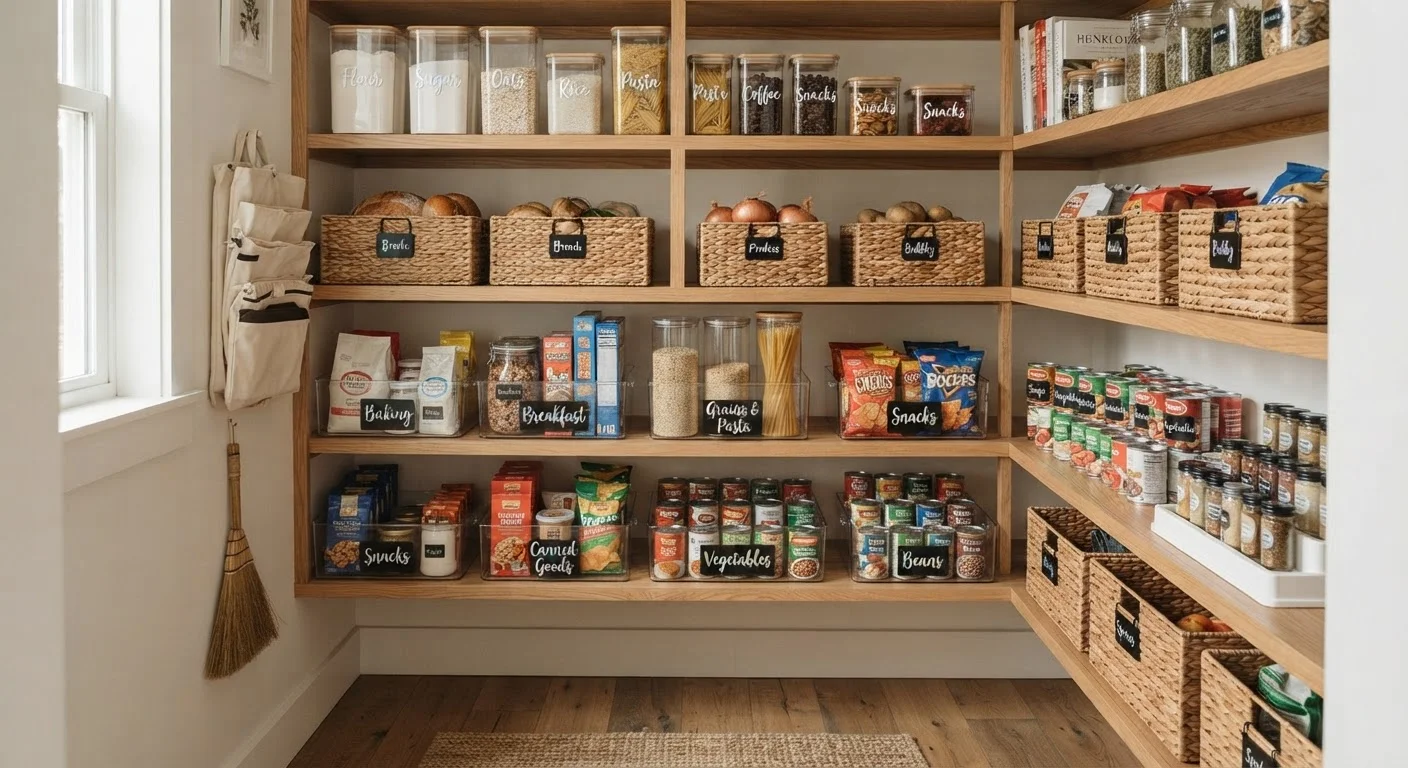
The process of transferring items from their original store packaging into a uniform, often clear container. Commonly used in pantries to make contents visible and to create a consistent look across shelves.
Zone
A designated area within a room assigned to a specific category of items or activity - for example, a "morning routine zone" by the entryway holding keys, bags, and mail. Zoning reduces decision fatigue by establishing predictable homes for things.
One-in, one-out rule
A maintenance principle: when a new item enters a category, one existing item must leave. It is widely recommended as a strategy for keeping storage from re-filling over time.
Negative space
Intentional empty space left in a drawer, shelf, or container to allow for growth and to reduce visual clutter. Systems that leave no room are usually the first to break down.
Containerizing
The act of placing loose, related items into a single container to create a defined boundary. Containerizing prevents categories from spreading beyond their intended area.
Visibility principle
The idea that items are used more consistently when they are easy to see. Organizing systems designed around this principle tend to favor clear containers, open shelving, or low-lid storage.
Prime real estate
Storage locations that are most accessible - roughly between knee and shoulder height, or at the front of a shelf. Items used most often should occupy prime real estate to reduce friction.
Like-with-like
The foundational sorting rule of most organizing systems: group items of the same type together before assigning a storage location. It prevents duplicates from hiding across multiple spots.
When professionals talk about making a home easier to maintain, most of these terms appear within the first few minutes of a consultation. They represent repeatable, transferable concepts - not brand-specific advice.
Labeling: More Than a Sticker
Labeling is often the finishing step in an organization project, but it does real functional work. A well-labeled system communicates to every household member - including guests and children - where things belong without any guesswork.
There are several labeling approaches in common use:
- Text labels: The most universal option; clear wording like "SNACKS" or "BATTERIES" removes ambiguity.
- Icon or picture labels: Especially useful in children's spaces, where a drawn image of blocks reinforces the word.
- Color-coded labels: Each household member or category gets a specific color; useful in shared spaces like medicine cabinets or mudrooms.
- Chalkboard labels: Reusable surface labels that can be wiped and rewritten as contents change - a good choice for seasonal or rotating categories.
Consistency matters more than aesthetics. A label that's easy to read and correctly placed on the right container will outlast a beautiful system that no one updates. See our related article on organizing shared spaces where people have different standards for how labeling can reduce household friction.
Bins, Baskets, and Containers: Choosing the Right Vessel
Not all containers serve the same purpose. The terms below are often used interchangeably in casual speech, but they describe meaningfully different objects in organizing contexts.
- Bin: Typically a rigid, open-top container - often plastic - used for grouping loose items. Bins work well in pantries, under sinks, and in garages where durability matters more than aesthetics.
- Basket: Usually woven (natural or synthetic), with softer visual weight. Baskets are common in living rooms, bathrooms, and bedrooms where the goal is to contain clutter while blending with décor.
- Drawer insert / divider: A rigid grid placed inside a drawer to separate small items. Common in kitchen junk drawers and bathroom vanities.
- Decant container: Any vessel used specifically for decanting - transferring contents from original packaging into a uniform, label-ready container.
- Pull-out tray: A shallow container designed to slide out from a shelf or cabinet, making items at the back accessible without reaching.
Matching your container type to the space's traffic level and visibility is a practical first step. High-traffic utility areas favor durability; visible living spaces often benefit from a more cohesive look. The choice between vertical and horizontal storage approaches will also influence which container shapes work best in a given spot.
Container Sizing: Measure Before You Buy
One of the most common organizing mistakes is purchasing containers before measuring the intended space. Even a small mismatch in depth or height can prevent a drawer insert from closing or a bin from fitting a shelf. Always note width, depth, and height - and account for any shelf lips or door clearances - before selecting containers.