

Key Takeaways
- Fixed expenses are predictable and repeat at the same amount each period, making them easier to plan around.
- Variable expenses change based on your behavior, making them the most flexible part of your budget to adjust.
- Knowing which category each expense falls into helps you spot where you actually have control over your spending.
- Semi-variable expenses - like utilities - have both fixed and variable components worth tracking separately.
- Reducing fixed expenses usually requires a major decision; cutting variable expenses can happen immediately.
Fixed vs. Variable Expenses
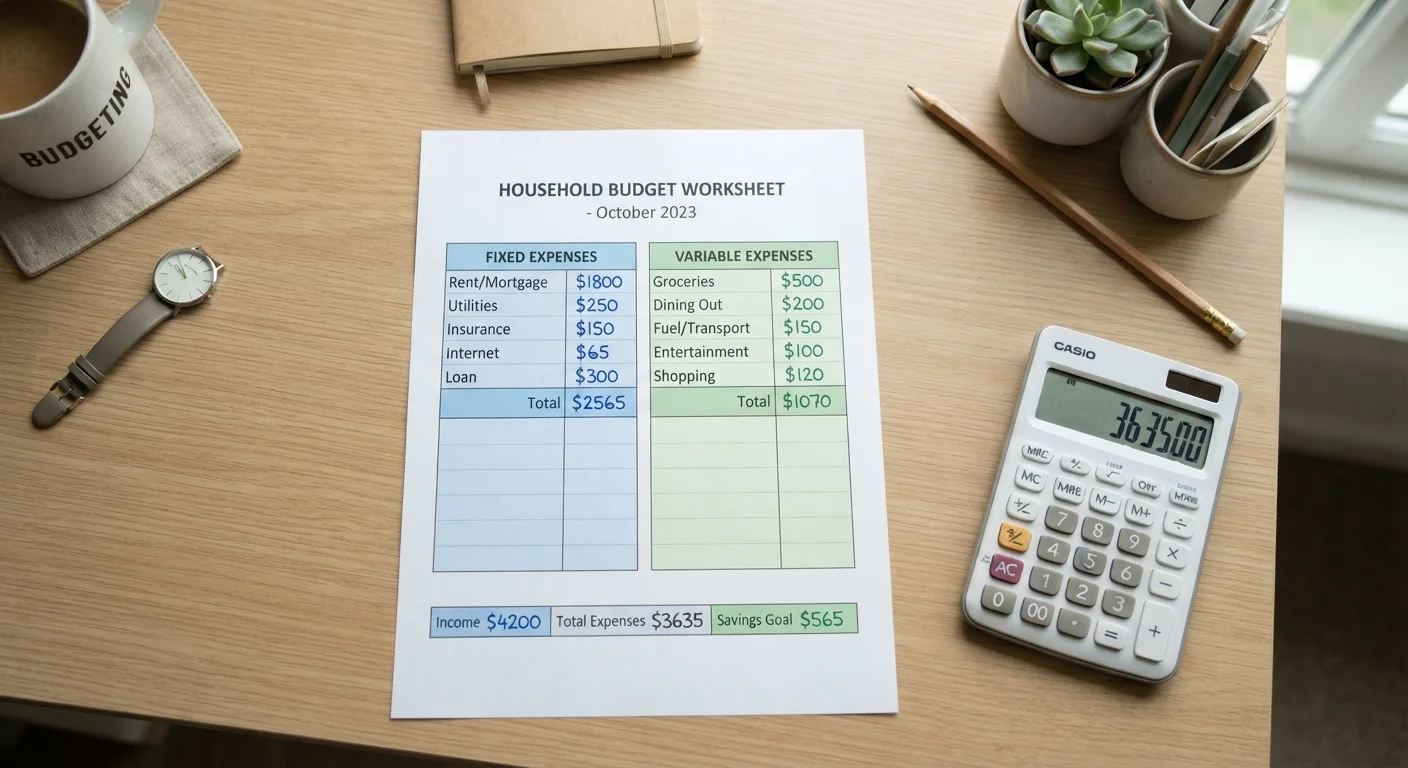
Fixed expenses are costs that stay the same amount every billing period - like rent or a car loan payment. Variable expenses fluctuate month to month based on usage or behavior - like groceries, gas, or dining out. Together, they make up most of your spending, but they require very different planning strategies.
In accounting, a third category - semi-variable or mixed expenses - contains both a fixed base charge and a usage-based component (e.g., a utility bill with a flat service fee plus consumption charges).
What Makes an Expense Fixed or Variable?
Every dollar leaving your account each month falls into one of two fundamental categories - and understanding which is which is a foundational budgeting skill. For a deeper glossary of terms like these, see our personal finance terms reference.
Fixed expenses arrive at the same amount, on the same schedule, regardless of what you do that month. Your rent or mortgage, car loan, student loan payment, and most insurance premiums fall here. Once you sign the agreement, the number is set until you actively change it.
Variable expenses depend on your behavior and usage. Your grocery bill, gas, dining, clothing, and entertainment spending all shift based on choices you make during the month. They are harder to predict precisely - but that unpredictability is actually a feature, because it means you have real-time control over them.
How to Quickly Sort Your Expenses
Pull your last three months of bank and credit card statements. Highlight every line item that appeared at exactly the same amount each time - those are your fixed costs. Everything else is variable or semi-variable. This simple exercise gives you a realistic picture of your actual spending baseline before you build any budget framework.
A practical way to sort your expenses: pull your last three months of bank and credit card statements. Highlight every line item that was the same amount each time - those are your fixed costs. Everything else is variable (or semi-variable).
Why the Distinction Matters for Your Budget
Mixing up fixed and variable expenses leads to one of the most common budgeting mistakes: trying to cut spending in the wrong places. When money is tight, many people default to squeezing variable categories - skipping coffee or eating out less - while ignoring large, locked-in fixed costs that may be doing far more damage.
~33%
Of average US household spending on housing alone
According to the U.S. Bureau of Labor Statistics Consumer Expenditure Survey, housing consistently represents the single largest fixed expense category for American households.
60%+
Of Americans living paycheck to paycheck at some point
Various surveys from financial research organizations have found that a majority of U.S. adults report difficulty covering an unexpected expense, often because fixed costs consume most of their income.
The distinction also shapes your strategy when income changes. If you lose a client, face a pay cut, or move to a single income, your variable expenses can be trimmed quickly. Your fixed expenses, on the other hand, require action - negotiating, refinancing, or restructuring - to reduce. Understanding this difference is especially relevant for households navigating tighter margins, as explored in our guide to budgeting on one income.
When building a budget framework - whether you follow the 50/30/20 rule or zero-based budgeting - knowing your fixed total first gives you a realistic baseline before you allocate anything else.
A Closer Look at Semi-Variable Expenses
Not every expense fits neatly into one box. Semi-variable expenses - sometimes called mixed costs - contain both a fixed component and a variable one. Utilities are the clearest example: your electric bill includes a flat service charge each month plus a consumption-based charge that reflects how much energy you actually used.
Phone plans, streaming bundles with data overages, and gym memberships with per-class fees can all behave this way. For budgeting purposes, it helps to estimate the fixed floor (the minimum you will always pay) and then track the variable portion separately so you know what behavior is driving the total.
Use a Sinking Fund for Irregular Bills
Irregular expenses - like annual car registration, holiday gifts, or seasonal insurance payments - can feel unpredictable but are actually predictable in total. A sinking fund strategy divides those known annual costs by 12 and sets aside that amount each month, so the bill never catches you off guard. Learn more in our guide to the sinking fund approach.
Irregular expenses - like annual car registration, holiday gifts, or seasonal insurance payments - can feel unpredictable but are actually predictable in total. A sinking fund strategy divides those known annual costs by 12 and sets aside that amount each month, so the bill never catches you off guard.
Putting It Into Practice
Start by listing every expense you paid in the last two to three months and labeling it fixed, variable, or semi-variable. Add up your fixed obligations first - this is your non-negotiable monthly floor. Subtract that number from your take-home income, and what remains is the pool available for variable spending, savings, and debt payoff.
From there, set category limits for your variable expenses based on past patterns and current goals. Variable categories are where deliberate choices compound quickly: cooking at home more often, reducing impulse purchases, or comparison shopping for recurring services. Car ownership costs, for instance, involve a mix of fixed loan payments and highly variable fuel and maintenance costs - understanding that split helps you find where the real flexibility lies. See our car ownership hub for more on managing those costs.
If you are new to tracking your spending at all, our first-time budgeting guide walks through the concrete first steps. And if you are working toward larger financial goals, pairing a clear expense framework with a plan for saving and paying down debt gives your budget real purpose beyond just tracking numbers.
This article is for general informational and educational purposes only and does not constitute personalized financial advice. Consult a qualified financial professional for guidance specific to your situation.