

Key Takeaways
- Compound interest earns returns on previous returns, not just the original principal.
- Starting early dramatically increases the final balance - time is the most powerful variable.
- Compounding works in reverse on debt, making balances grow faster the longer they go unpaid.
- Even small, consistent contributions benefit enormously from long compounding periods.
- Investment fees also compound over time, quietly reducing long-run returns.
Compound Interest
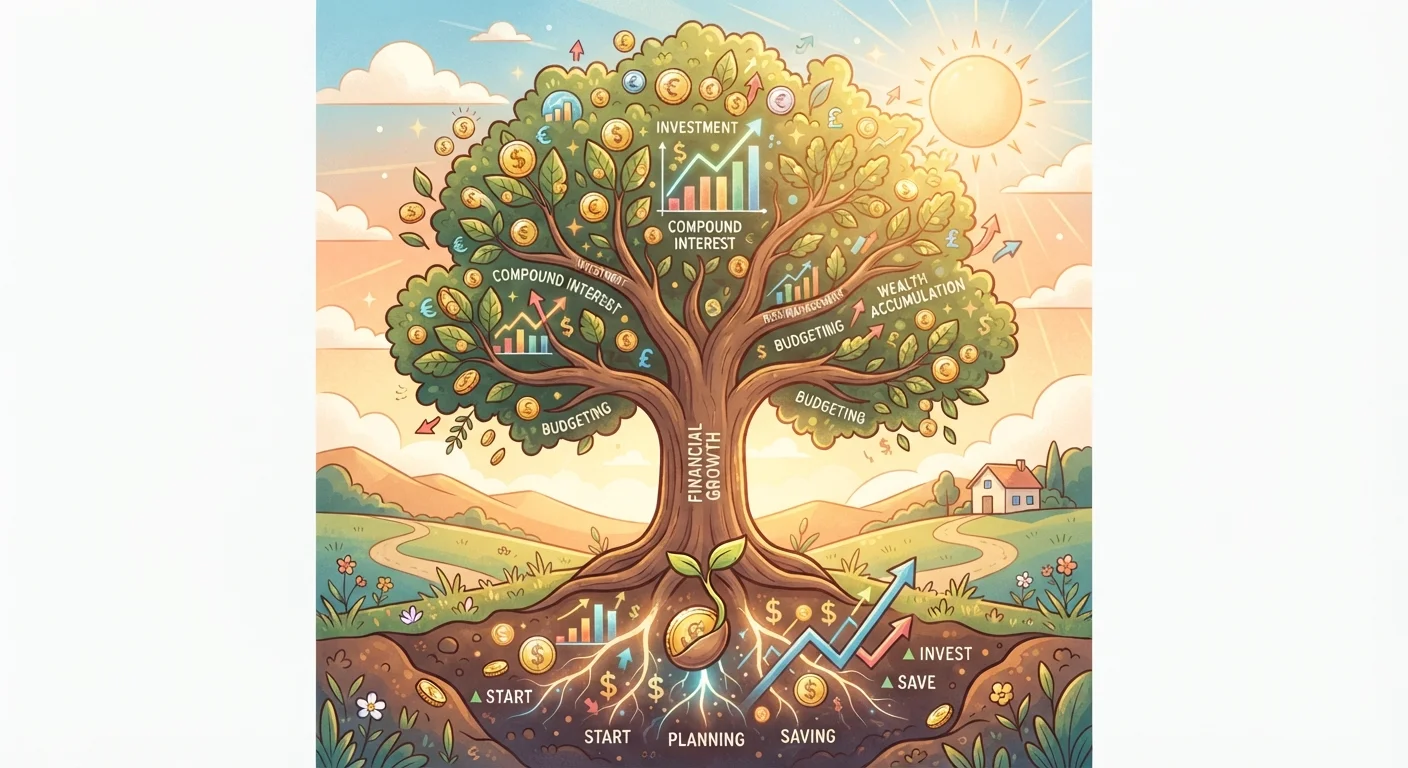
Compound interest is interest calculated not just on the money you originally put in, but also on the interest you've already earned. Over time, this creates a snowball effect: your earnings generate their own earnings, and the total grows faster and faster. It's sometimes called "interest on interest," and it's the core engine behind long-term wealth building.
The compounding frequency - daily, monthly, or annually - affects the rate at which interest accumulates. More frequent compounding periods produce slightly higher effective returns for the same stated annual rate, a figure sometimes expressed as the Annual Percentage Yield (APY).
The Basic Mechanic: Why Interest on Interest Changes Everything
Imagine you deposit $5,000 into an account earning 6% annually. In year one, you earn $300 in interest, bringing your total to $5,300. In year two, you earn 6% on $5,300 - not the original $5,000 - adding $318. By year three, the base is $5,618, so the interest earned is slightly higher again.
This is the compounding mechanic: each period's interest becomes part of the principal for the next period. The amounts seem modest at first, but the curve steepens noticeably over decades. After 30 years at that same 6% rate, with no additional contributions, the original $5,000 grows to roughly $28,717. That's more than five times the starting amount - from a single deposit, never touched.
The key insight is that time does the heavy lifting. The longer money compounds uninterrupted, the more dramatic the growth. This is why financial educators consistently emphasize starting early, even with small amounts.
Use the Rule of 72 for Quick Estimates
Divide 72 by your expected annual return rate to get a rough estimate of how many years it will take your money to double. At a 6% average annual return, that's about 12 years. At 8%, roughly 9 years. It's a useful mental shortcut for setting realistic long-term expectations without a calculator.
Why Starting Early Outweighs Starting Big
Consider two hypothetical investors. The first begins investing at age 25 and contributes $200 per month for 15 years, then stops entirely at age 40. The second waits until age 40 and contributes $200 per month for 25 years, stopping at age 65. Assuming the same average annual return for both, the first investor - who contributed for far fewer years - often ends up with a comparable or larger balance at retirement simply because of earlier compounding.
This is one of the most counterintuitive realities in personal finance, and it illustrates why the timing of contributions matters as much as the amount. Dollars invested in your 20s have decades to compound; dollars invested in your 50s have far less runway.
5x+
Growth of a single $5,000 deposit at 6% over 30 years
Illustrative example based on standard compound interest calculation with no additional contributions, compounded annually.
72
The Rule: divide by your rate to find doubling time
The Rule of 72 is a widely taught approximation used in financial education to estimate how long an investment takes to double at a given rate.
~10 yrs
Approximate doubling time at a 7% annual return
Based on the Rule of 72 (72 ÷ 7 ≈ 10.3 years), a common benchmark return referenced in long-term retirement planning discussions.
This is also why understanding core investing terms early - things like rate of return, principal, and reinvestment - helps you make more informed decisions before habits are set.
Where Compound Growth Appears - and Where It Works Against You
Compounding shows up in more places than most people realize. Tax-advantaged retirement accounts, regular brokerage accounts with reinvested dividends, and high-yield savings accounts all benefit from it. High-yield savings accounts, for instance, use compounding to grow emergency fund balances faster than traditional savings accounts - though the effect is most meaningful over longer time horizons.
The same force works against you on the liability side. Credit card debt, personal loans with high interest rates, and unpaid medical bills can compound just as aggressively. Understanding both sides of compounding is essential for anyone managing debt and savings simultaneously. A balance that goes unpaid grows faster than most people intuitively expect - which is why financial guidance consistently recommends paying high-interest debt before aggressively investing.
Compounding Frequency Matters - But Less Than You'd Think
Daily compounding does produce slightly more than monthly or annual compounding at the same stated rate. However, for most long-term investing scenarios, the difference in compounding frequency is far less significant than the rate of return itself and the length of time invested. Focus more on consistent contributions and time horizon than on optimizing compounding frequency.
It's also worth noting that fees compound too - only in the opposite direction. A fund with a 1% annual fee versus a 0.1% fee doesn't sound like much, but over 30 years, that difference quietly erodes a meaningful portion of total returns. See how investment fees compound in reverse for a fuller picture.
Putting Compounding to Work: Practical Steps
Understanding the concept is one thing; building habits around it is another. A few principles apply broadly:
- Start with whatever you have. Waiting for a larger sum to invest delays the compounding clock. Smaller amounts started earlier often outperform larger amounts started later.
- Reinvest earnings. In investment accounts, this usually means opting in to dividend reinvestment. In savings accounts, leaving interest in the account rather than withdrawing it maintains the compounding base.
- Minimize interruptions. Withdrawing funds resets the base and loses compounding momentum. Treating long-term accounts as untouchable - except in genuine emergencies - preserves growth potential.
- Account for inflation. Compounding nominal returns is only part of the picture. Inflation erodes purchasing power of idle cash over time, which is one reason keeping all savings in low-yield accounts carries its own risk.
“Compound interest is the eighth wonder of the world. He who understands it, earns it; he who doesn't, pays it.”
— Widely attributed to Albert Einstein, This quote, though its precise origin is debated by historians, has become a widely cited expression in financial education circles.
This article provides general financial education and is not personalized investment advice. For decisions specific to your financial situation, consider consulting a qualified financial professional.