

Key Takeaways
- Compound interest accelerates growth in savings by earning returns on previously earned interest.
- The same mechanism works against you on debt, making balances grow faster the longer you carry them.
- Starting to save earlier magnifies the compounding effect significantly over time.
- High-interest debt - like credit cards - typically compounds faster than most savings accounts grow.
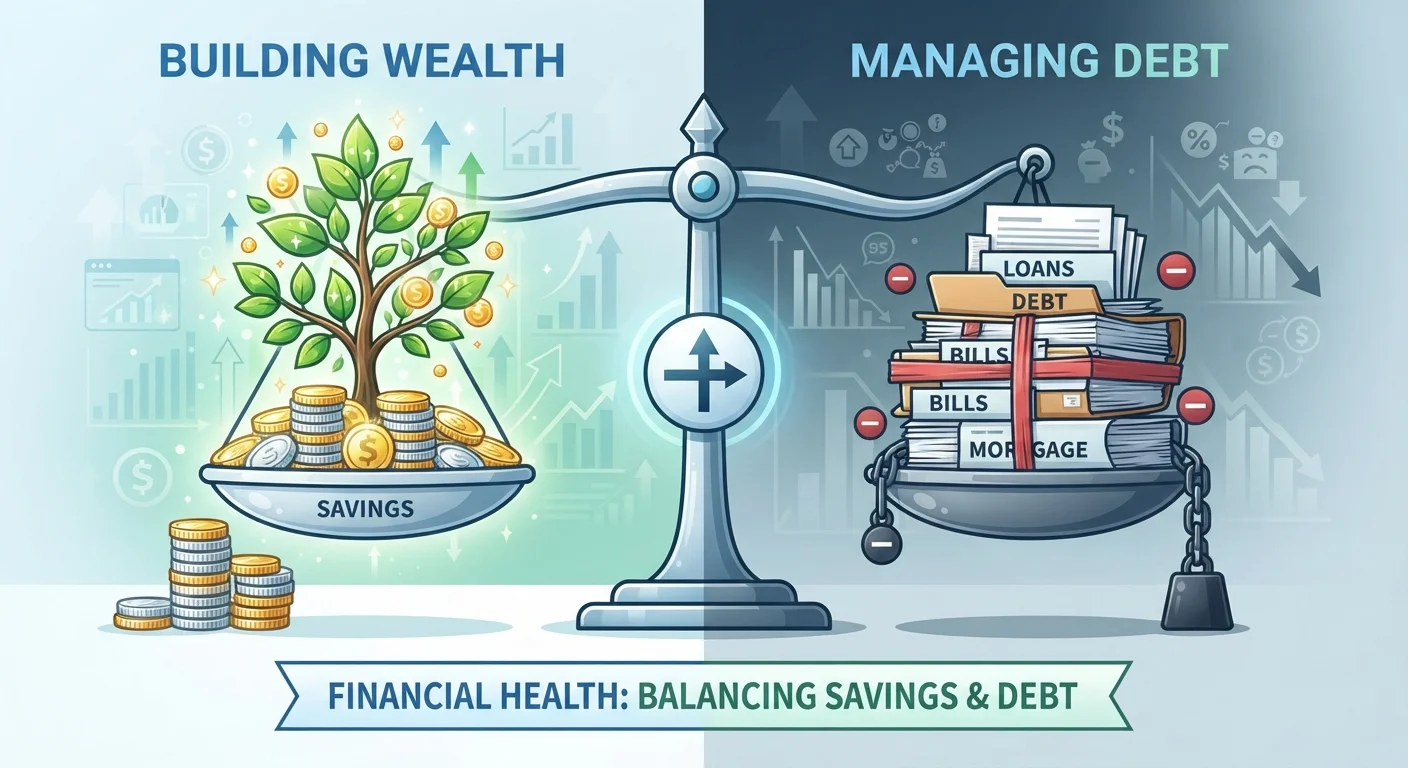
- Understanding compounding on both sides helps you prioritize where your money should flow.
Compound Interest
Compound interest is interest calculated not just on the money you originally deposited or borrowed, but also on the interest that has already accumulated. Over time, this creates a snowball effect where the total grows faster and faster. It applies to both savings accounts and debts, meaning it can either multiply your wealth or inflate what you owe.
The compounding frequency - daily, monthly, or annually - affects the total amount accumulated. More frequent compounding results in slightly higher totals due to the Annual Percentage Yield (APY) exceeding the stated Annual Percentage Rate (APR).
The Core Mechanic: Interest on Interest
At its simplest, compound interest means you earn (or owe) interest on a growing base - not just on what you started with. Each time interest is added to your balance, that new, larger balance becomes the starting point for the next calculation.
Consider a straightforward example: if you deposit $1,000 at a 5% annual rate, you earn $50 in year one. In year two, your 5% applies to $1,050 - so you earn $52.50. The amounts seem small at first, but over decades, this acceleration becomes dramatic. This is why compounding is often described as exponential rather than linear growth.
The formula behind it - A = P(1 + r/n)^(nt) - reflects four variables: principal (P), annual interest rate (r), compounding frequency (n), and time (t). Time is the most powerful lever available to most people. For a plain-language breakdown of what this looks like in practice over decades, see what compound interest actually does to your money over time.
72
Years to double money (Rule of 72 at 6%)
The Rule of 72 estimates doubling time by dividing 72 by the annual interest rate - a widely used approximation in financial education.
~20%+
Average credit card APR in recent years
According to Federal Reserve data, average credit card interest rates have remained above 20% APR in recent reporting periods, illustrating how quickly compound interest can expand balances.
10x+
Potential growth difference over 40 years vs. 20 years
Compounding over a longer timeline can produce dramatically different outcomes; financial educators frequently illustrate how starting two decades earlier can result in multiples more wealth at retirement.
When Compounding Works For You
In savings and investment accounts, compound interest is one of the most reliable forces available to everyday investors. The key ingredient is time - the earlier you start, the longer compounding has to work.
A person who begins contributing to a retirement account in their mid-20s will typically accumulate significantly more wealth than someone who starts in their late 30s, even if the late starter contributes more money overall. The gap isn't about discipline - it's about how many compounding cycles each dollar experiences.
High-yield savings accounts, certificates of deposit (CDs), and tax-advantaged accounts like 401(k)s and IRAs all use compounding to grow balances. The annual percentage yield (APY) reflects actual earnings after compounding is factored in, which is why APY is more useful than a stated interest rate when comparing savings products.
Automate to Maximize Compounding
Setting up automatic contributions to a savings or retirement account - even small ones - keeps compounding working continuously without requiring willpower each month. Regular contributions also mean more frequent additions to the base on which interest is calculated, accelerating long-term growth.
It's also worth noting that compounding doesn't solve every challenge. If your savings rate lags inflation, your purchasing power can decline even as your nominal balance rises. Inflation's effect on money that sits still explains this dynamic in detail.
When Compounding Works Against You
The same mechanism that quietly grows savings can just as quietly expand debt. Credit cards are a common example: most carry high APRs and compound interest daily. If you carry a $3,000 balance at 22% APR and make only minimum payments, the interest compounds on an ever-growing balance - making it genuinely difficult to reduce the principal.
This is one reason why Americans can inadvertently grow their debt without spending a single extra dollar. Missing a payment, paying only the minimum, or carrying balances month to month all allow compounding to deepen the hole.
Student loans, personal loans, and auto loans may also carry compound interest depending on their terms. Reviewing your loan agreement or asking your lender whether interest compounds - and how frequently - is an important step before committing to any payoff strategy.
Using This Knowledge to Make Better Decisions
Understanding both sides of compound interest leads to a practical framework: pay down high-interest debt aggressively while simultaneously making it possible for savings to compound over time. These goals aren't always in conflict, but they do require prioritization.
A common approach is to maintain a small emergency fund first - enough to cover immediate unexpected expenses - before redirecting extra cash toward high-interest debt payoff. Once high-rate debt is eliminated, redirecting those same payments into savings accelerates the positive side of compounding. Deciding between an emergency fund and debt payoff covers how to weigh these trade-offs based on your interest rates and income stability.
For those managing multiple debts, two well-known strategies - the avalanche (highest interest first) and the snowball (smallest balance first) - each interact with compounding differently. The debt avalanche vs. debt snowball comparison breaks down which approach minimizes total interest paid versus which builds psychological momentum fastest.
“Compound interest is the eighth wonder of the world. He who understands it, earns it; he who doesn't, pays it.”
— Widely attributed to Albert Einstein, This quote - frequently cited in financial education - captures the dual nature of compounding regardless of its precise origin.
This article is for general informational and educational purposes only and does not constitute personalized financial, investment, or tax advice. Consult a qualified financial professional for guidance specific to your situation.