

Key Takeaways
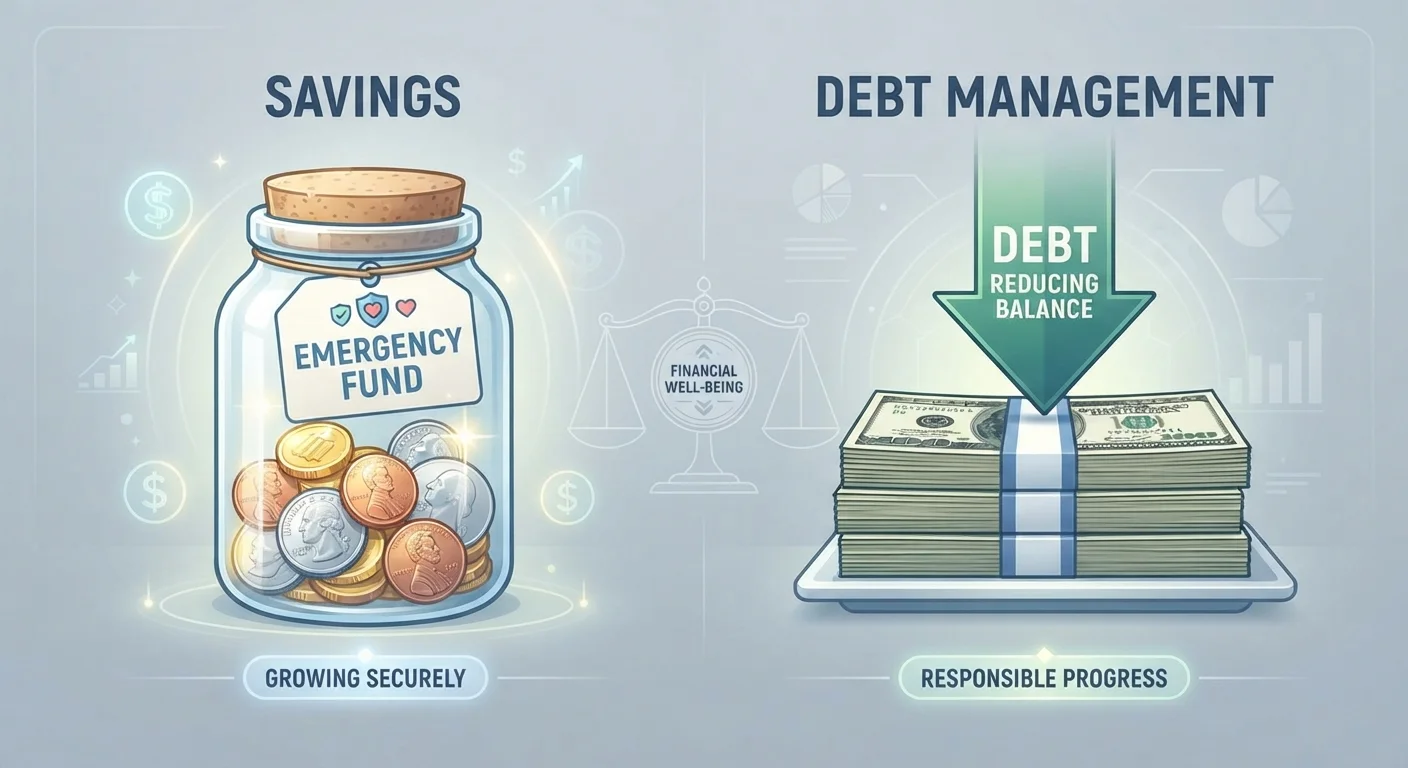
- High-interest debt (above 7-8%) often costs more over time than a savings account earns.
- A small starter emergency fund of $500-$1,000 is widely recommended before aggressively paying down debt.
- Income stability and job security are key factors in deciding how large your emergency fund should be.
- A hybrid approach - splitting extra dollars between saving and debt payoff - is suitable for many households.
- Neither path is universally correct; your personal risk tolerance and financial situation drive the right order.
Option A
Emergency Fund First
The financial safety net that prevents new debt from forming.
Best for: Those with unstable income, no savings cushion, or high-risk employment situations.
Option B
Debt Payoff First
The interest-eliminating strategy that frees up long-term cash flow.
Best for: Those with stable income, at least a minimal cash buffer, and high-interest debt draining their budget.
If your income is unpredictable or you work in a volatile industry
Emergency Fund First
Without a cash cushion, an unexpected expense forces you back into debt, undoing any payoff progress. Prioritize at least one to two months of expenses before aggressively attacking balances.
If you carry high-interest credit card debt above 15% APR
Debt Payoff First
Debt at that rate compounds quickly and likely outpaces what a savings account returns, making aggressive repayment the mathematically stronger move once a minimal buffer exists.
If your debt is low-interest (student loans, car loans under 5%)
Emergency Fund First
At low rates, the cost of carrying debt is modest. Building a full emergency fund provides more financial resilience than marginally faster loan payoff.
If you have a stable job and a small existing savings buffer
Debt Payoff First
Stable income reduces your need for a large emergency reserve, so channeling extra funds toward high-cost debt accelerates your path to financial freedom.
If you feel anxious without any savings and struggle to stay motivated
Emergency Fund First
Behavioral factors matter. Having even a modest savings cushion reduces financial stress and helps you stay consistent with your overall money plan.
Why This Decision Is Harder Than It Looks
Most personal finance advice oversimplifies this choice: "Pay off debt first" or "Always have three months saved." The reality is that neither rule applies universally. The right answer depends on the type of debt you carry, how secure your income is, and how psychologically resilient you are when money is tight.
Think of it this way: an emergency fund and debt payoff serve different roles. Debt payoff reduces what you owe - and what you're charged - over time. An emergency fund prevents you from taking on new debt when life surprises you. Both matter. The question is sequencing. As part of any broader money plan, this decision sits at the intersection of your budgeting strategy and your debt management goals.
| Criterion | Emergency Fund First | Debt Payoff First |
|---|---|---|
| Primary benefit | Prevents new debt from emergencies | Reduces ongoing interest costs |
| Best income situation | Variable or unpredictable income | Stable, reliable paycheck |
| Debt type fit | Low-interest debt (under 5-6%) | High-interest debt (above 8-10%) |
| Financial risk | Carries debt longer; costs more interest | Exposed to cash gaps if emergency hits |
| Recommended starter threshold | $500-$1,000 minimum before pivoting | Minimum payments only until debt cleared |
| Behavioral advantage | Reduces anxiety; improves financial stability | Tangible progress motivates consistency |
The Case for Building Your Emergency Fund First
Without any savings, a car repair, medical bill, or job loss pushes most households straight onto a credit card. That means even disciplined debt payoff can unravel the moment life intervenes. This is why many financial educators recommend establishing a starter emergency fund - often cited as $500 to $1,000 - before putting extra dollars toward debt beyond minimum payments.
The argument strengthens if your income is irregular. Freelancers, gig workers, seasonal employees, and anyone in a cyclical industry face higher exposure to sudden income gaps. For them, a larger cushion - commonly described as three to six months of essential expenses - may justify carrying debt longer, even if it costs more in interest. You can learn how to start this process even on a tight budget with our guide to building an emergency fund from zero.
~57%
Americans unable to cover a $1,000 emergency with savings
According to Bankrate's annual emergency savings report, a majority of U.S. adults lack the cash reserves to absorb a common unexpected expense without borrowing.
20%+
Average credit card APR in the US
The Federal Reserve has reported average credit card interest rates exceeding 20% in recent years, making high-interest debt one of the costliest financial burdens for households.
3-6 months
Commonly recommended emergency fund size
Most mainstream financial guidance suggests covering three to six months of essential living expenses, though the right amount varies by income stability and household risk.
The Case for Paying Off Debt First
High-interest debt - particularly credit card balances carrying annual percentage rates (APRs) of 18-25% - compounds relentlessly. Every dollar sitting in a savings account earning 4-5% while you carry a 20% APR balance represents a net loss of roughly 15-16 cents per dollar per year. In purely mathematical terms, eliminating that debt delivers a guaranteed "return" equal to the interest rate you stop paying.
If you have stable employment, a predictable paycheck, and at least a small cash buffer already in place, the stronger financial move may be directing extra income toward debt elimination. Once that debt is gone, the monthly cash flow you recover can fund a full emergency reserve much faster. For a structured approach to choosing a repayment method, see how the debt avalanche and debt snowball methods compare.
The Hybrid Approach: Doing Both Simultaneously
For many households, a split strategy is the most practical path. Rather than choosing one goal exclusively, you allocate a portion of discretionary income to each - for example, directing 60% toward extra debt payments and 40% toward savings until you hit a target balance, then reversing the ratio.
This approach sacrifices some mathematical efficiency but offers meaningful protection. You're reducing debt costs while also building a buffer that prevents you from sliding backward. The sinking fund concept pairs well here - setting aside small, consistent amounts for predictable expenses keeps you from raiding your emergency fund or reaching for credit when irregular costs arise.
When Employer Benefits Change the Math
If your employer offers a 401(k) match, capturing that match before aggressively paying down low-interest debt is generally considered worthwhile - it's a guaranteed return that typically exceeds the cost of moderate-rate debt. However, high-interest credit card balances often warrant prioritization even over retirement contributions beyond the match. Consider consulting a financial adviser to model the trade-offs for your specific situation.
Once your debt is under control and your emergency fund is established, the natural next step is putting money to work. Our Investing Essentials hub covers the foundational concepts for growing wealth over time.
This article is for general informational and educational purposes only and does not constitute personalized financial advice. Consult a licensed financial professional for guidance tailored to your specific situation.