

Key Takeaways
- Indoor cats are at significant risk of boredom-related stress without intentional daily enrichment.
- Feline enrichment works best when it targets natural predatory, sensory, and social instincts.
- Small, consistent changes to the home environment can meaningfully reduce anxiety and destructive behavior.
- Rotating enrichment activities prevents habituation and keeps cats genuinely engaged over time.
- Puzzle feeders and foraging activities tap into a cat's hardwired hunting drive effectively.
Why Indoor Cats Need More Than Food and Shelter
Domestic cats retain the behavioral wiring of their wild ancestors — predatory drive, territorial awareness, acute sensory processing — even when they never set foot outside. For an indoor cat, that wiring has nowhere to go unless owners actively create outlets for it.
The consequences of chronic under-stimulation are well-documented in veterinary behavioral literature: overgrooming, aggression, repetitive vocalizations, inappropriate elimination, and weight gain from inactivity. These aren't personality quirks. They're symptoms. As the signs of feline stress can be subtle, many owners don't connect boredom to behavior until problems are entrenched.
The good news is that effective enrichment doesn't require expensive equipment or hours of daily effort. It requires understanding what cats are actually designed to do — and building a home environment that lets them do it.
Start With Observation, Not Equipment
Before purchasing any enrichment tools, spend a few days noting when your cat is most active, where it gravitates, and what behaviors it repeats. Cats that pace near windows have different unmet needs than cats that sleep excessively or over-groom. Matching enrichment to observed behavior patterns produces far better results than a generalized approach.
The strategies below are organized by the type of feline need they address. Working through them systematically gives you the clearest picture of gaps in your cat's current environment.
Puzzle Feeders and Foraging Opportunities
In the wild, cats spend a substantial portion of their waking hours in predatory activity — stalking, pouncing, and manipulating prey. Presenting all of a cat's daily calories in a static bowl eliminates this behavioral need entirely.
Puzzle feeders — bowls, mats, and interactive devices that require cats to manipulate food before eating — reintroduce cognitive effort into mealtimes. Research in applied animal behavior suggests that food-motivated cognitive tasks reduce frustration behaviors in confined animals. Start with low-difficulty designs and gradually increase complexity as your cat gains confidence. Scatter feeding on a snuffle mat or hiding small portions around the home in foraging spots achieves similar results at minimal cost.
Puzzle feeders reintroduce the cognitive effort that a static food bowl completely removes.
Vertical Space and Territorial Navigation
Cats are vertical animals. Access to height serves multiple behavioral functions: surveying territory, retreating from perceived threats, and exercising muscles used in climbing and jumping. A home without vertical options is, from a feline perspective, impoverished regardless of its floor space.
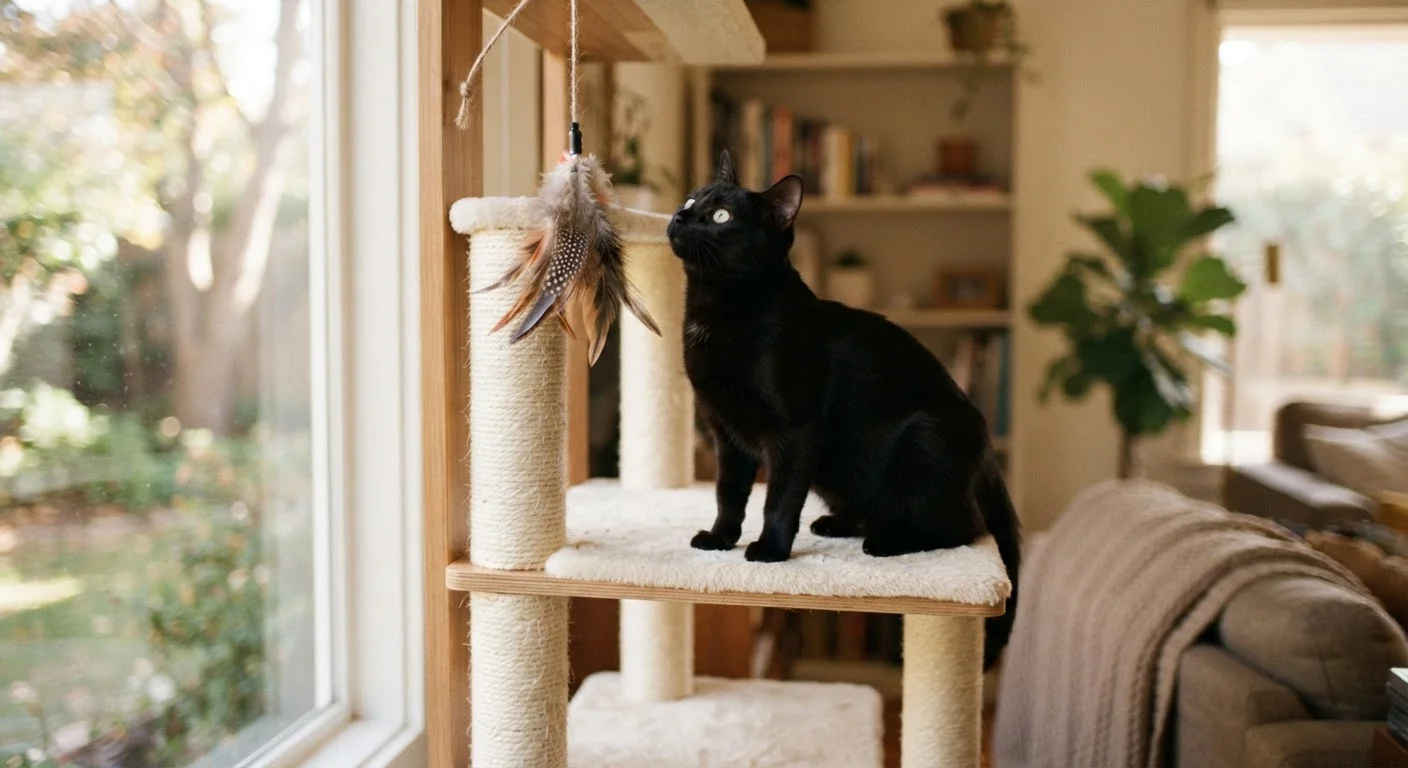
Cat trees, wall-mounted shelving systems, and window perches all create navigable vertical territory. Ideally, a cat should be able to move through multiple height levels without touching the floor — a concept sometimes called a cat superhighway. In multi-cat households, adequate vertical space is especially important because it gives lower-status cats escape routes and reduces conflict over resources.
A cat should ideally be able to travel through multiple height levels without ever touching the floor.
Interactive Play That Mimics the Hunt Sequence
Not all play is created equal. For cats, play is most satisfying — and most enriching — when it follows the natural predatory sequence: stalk, chase, pounce, grab, kill. Wand toys with feathers or soft attachments are particularly effective because they allow owners to simulate erratic prey movement.
Sessions of five to fifteen minutes, two or more times daily, are generally more effective than a single long session. Critically, allow the cat to "catch" the toy regularly — play that never results in a catch can increase frustration rather than relieve it. Ending a session with a small food reward completes the hunt-eat cycle and signals closure, which many behaviorists consider important for emotional satisfaction.
Always let your cat catch the toy — play that never ends in a catch can increase frustration.
Sensory Enrichment: Scent, Sound, and Sight
Cats process the world through senses far more acute than our own, yet most indoor environments offer very little sensory variety. Targeted sensory enrichment addresses this gap directly.
Scent: Dried catnip, silver vine, and valerian root each produce documented responses in a proportion of cats — though individual sensitivity varies genetically. Rotating novel scents (a pinecone, an herb bundle, fabric from a pet-supply store) provides olfactory novelty without overwhelming the cat. Sound: Species-specific audio — bird calls, rustling leaves, water sounds — can hold feline attention, particularly when a cat cannot see outside. Sight: A bird feeder placed just outside a window creates a live, ever-changing visual stimulus that many cats find deeply absorbing. This is sometimes called a cat TV setup, and its effectiveness is well-supported by behavioral observation.
A bird feeder just outside a window is one of the most consistently effective visual enrichment tools.
Training as Cognitive Enrichment
Many cat owners are surprised to learn that cats are highly trainable using positive reinforcement — clicker training in particular has a well-established evidence base in domestic cats. Training sessions engage working memory, build confidence, and strengthen the human-cat bond simultaneously.
Start with simple behaviors: sit, target (touching a finger or stick with the nose), or come when called. Keep sessions short — two to three minutes is often enough before a cat loses interest. The cognitive load of learning and performing behaviors is genuinely tiring for cats in the same way physical exercise is, making training an efficient enrichment tool for owners with limited time.
Two to three minutes of positive reinforcement training can be as cognitively tiring as a full play session.
Safe Outdoor Access: Catios and Leash Training
For cats that would benefit from outdoor exposure without the risks of free roaming, two well-established options exist. A catio — an enclosed outdoor enclosure — provides fresh air, natural sounds, and direct sensory contact with the outside environment while keeping the cat physically secure. Designs range from window-box attachments to large walk-in structures, and many owners build them with standard lumber and hardware cloth.
Leash and harness training is a viable alternative for cats that adapt to it, though it requires patience and a gradual acclimation process. Not all cats will accept a harness, and forcing the issue increases stress rather than reducing it. Assess your individual cat's temperament and introduce equipment slowly over days or weeks, using high-value treats as positive reinforcement.
A catio provides genuine outdoor sensory exposure while eliminating the safety risks of free roaming.
Rotating and Refreshing the Environment
Even well-designed enrichment environments lose their effectiveness over time as cats habituate to familiar stimuli. Novelty is itself a form of enrichment. A simple rotation strategy — swapping out toys weekly, rearranging furniture occasionally, introducing a new hiding spot or cardboard box — maintains environmental complexity without requiring ongoing expense.
Paper bags (handles removed for safety), cardboard boxes, and crinkle tunnels cost very little and typically generate strong exploratory interest. The key principle is that the environment should feel slightly different on a regular basis, prompting the cat to re-investigate territory it has already mapped. This mirrors the experience of an outdoor cat encountering changed scent markings or new objects in its range.
Rotating toys weekly costs nothing but consistently renews a cat's motivation to engage with its environment.
Building Enrichment Into Everyday Life
The most effective enrichment programs aren't elaborate — they're consistent. A cat that has reliable daily opportunities to hunt, climb, hide, and explore is far less likely to develop the stress-related behaviors that frustrate owners. For context on how the indoor lifestyle itself shapes these needs, our overview of indoor vs. outdoor cat trade-offs covers what the research shows about enrichment demands by lifestyle.
It's also worth noting that enrichment isn't one-size-fits-all. Senior cats, kittens, and cats with mobility limitations each need approaches scaled to their physical and cognitive capacity. If your cat seems persistently disengaged despite environmental changes, a consultation with a veterinary behaviorist can help identify whether anxiety or an underlying health issue is a factor.
Enrichment Parallels Across Species
The principles behind feline enrichment — foraging, sensory variety, social stimulation, and cognitive challenge — apply broadly across companion animals. If your household includes other pets, the same framework can guide their care.
Owners of other species navigating similar challenges may find useful parallels in enrichment strategies for pet birds, where foraging and sensory variety play equally central roles in preventing stress behaviors.
This article is for general informational and educational purposes only. For concerns about your cat's behavior or health, consult a licensed veterinarian or certified veterinary behaviorist.