

Key Takeaways
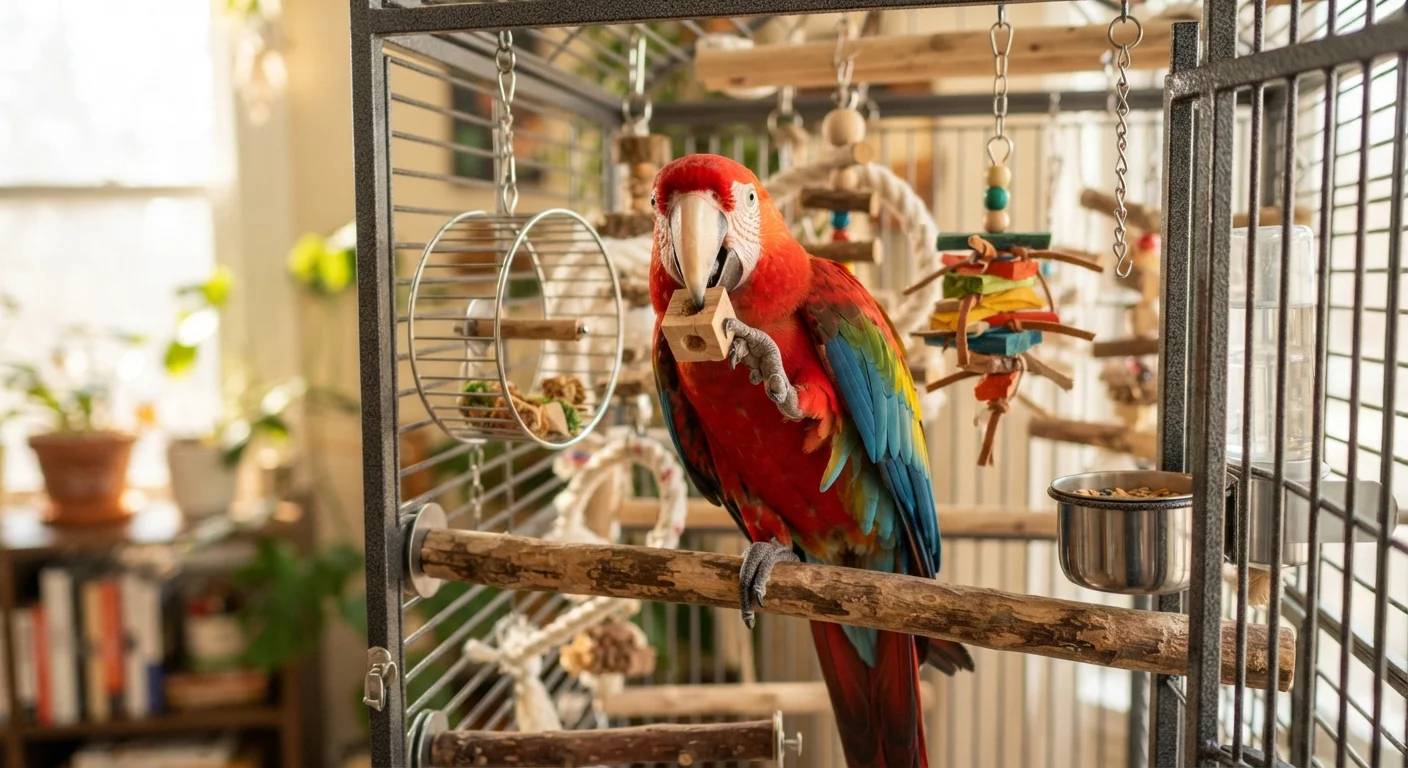
- Foraging activities tap into birds' natural instincts and reduce boredom-related behaviors like feather destructiveness.
- Perch variety — different diameters, textures, and materials — supports physical and cognitive stimulation simultaneously.
- Short, consistent training sessions using positive reinforcement build trust and provide reliable daily mental engagement.
- Social interaction and out-of-cage time are non-negotiable components of a psychologically healthy bird's routine.
- Rotating toys regularly prevents habituation, keeping novelty high without requiring constant new purchases.
- Recognizing stress signals early allows owners to adjust enrichment before destructive habits become entrenched.
Why Mental Enrichment Isn't Optional for Pet Birds
In the wild, parrots, parakeets, and other psittacines spend the majority of their waking hours foraging, navigating complex social hierarchies, solving spatial problems, and vocalizing. Captivity removes nearly all of those demands — and that cognitive vacancy has consequences. Feather-destructive behavior, excessive screaming, repetitive rocking, and aggression are commonly linked to under-stimulation rather than physical illness, according to avian veterinary literature.
Understanding what drives these behaviors is the first step toward addressing them. Our article on reading what your parrot or parakeet is telling you covers stress body language in depth — knowledge that pairs directly with an enrichment strategy. The goal isn't entertainment for its own sake; it's replicating enough of the cognitive demands birds evolved to meet so that captive life feels purposeful.
Foraging: The Single Most Impactful Enrichment Category
Wild parrots dedicate four to six hours daily to foraging. Delivering food in a bowl eliminates that work entirely, leaving a cognitively capable animal with nothing to solve. Foraging enrichment reintroduces that challenge in safe, manageable ways.
Introduce foraging at multiple difficulty levels, starting simple and increasing complexity gradually.
Birds that encounter foraging puzzles too difficult too soon become frustrated and disengage, potentially reinforcing avoidance rather than problem-solving. Scaffolded difficulty builds confidence and sustains participation over time.
Scatter-feed portions of the daily diet throughout the cage rather than concentrating food in one bowl.
Scatter feeding distributes food search across the enclosure, extending foraging time naturally without requiring additional equipment. It mimics the way food occurs in patches in a wild environment.
Provide at least three perch types with different diameters and textures in every enclosure.
Foot health and sensory engagement are interlinked. Varied perch surfaces exercise different muscle groups and give the bird textural information that keeps the nervous system actively processing its environment.
Conduct brief, daily training sessions using positive reinforcement to teach or maintain at least one behavior.
Regular training sessions create a reliable daily interaction that the bird anticipates, satisfying social bonding needs while building cognitive flexibility. Birds that receive consistent training are generally less reactive to environmental changes.
Rotate enrichment items on a weekly cycle rather than leaving the same toys in place indefinitely.
Novelty is a primary driver of exploratory behavior in birds. Consistent rotation resets interest and allows observation of which item categories — shredding, puzzle, sound-producing — consistently attract the most engagement.
Start by partially hiding food inside paper cups, crumpled paper, or cardboard tubes before graduating to commercial foraging toys with multiple compartments. The level of difficulty should match your bird's experience — a bird that has never foraged before needs easy wins first to build confidence. Common feeding myths for small pets are worth reviewing alongside foraging work, since diet variety itself is part of meaningful enrichment.
Perch Variety, Training, and Social Time
Perch monotony is an often-overlooked stressor. Uniform diameter dowel rods force the foot into the same position for hours, causing both physical fatigue and reduced sensory input. Offering perches of varying diameter, texture (rope, natural wood, cork), and orientation gives feet and minds more to navigate.
Training is equally valuable. Even five-minute daily sessions — teaching a bird to step up reliably, identify colors, or retrieve small objects — provide structured problem-solving that generalizes to calmer overall behavior. Use only positive reinforcement (offering a preferred food item or verbal praise immediately after the desired behavior). Punishment-based approaches cause fear and erode the trust that makes all other enrichment more effective.
Out-of-cage social time is the third pillar. Birds are flock animals; isolation, even in a well-equipped cage, does not meet their social needs. Supervised time outside the cage — whether perching near a family member or participating in household activity — fulfills the contact-seeking drive that enrichment toys alone cannot address. For context on how stress compounds in small pets broadly, see our guide on stressors small pet owners frequently overlook.
“Parrots are not domesticated animals — they are wild animals living in our homes. Meeting their behavioral needs requires us to think about what their brains were built to do, not just what is convenient for us to provide.”
— Susan Friedman, Behavior analyst and applied animal behavior educator, Utah State University
Rotating Novelty and Knowing When Enrichment Isn't Enough
Habituation — the gradual loss of interest in a stimulus — is real in birds. A toy that excited a cockatiel on Monday may be ignored by Friday. Rotation strategies (cycling three to four sets of toys in and out of the cage weekly) maintain novelty without requiring constant spending. Introduce new items outside the cage first; some birds are neophobic and need time to investigate from a distance before accepting an object in their territory.
When Feather Plucking Requires Veterinary Attention
Feather-destructive behavior has both psychological and medical causes — skin infections, nutritional deficiencies, and hormonal imbalances can all produce similar outward signs. Enrichment improvements are appropriate as a preventive and supportive measure, but a bird that is actively plucking should be evaluated by an avian veterinarian before assuming boredom is the sole driver. An accurate diagnosis ensures the correct intervention is applied.
Enrichment reduces the likelihood of feather-destructive behavior and excessive vocalization, but it is not a cure for established behavioral disorders or underlying medical causes. If a bird is already plucking or showing severe anxiety, a consultation with an avian veterinarian or a certified parrot behavior consultant is the appropriate starting point. Enrichment and professional support work together — one does not replace the other.
If you're evaluating whether bird ownership is right for you or want a fuller picture of the commitment involved, our honest assessment of bird ownership pros and cons lays out the full scope of enrichment demands alongside other key considerations.