

Key Takeaways
- Knocking objects off surfaces is rooted in predatory instinct, not defiance or spite.
- Cats use their paws as sensory organs to assess texture, weight, and movement.
- Elevated surfaces serve as natural vantage points that amplify a cat's environmental awareness.
- Attention-seeking can reinforce the behavior when owners react consistently.
- Enrichment and interactive play are the most effective tools for redirecting the habit.
- Frequent object batting may occasionally signal understimulation or stress.
Object Batting Behavior in Cats
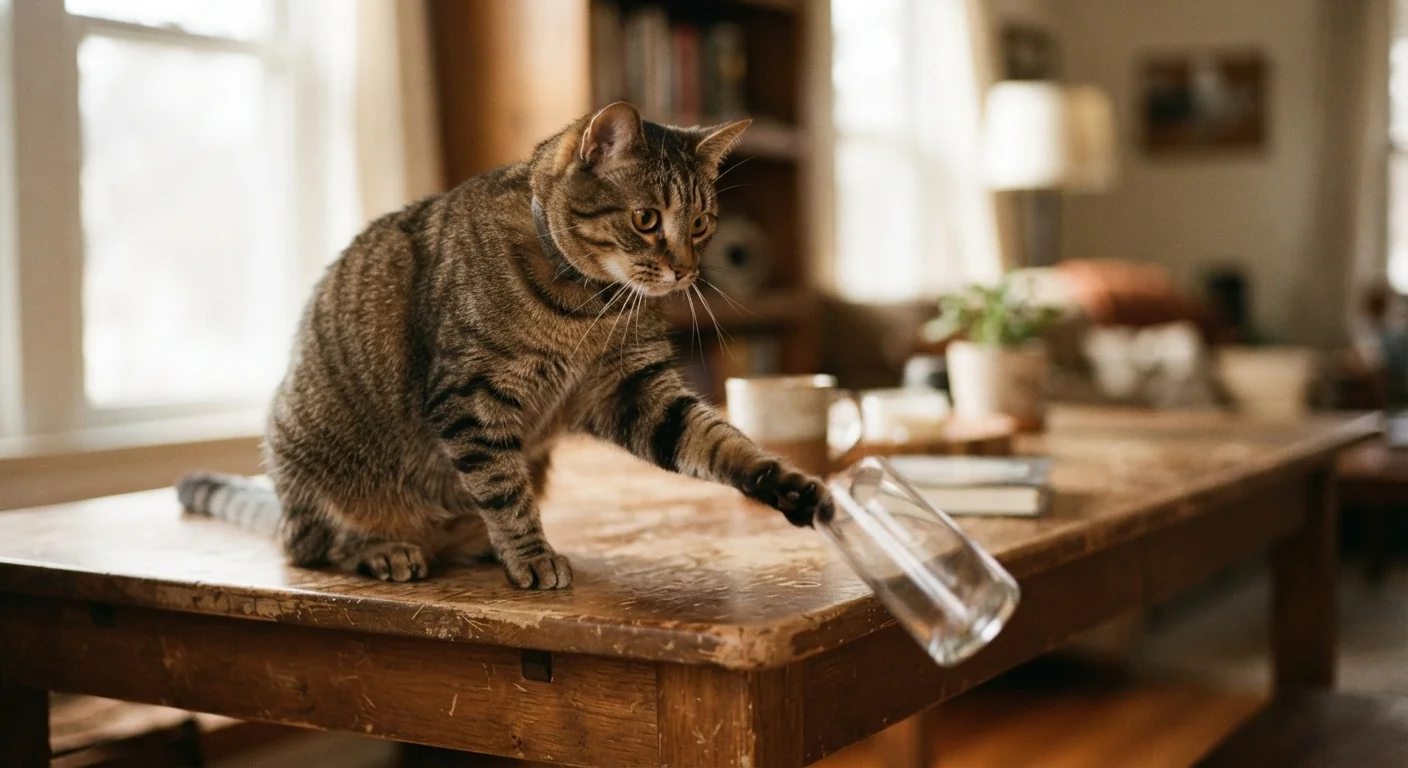
Object batting — the act of pushing, pawing, or knocking items off elevated surfaces — is a normal feline behavior driven by predatory instinct, sensory curiosity, and environmental investigation. Cats use their paws as precision sensory tools, and elevated surfaces give them a prime vantage point to do it. The behavior is not random; it reflects how cats gather information about their world and test for prey-like movement.
Cats possess touch receptors concentrated in their paw pads and claws, making pawing an active form of tactile exploration. This is distinct from attention-seeking behavior, though the two can overlap.
The Predator Behind the Swipe
Domestic cats share roughly 95% of their genome with tigers, and that ancestry shows up in everyday behaviors most owners chalk up to personality quirks. When a cat extends one deliberate paw toward a pen or a glass and sends it sailing off a countertop, it is enacting a sequence that is deeply conserved in feline biology: locate an object, test it for movement, and assess whether it represents prey or a threat.
In the wild, a small, ambiguous shape on a branch or rock could be a mouse, a lizard, or nothing at all. Pawing at it — from a safe angle — is how a cat gathers information before committing to a strike. The elevated surface matters too. Height gives cats a sweeping visual field, which is why tables, shelves, and refrigerators become preferred staging grounds. That vantage point is not coincidental; it mirrors the raised outcroppings and tree limbs that wild felids use to survey territory and spot movement below.
“Play behavior in cats is not frivolous — it is the expression of a sophisticated predatory system that requires regular activation to maintain behavioral health. When cats lack appropriate outlets, that system finds its own targets.”
— John Bradshaw, Anthrozoologist and author of 'Cat Sense,' University of Bristol
Paws as Sensory Instruments
A cat's paw pads are densely packed with mechanoreceptors — specialized nerve endings that detect pressure, texture, vibration, and temperature. When a cat prods an object before pushing it, it is running a tactile analysis that complements what its eyes and nose have already reported. The combination of senses helps a cat build a rapid model of the object: is it rigid or soft, hollow or solid, likely to skitter like a beetle or stay still like a stone?
This is why cats often appear to deliberately choose objects of a certain size and shape for batting — items that approximate the dimensions and weight of small prey are particularly engaging. A pencil rolls and skitters; a chunky book does not. The pencil wins every time.
Match Toys to the Predatory Sequence
For play to genuinely satisfy a cat's hunting drive, it should allow the full sequence: stalk, chase, pounce, and catch. Wand toys that mimic the erratic movement of prey are more effective than static objects. Ending each session with a small food treat mimics the 'kill and eat' conclusion, which can reduce post-play restlessness.
Understanding this sensory dimension can shift how owners interpret the behavior. It is less about destruction and more about information gathering — the same motivation that drives a cat to sniff a newcomer thoroughly or rub its face along unfamiliar furniture. For a deeper look at how cats communicate through body and movement, see Reading the Room: A Field Guide to Cat Body Language.
When Attention Enters the Equation
Instinct accounts for most object batting, but learning shapes how often it happens. Cats are observant animals that pick up on cause-and-effect patterns quickly. If a cat nudges a phone off a nightstand and its owner leaps up, makes eye contact, and retrieves the phone — that is a rich, predictable social response. From the cat's perspective, the behavior produced an outcome worth repeating.
Owners who react consistently — even with scolding — may inadvertently reinforce the behavior. Behavioral research on domestic cats supports the view that negative attention can be as reinforcing as positive attention for animals that have limited outlets for social engagement. This overlap between instinct and learned behavior is one reason the habit can seem so persistent.
The practical implication: avoiding dramatic reactions and ensuring the cat has other reliable ways to initiate interaction tends to reduce attention-driven batting over time. Enrichment strategies grounded in feline behavioral science offer a useful framework for addressing the underlying drive.
What the Habit Tells You About Your Cat's Needs
Frequent, escalating object batting — especially when paired with other restless behaviors like vocalizing at night or overgrooming — can be a signal that a cat's environment is not meeting its cognitive and physical needs. Indoor cats, in particular, may not receive sufficient outlets for predatory sequences: stalk, chase, pounce, catch. Without those outlets, displacement behaviors like batting and knocking tend to increase.
~60%
Estimated share of US cats living exclusively indoors
Figures from the American Pet Products Association suggest the majority of owned cats in the US are kept indoors full- or part-time, making deliberate enrichment especially important for behavioral health.
26 bones
Bones in each cat paw — enabling fine motor control
The skeletal complexity of a cat's forepaw gives it exceptional dexterity and precision, supporting the nuanced tactile exploration that underlies pawing behavior.
This connects directly to broader questions about indoor lifestyle and enrichment. Research on indoor versus outdoor cats consistently highlights that indoor environments require deliberate enrichment to support feline wellbeing. Puzzle feeders, wand toys used for structured play sessions, rotating novel objects, and vertical climbing structures are among the evidence-supported approaches to keeping predatory instincts appropriately engaged.
Object batting is ultimately a window into a cat's inner life — one that reveals an active, curious animal running behavioral programs refined over millions of years. Responding to it with enrichment rather than frustration tends to produce better outcomes for both species in the household.
This article provides general information about feline behavior and is not a substitute for personalized guidance from a licensed veterinarian or certified veterinary behaviorist.