

Key Takeaways
- A crate should always be introduced gradually using positive associations, never as punishment.
- Correct crate sizing — enough room to stand, turn, and lie down — is essential for comfort and housetraining.
- Most dogs need days to weeks of consistent conditioning before tolerating longer stays comfortably.
- Breed size, temperament, and life stage all influence how you adapt the crate training process.
- Puppies have limited bladder control; overnight crating requires realistic scheduling expectations.
What you will need
Why Crate Training Works — When Done Correctly
Dogs are den animals by instinct. In the wild, canids rest in enclosed, sheltered spaces that provide security. A properly introduced crate taps into this tendency — but only when the dog has been given the time and positive reinforcement to genuinely accept it. A crate that is introduced abruptly, used as punishment, or sized incorrectly produces the opposite effect: stress, resistance, and sometimes lasting behavioral fallout.
Crate training serves several practical purposes simultaneously. It supports housetraining by using a dog's reluctance to soil their sleeping space. It keeps puppies safe during unsupervised periods when chewing, ingestion hazards, and destructive exploration are genuine risks. And for many dogs, a well-conditioned crate becomes a voluntary retreat — a place they choose during thunderstorms, household chaos, or simply when they want to rest undisturbed.
Understanding why the method works makes it easier to troubleshoot when progress stalls. If your dog resists the crate, the answer is almost always to slow down, not push through. Consult our guide to positive reinforcement training if you want a deeper grounding in the behavioral science behind this approach.
What you will need
What You'll Need Before You Start
Appropriately Sized Crate
Provides the enclosed den space; must allow the dog to stand, turn around, and lie down fully without excess room that undermines housetraining.
Soft Crate Bedding or Mat
Adds comfort and helps the dog associate the crate with rest and relaxation.
High-Value Training Treats
Used to build positive associations at each stage of the introduction process.
Durable Chew Toy or Food Puzzle
Keeps the dog occupied and content during crate time, extending positive association independently.
Crate Cover or Blanket
Mimics a den environment by reducing visual stimulation; particularly helpful for anxious or easily distracted dogs.
Choose and Position the Crate
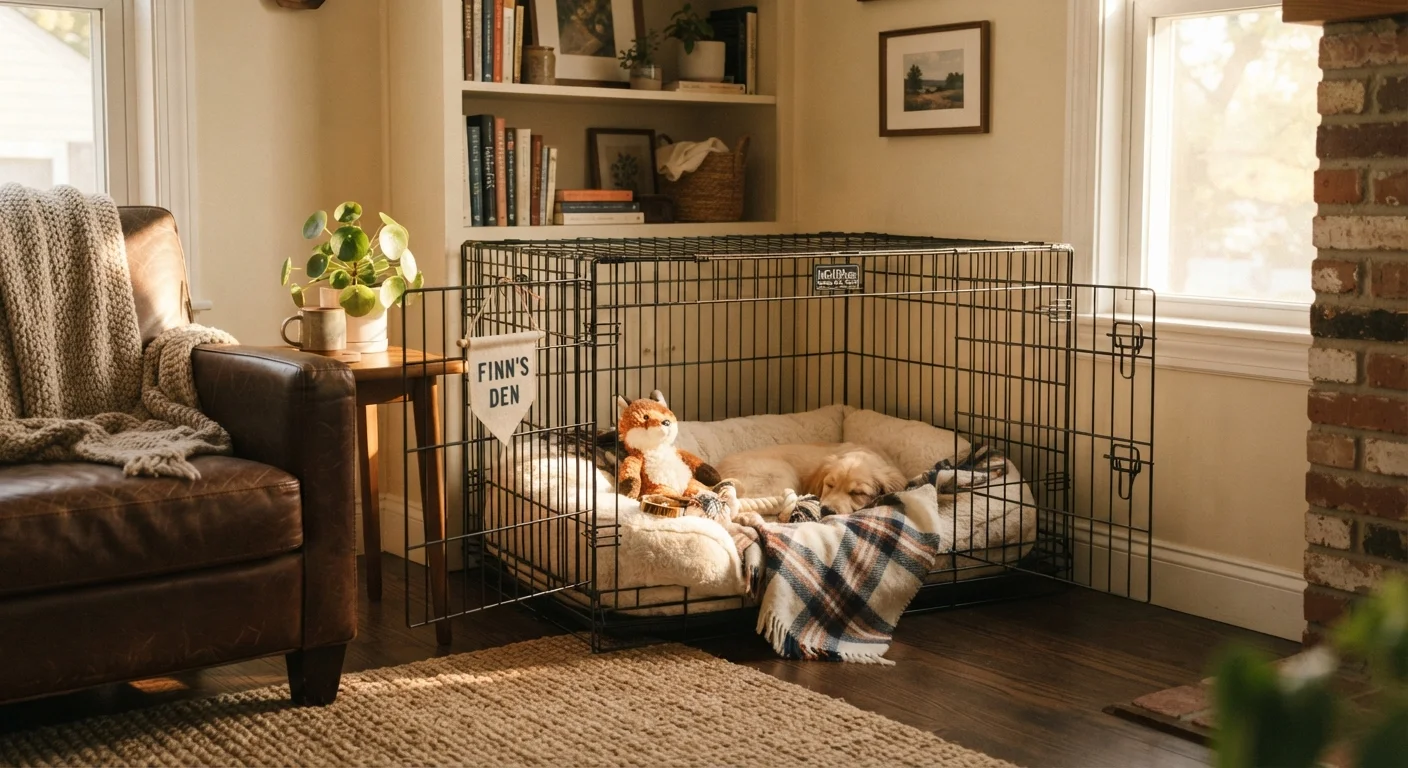
Select a crate large enough for your dog to stand fully upright, turn in a complete circle, and stretch out when lying down. For puppies, use a divider panel to limit interior space during housetraining — too much room allows a puppy to eliminate in one corner and sleep in another, which undermines the den instinct.
Place the crate in a living area where your family spends time, not in an isolated room. Dogs are social animals, and isolation amplifies anxiety. A corner of the living room or bedroom is ideal.
Introduce the Crate Without Any Pressure
Open the crate door and allow your dog to investigate freely at their own pace. Do not push, lure, or place your dog inside — simply let the crate exist as a neutral object in the environment. Toss a few treats near the crate entrance and let the dog retrieve them without expectation.
Repeat this several times over the first day. The goal is curiosity, not compliance.
Build Positive Associations at the Threshold
Once your dog approaches the crate comfortably, begin tossing treats just inside the entrance — not deep into the crate yet. Let the dog step in with their front paws, retrieve the treat, and exit freely. Repeat many times before progressing.
Add a verbal cue like "crate" or "bed" as your dog begins stepping in voluntarily. Mark the moment with a calm "yes" and reward. This reward-based conditioning is what transforms the crate from unfamiliar object to valued space.
Practice Closing the Door Briefly
Once your dog enters the crate fully and appears relaxed, gently close the door for just a few seconds, then open it before any sign of distress. Reward calm behavior immediately. Gradually extend the duration: ten seconds, thirty seconds, a minute, a few minutes.
Stay present during this phase — do not leave the room. Your proximity helps the dog stay calm while they acclimate to the closed door.
Extend Duration and Step Out of Sight
When your dog settles calmly for several minutes with the door closed, begin stepping briefly out of the room while they are inside. Return before any signs of distress. Gradually build to longer absences over multiple sessions across several days.
This is the phase where many owners stall — patience here pays off over the dog's lifetime. Dogs that are properly conditioned through this stage typically self-settle in their crates without prompting.
Establish a Consistent Crating Routine
Once your dog is comfortable, integrate crate time into daily life predictably: rest after meals, quiet time during household activity, or nighttime sleep. Consistency helps dogs understand crating as a normal part of the day rather than an unpredictable event.
For puppies and newly adopted dogs, this routine pairs naturally with housetraining schedules and the general orientation described in our first-dog preparation guide. As your dog matures and earns trust, you can gradually expand unsupervised freedom outside the crate.
Troubleshooting Common Crate Training Challenges
Even with the best technique, some dogs resist crating longer than expected. Here are the most common sticking points and how to address them:
- Whining or barking when left: This usually means the duration was extended too quickly. Return to shorter, successful intervals. Avoid returning to release the dog while they are actively vocalizing — wait for even a brief pause, then open the door and reward calm.
- Refusing to enter voluntarily: Go back to Step 2 and rebuild threshold comfort. Increase treat value and reduce any environmental pressure around the crate.
- Anxiety in previously crated dogs: Rescue dogs or dogs with unknown histories may have negative crate associations. Progress will be slower, and a veterinary behaviorist consultation may be worthwhile if stress signs are significant.
- Escaping or injuring themselves: Some dogs with genuine separation anxiety require professional support beyond crate training alone. This is outside the scope of general training guidance — consult a certified applied animal behaviorist or veterinary behaviorist.
Never Use the Crate as Punishment
Sending a dog to the crate after misbehavior undermines every positive association you are trying to build. If the crate becomes linked to frustration or isolation, dogs may develop anxiety, resistance, or destructive behavior inside it. Keep the crate exclusively associated with rest, calm, and reward.
Keep in mind that crate training is one layer of a broader developmental picture. If you have a young puppy, the socialization window overlaps with the crate training period — managing both thoughtfully during early puppyhood sets a strong behavioral foundation. And be aware of how your responses during training may inadvertently shape behavior; our piece on common reinforcement mistakes is a useful companion read.
Tailor the Pace to Your Dog
Larger, calmer breeds may progress through the steps quickly, while anxious dogs or those with past negative associations may need significantly more time at each phase. There is no fixed timeline — success is measured by your dog's body language, not the calendar. Watch for relaxed posture, voluntary entry, and settled breathing as signs you can move forward.
Time Limits Matter — Especially for Puppies
Puppies under six months generally cannot hold their bladder for more than a few hours. A common guideline is that puppies can wait approximately one hour per month of age, up to a reasonable maximum. Exceeding these limits forces accidents inside the crate, which can set back housetraining significantly. Adult dogs also should not be crated for excessive hours — crating is a management tool, not a substitute for exercise, interaction, and enrichment.