

Key Takeaways
- Hamsters are biologically wired to sleep during the day and be most active at night.
- Forcing a hamster awake during daylight hours causes measurable stress and can affect its health.
- Evening is the best time to feed, handle, and interact with a hamster.
- Enclosure placement, lighting conditions, and wheel access all need to accommodate a nocturnal schedule.
- Dwarf hamster species may show some activity at dusk and dawn, unlike the more strictly nocturnal Syrian hamster.
Nocturnal Behavior in Hamsters
Hamsters are nocturnal animals, meaning they are naturally programmed to sleep through most of the day and become active during the night. This is a hardwired biological trait inherited from wild ancestors that needed darkness to safely forage, travel, and explore while avoiding daytime predators. For pet hamsters, this cycle doesn't change simply because they live indoors.
Some hamster species, particularly dwarf varieties, show crepuscular tendencies — meaning peak activity around dusk and dawn — rather than strictly midnight-centered activity. Syrian hamsters tend to be more deeply nocturnal.
The Biology Behind the Night Shift
In the wild, hamsters originate from semi-arid regions of the Middle East and Central Asia where daytime temperatures are extreme and predator activity is high. Evolving as nocturnal foragers gave them a survival advantage: cooler temperatures, reduced predator visibility, and access to food sources without competing with diurnal species. This evolutionary history is encoded in their circadian rhythm — the internal biological clock that governs sleep, hormone release, metabolism, and activity patterns.
Pet hamsters carry this same clock. No amount of domestication has altered their core biology. Their bodies release activity-triggering hormones in response to decreasing light levels, which is why you'll reliably hear rustling and wheel spinning after sunset regardless of what time you go to bed.
Artificial Light Can Disrupt Their Clock
Hamsters use ambient light levels as a cue for their circadian rhythm. Keeping bright lights on in the room late into the evening can delay your hamster's natural waking time and suppress activity. Dim or indirect lighting in the evening — rather than full overhead illumination — better supports their biological schedule. This is especially relevant if the enclosure is in a living room or home office.
It's worth noting that a hamster's circadian rhythm is sensitive to artificial light. Leaving bright overhead lights on late into the evening can delay or suppress your hamster's natural activity window, which over time may contribute to stress and disrupted sleep patterns.
What Nocturnality Means for Feeding
Because hamsters are most active — and most hungry — at night, the ideal time to offer fresh food is in the evening, just before or around the time they naturally wake up. Placing fresh vegetables, protein sources, or supplemental treats during the day means food may sit uneaten for hours, increasing the risk of spoilage in the enclosure.
Dry food mixes and pellets can be topped off at any time since they don't spoil quickly, but fresh foods should align with your hamster's active window. This small scheduling adjustment reduces waste and ensures your hamster gets the nutritional benefit of perishable items at their peak.
Time Fresh Food for the Evening
Offer perishable foods — fresh vegetables, cooked egg, or fruit — shortly before your hamster typically becomes active. This ensures food is eaten promptly, reduces spoilage risk inside the enclosure, and aligns feeding with the hamster's natural hunger cycle. Remove any uneaten fresh items after a few hours to maintain hygiene.
For hamsters across all life stages, consistent evening feeding times also help reinforce a stable routine. See our guide to small pet care across life stages for how nutritional needs shift as hamsters age.
Handling and Socialization: Working With the Clock
Attempting to handle a hamster mid-afternoon is one of the most common mistakes new owners make. A hamster jolted out of deep sleep is disoriented and may bite defensively — not out of aggression, but out of genuine startlement. This can damage the trust-building process significantly, particularly in the early weeks of ownership.
The solution is straightforward: schedule handling sessions for the evening, after your hamster has naturally emerged, eaten, and explored for at least 20–30 minutes. By that point, the animal is alert, calm, and far more receptive to human interaction. Consistent evening handling also helps hamsters learn to associate your scent and presence with positive, low-stress experiences.
Owners who find it difficult to align with a hamster's schedule — due to early work schedules or young children's bedtimes — should honestly assess whether a hamster is the right fit. Irregular routines are a significant stressor for small animals, and hamsters are particularly sensitive to handling at the wrong time of day.
5–8 miles
Distance wild hamsters travel nightly while foraging
Research on Syrian hamster behavior in their native range documents extensive nightly movement — a drive that translates directly into the wheel-running behavior seen in captive animals.
6–8 hours
Typical duration of a hamster's nightly active period
Most pet hamsters maintain a consistent nocturnal activity window regardless of household schedules, driven by their internal circadian clock.
Enclosure Setup That Supports Nocturnal Needs
A well-designed enclosure acknowledges that your hamster will be most active for six to eight hours while the household is asleep. This has practical implications for several setup decisions:
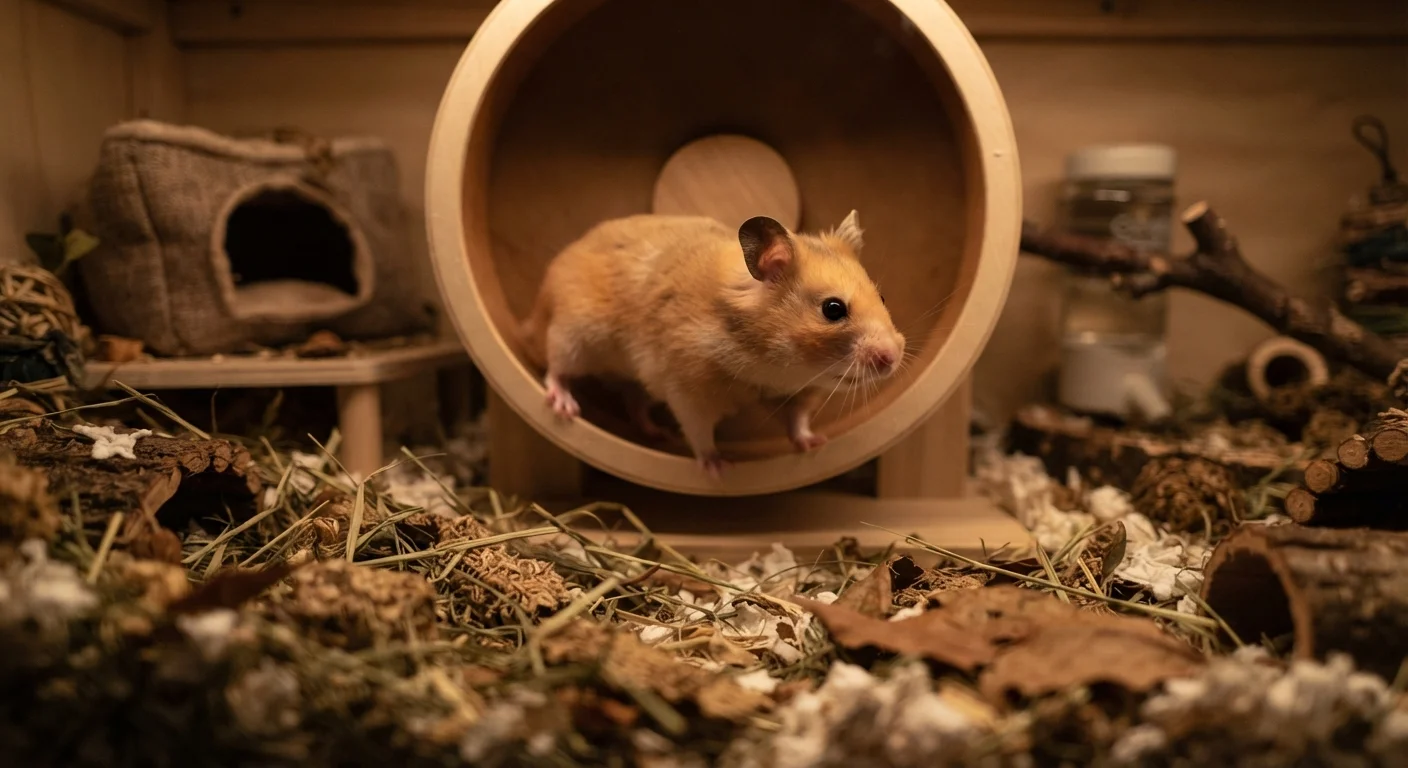
- Wheel placement: A silent-spinner wheel is not optional — it is essential. Hamsters run instinctively and extensively at night, and a squeaky wheel in a bedroom will disrupt both owner and animal. A smooth, appropriately sized wheel (at minimum 8 inches for Syrians, 6 inches for dwarf species) keeps the hamster's spine properly aligned during use.
- Enclosure location: Avoid placing the cage in a room with late-night televisions, loud conversations, or frequent light changes. A quieter room with stable, dim ambient light in the evening supports a more natural activity pattern.
- Enrichment timing: Tunnels, foraging opportunities, and new enrichment items are best introduced in the early evening so the hamster can explore them during peak activity hours.
For a comprehensive look at enclosure design principles, our guide to setting up a safe enclosure for small rodents covers tank sizing, bedding depth, and ventilation in detail.
This article is for general informational purposes only and does not substitute for guidance from a qualified exotic animal veterinarian. If you have concerns about your hamster's health or behavior, consult a veterinary professional experienced with small mammals.