
Decluttering a Family Home From First Pass to Finished: A Room-by-Room Walkthrough

Key Takeaways
- Start with a planning session before touching a single drawer - preparation prevents stalled momentum.
- Work room by room rather than category by category when tackling a full family home.
- The kitchen and common areas deserve the most time because they accumulate clutter fastest.
- Children's spaces require age-appropriate involvement to build lasting habits.
- Maintenance routines matter more than the initial declutter for long-term results.
- Quarterly reassessments prevent the slow re-accumulation that undoes large efforts.
Before You Begin: Setting Up for Success
Decluttering a lived-in family home is fundamentally different from tidying a small apartment. Multiple people, overlapping schedules, and years of accumulated belongings mean the project requires real structure before a single item is sorted. If you're starting from scratch with organizing principles, our beginner's home organization guide covers the foundational concepts worth reviewing first.
Begin with a planning session - not a decluttering session. Walk every room and make notes on where clutter concentrates, which spaces feel unmanageable, and which family members use each area. Assign realistic time blocks: kitchens and garages typically need a full day each; bathrooms can be done in two hours.
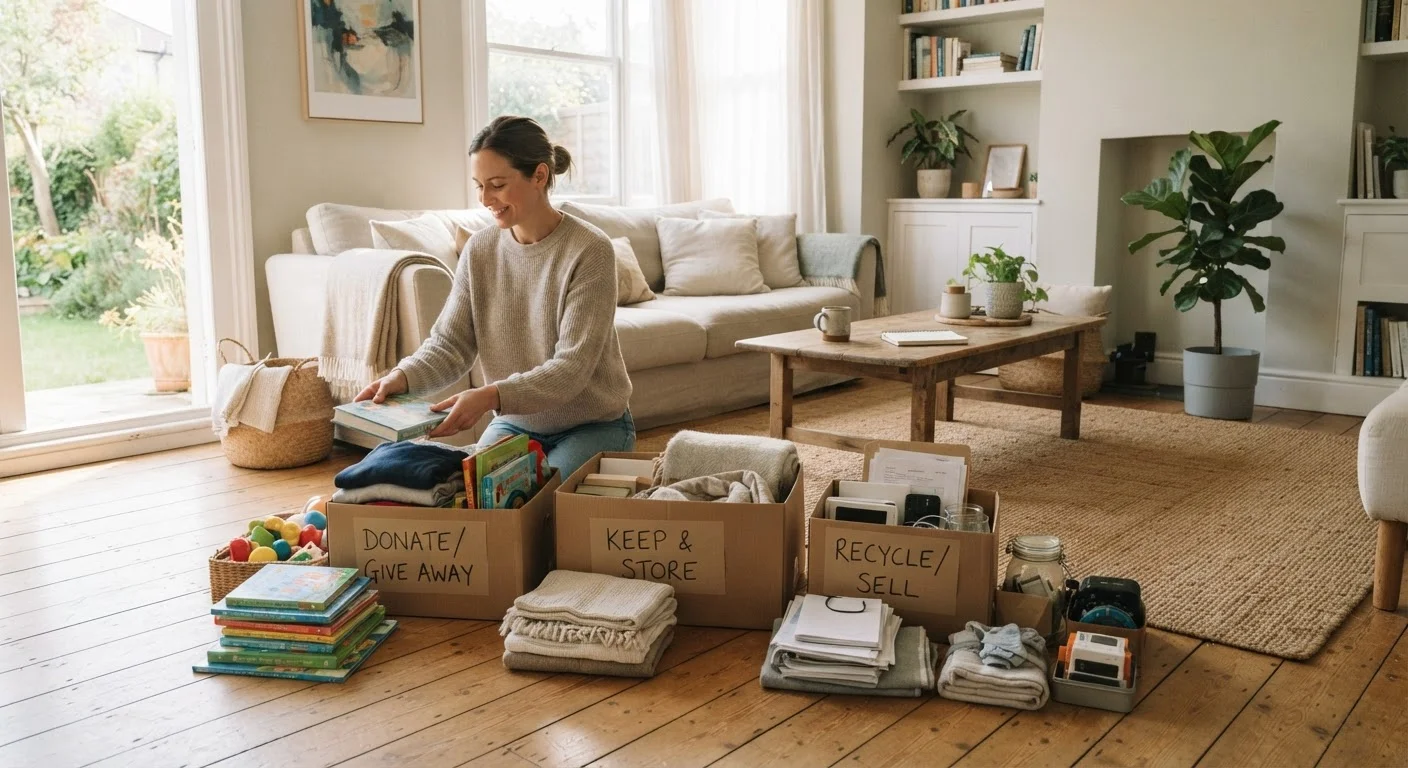
Gather supplies before you start: sturdy bags or boxes labeled Keep, Donate, Discard, and Relocate. The Relocate box is critical in family homes - many items belong in a different room, not out the door. Struggling with the keep-or-go decision for specific items? Our decision framework for sorting items walks through the questions that make those calls faster and less emotionally draining.
Don't declutter and organize at the same time - finish the full first pass of a room before buying a single bin or label. Organizing clutter just hides it.
Purchasing storage before removing excess is one of the most common reasons decluttering projects stall; you end up organizing things you should have discarded.
Schedule decluttering sessions the same way you'd schedule a work meeting - block specific hours on specific days, and protect them from interruption.
Open-ended commitments to 'do it this weekend' rarely survive the competing demands of family life; time-blocking dramatically increases follow-through.
The Kitchen: Tackle the Hardest Room First
The kitchen is the most high-traffic, high-conflict room in a family home, which is exactly why it should come first. Starting here builds momentum and delivers an immediate, visible payoff that motivates the rest of the project.
Work zone by zone: countertops, upper cabinets, lower cabinets, the pantry, and finally the junk drawer. Countertops should hold only appliances used multiple times per week - everything else earns cabinet space or leaves the kitchen entirely. For pantry items, pull everything out, check dates, group by category, and return only what the household genuinely uses.
Cabinet audit: open every door and look honestly at duplication. Most family kitchens hold three times the bakeware, travel mugs, and plastic containers actually needed. Set a firm limit - say, one sheet pan per household member - and donate the rest.
80%
of household items rarely or never used
Professional organizers commonly report that the majority of items in a typical home are seldom touched, with the 80/20 principle frequently cited in organization literature.
40%
of housework attributed to clutter
Research from the National Soap and Detergent Association has been widely cited suggesting that clutter accounts for a significant share of household cleaning time.
Living and Common Areas
Living rooms, dining rooms, and entryways are clutter magnets because they serve as transition zones - items get set down and never moved. The entryway is particularly prone to re-cluttering; our article on spaces that always re-clutter explains why and what actually keeps them clear.
For living rooms, sort items into three functional categories: things used daily, things used occasionally, and things that simply live there out of habit. The third category is the problem. Books, board games, and hobby supplies are fine to keep - but they need dedicated storage locations, not permanent floor or surface residency.
Involve children in common areas where their belongings land. Give each child a small basket in the living room for their items; at the end of each day, the basket goes back to their room. Simple, physical systems like this work better than rules alone. When household members have genuinely different standards for tidiness, organizing around disagreement offers practical frameworks for finding workable middle ground.
Bedrooms and Closets
Adult bedrooms accumulate two distinct types of clutter: surfaces piled with daily items (charging cables, books, receipts) and closets overfilled with clothing that hasn't been worn in years. Address surfaces first by establishing a small, intentional landing zone - a tray or drawer - for items that migrate to the nightstand. Clear everything else.
Closet decluttering is most effective when you pull everything out and sort into the four boxes before returning anything. The standard test - have I worn this in the past 12 months? - is reliable for adults. For children's clothing, size is the faster filter: if it doesn't fit now, it goes.
Children's bedrooms require age-appropriate involvement. Children ages 4 and up can participate in sorting their toys meaningfully if the task is framed as choosing favorites rather than losing things. Keep toy storage simple and accessible; complex systems that require adult help to maintain will fail within weeks.
Make It Age-Appropriate for Children
For children under age 8, limit toy choices in any one room to what fits in clearly labeled open bins. When new toys arrive, involve the child in choosing something to pass on - this builds decision-making skills and prevents overflow. The goal isn't minimalism; it's a space children can actually maintain themselves.
Bathrooms and Linen Storage
Bathrooms are quick wins. Most families find that expired medications, near-empty product bottles, and duplicated items account for a significant portion of bathroom clutter. Pull everything from under the sink, from the medicine cabinet, and from shower shelves. Discard expired items responsibly - many pharmacies accept unused medications for safe disposal.
Linen closets suffer from over-accumulation of towels and sheets the household has outgrown in size. A practical benchmark: two full sets of sheets per bed, and two bath towels per person. Anything beyond that can be donated to animal shelters, which often accept used linens.
Establish a clear zone for each household member's toiletries if multiple people share a bathroom. Hooks, labeled bins, or shelf dividers prevent the drift that causes shared spaces to become chaotic.
Garage, Basement, and Storage Zones
These spaces are where clutter goes to become invisible - and where decluttering projects most often stall. Budget a full weekend day, not an afternoon. The key principle is to impose categories before organizing: tools, sporting equipment, seasonal items, automotive supplies, and donations should each occupy a defined zone before any shelving or bins are purchased.
Avoid the common mistake of buying storage solutions before knowing what you're keeping. Bins and shelving systems are only useful once excess has been removed. Purchase containers only after the first pass is complete.
For items you're genuinely unsure about - furniture, equipment, sentimental belongings - use a time-boxed holding strategy: place them in a clearly labeled box with a date six months out. If you haven't needed or thought about the items by that date, donate without revisiting the decision.
Note that any structural modifications to garage or basement spaces - shelving anchored to walls, electrical work for lighting, or drainage changes - may require permits depending on your local building codes. Always verify requirements with your local authority before beginning such work.
Maintaining the Results Over Time
The declutter is only the beginning. Family homes re-accumulate clutter steadily unless maintenance routines are built into daily and weekly rhythms. The most effective households treat tidying as a brief, consistent habit rather than an occasional large event.
A useful minimum: a 10-minute end-of-day reset where each family member returns items to their designated homes. This alone prevents the creeping accumulation that makes weekend cleanups feel overwhelming.
Beyond daily resets, build in a structured quarterly review. A seasonal declutter checklist covering clothing, pantry, and key storage areas every three months prevents clutter from quietly rebuilding between larger efforts.
Some households find that a category-based approach - popularized by methods like the KonMari method - works better for maintenance than room-by-room reviews. Worth exploring if the room-by-room model feels repetitive once the initial project is finished.
Finally, revisit your systems whenever the household changes: a new child, a teenager leaving home, or a new hobby all shift how space is used. Systems that fit last year's household may be the source of this year's clutter.