

Key Takeaways
- Certain high-traffic zones re-clutter because they lack defined homes for everyday items.
- Small, repeatable habits - not marathon cleanups - are what keep problem spots clear long-term.
- Most clutter accumulates because putting things away takes more effort than setting them down.
- Matching the storage system to actual behavior is more effective than willpower alone.
- Household alignment on shared spaces significantly reduces recurring clutter.
Why the Same Spots Keep Getting Messy
Every household has them: the kitchen counter that disappears under mail and groceries, the entryway that collects shoes and bags, the bathroom ledge buried under half-used products. You clear them, and within days they look exactly the same. This isn't a character flaw - it's a systems problem.
Clutter tends to settle where decision-making slows down. When someone walks in the door with full hands, they set things on the nearest flat surface. When mail arrives, it lands wherever there's space. These moments aren't careless - they're just unguided. Without a clear, easy destination for an item, the default is always "here for now."
The fix isn't to clean more often. It's to make putting things away as frictionless as setting them down. That means understanding which spaces are most vulnerable, why they attract clutter, and what low-effort habits and structures actually hold. If you're just getting started building these kinds of systems, this beginner's guide to home organization covers the core principles from the ground up.
The Entryway: Where Everything Lands First
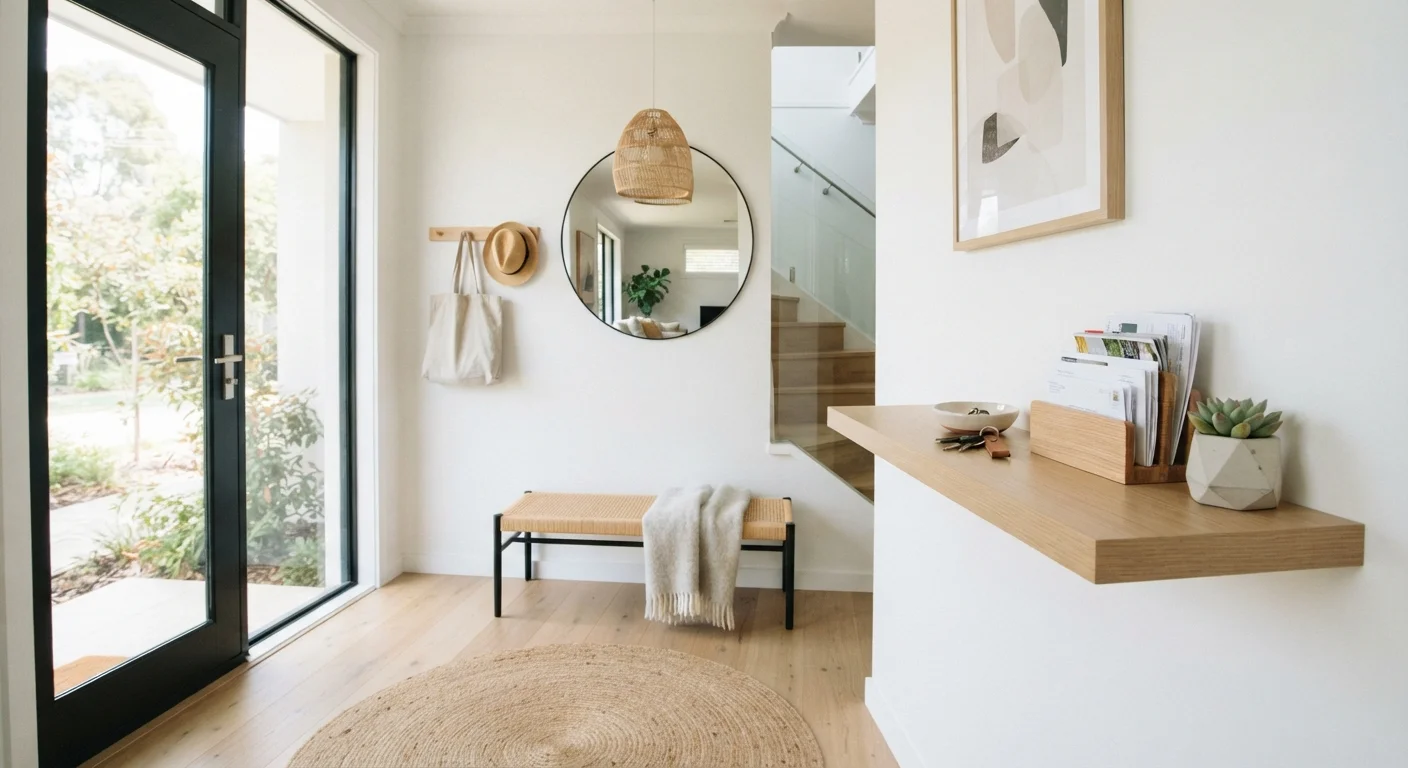
Entryways are the most common re-cluttering zone in the home because they're the transition point between outside and inside. Bags, shoes, keys, coats, mail, and reusable grocery bags all converge here simultaneously.
The solution is proximity storage. Hooks at shoulder height for bags and coats, a small tray or bowl for keys, and a dedicated spot for shoes - ideally a bench with storage underneath - eliminate the need to make decisions mid-entry. When the hook is right there, hanging the coat is the path of least resistance. When it isn't, the coat goes on the nearest chair.
The critical rule: every item that regularly enters through the door needs a defined home within arm's reach of where it naturally lands.
When the hook is right there, hanging the coat is the path of least resistance.
Kitchen Counters: The Default Drop Zone
Kitchen counters re-clutter for a specific reason: they're flat, central, and constantly in use. Anything without a permanent home migrates there. Vitamins, charging cables, school papers, lip balm, and random hardware all end up on the counter because it's the most accessible surface in the house.
Counter clarity starts with an honest audit of what actually lives there versus what drifts in. Items used daily - coffee maker, toaster - earn counter space. Everything else needs a drawer, cabinet, or designated basket nearby. A small, contained "landing basket" for mail and miscellaneous items can work temporarily, but it needs a daily or weekly emptying habit attached to it, or it simply becomes structured clutter.
Reducing the counter's appeal as a catch-all also means keeping appliances that aren't used frequently in cabinets, which frees both physical space and visual calm.
A landing basket without an emptying habit is just structured clutter.
Bathroom Surfaces: Product Creep Over Time
Bathroom counters and ledges suffer from a slow accumulation known as product creep - new items arrive and old ones never leave. Half-finished bottles, expired medications, and duplicate products gradually crowd every surface.
Two habits address this directly. First, a quarterly edit: pull everything out, discard what's expired or unused, and return only what belongs. Second, apply a one-in-one-out rule for new products. If a new shampoo comes in, the old bottle gets finished or discarded before the new one claims shelf space.
Vertical storage - wall-mounted shelves, magnetic strips for metal tools, over-door organizers - opens up counter space without requiring a larger bathroom. The goal is to store items where they're used rather than wherever they were last set down.
Quarterly edits and a one-in-one-out rule stop bathroom surfaces from slowly disappearing.
The Dining Table: Paperwork's Favorite Resting Place
The dining table is intended for meals, but in most homes it doubles as a homework station, bill-sorting surface, craft area, and general overflow zone. It re-clutters because it's large, flat, and often not in constant enough use to force a daily clearing.
The most effective approach is to give the table a hard rule: it gets cleared before every meal, full stop. That simple constraint creates a twice- or three-times-daily reset habit. For households with children doing homework at the table, a dedicated portable bin or tote for school materials makes gathering and clearing a one-step task.
Persistent paper piles on dining tables are often a sign that the home lacks a processing point for incoming mail and documents. Addressing that inflow upstream is what prevents the pile from returning.
A rule to clear before every meal creates a built-in reset habit without extra effort.
Bedroom Floors and Chairs: The Clothes Limbo Problem
The bedroom chair - or floor - is where clothes go when they're not quite clean enough to fold away but not dirty enough for the laundry. This "limbo zone" re-clutters reliably because there's no defined system for in-between clothing.
Acknowledging the reality of limbo clothes is more effective than fighting it. A dedicated hook, a small hanging rail, or an open bin assigned specifically to worn-but-not-washed items gives them a home that isn't the floor or chair. Once the pile has a proper container, it stops spreading.
The secondary habit is a weekly reset: on laundry day, everything in the limbo spot either goes into the wash or back into the wardrobe. This keeps the container from simply becoming another permanent pile.
Acknowledging limbo clothes and giving them a container beats fighting the habit entirely.
Home Office and Desk Areas: Unfinished Business Accumulates
Desks and home office surfaces clutter because they're where unfinished tasks live. A bill that needs to be paid, a form that needs signing, a library book that needs returning - all of these items stay visible because they're action items, not clutter in the traditional sense.
The fix is a simple inbox system: a single tray or folder designated for "needs action" items. When something requires follow-up, it goes in the tray. When it's handled, it either gets filed or discarded. This separates active items from completed ones and prevents the desk from becoming a visual to-do list spread across every surface.
Weekly processing of the inbox - even just ten minutes - is what keeps the system functional. Without it, the tray overflows and the desk returns to its previous state.
A dedicated inbox tray turns scattered action items into a manageable, contained list.
Building Habits That Stick
A single organizing session won't solve a re-cluttering problem permanently. What works is layering small, consistent habits onto the physical systems you've put in place. A one-minute reset at the end of the day - returning items to their designated spots before bed - is often enough to prevent the slow accumulation that leads to overwhelm.
The One-Minute Rule Worth Adopting
If putting something away takes less than a minute, do it immediately rather than setting it down temporarily. This single habit, applied consistently, prevents the micro-accumulations that turn into full clutter sessions. It works especially well in entryways and kitchens, where most re-cluttering happens in brief, distracted moments.
Shared households bring an added layer of complexity. Systems only hold when everyone who uses a space understands them and can realistically follow them. Organizing a home when people have different standards requires buy-in, not just better bins.
Paper is one of the most persistent re-clutter culprits in any of these zones. It migrates from the entryway to the counter to the dining table in a predictable cycle. Understanding why paper clutter keeps coming back can help you address the inflow before it becomes a pile. And if you find that one drawer has silently become the repository for everything without a home, it may be worth rethinking the catch-all habit entirely.
The goal isn't a showroom. It's a home where tidying takes minutes rather than hours, and where the spaces that matter most stay functional without constant effort.