

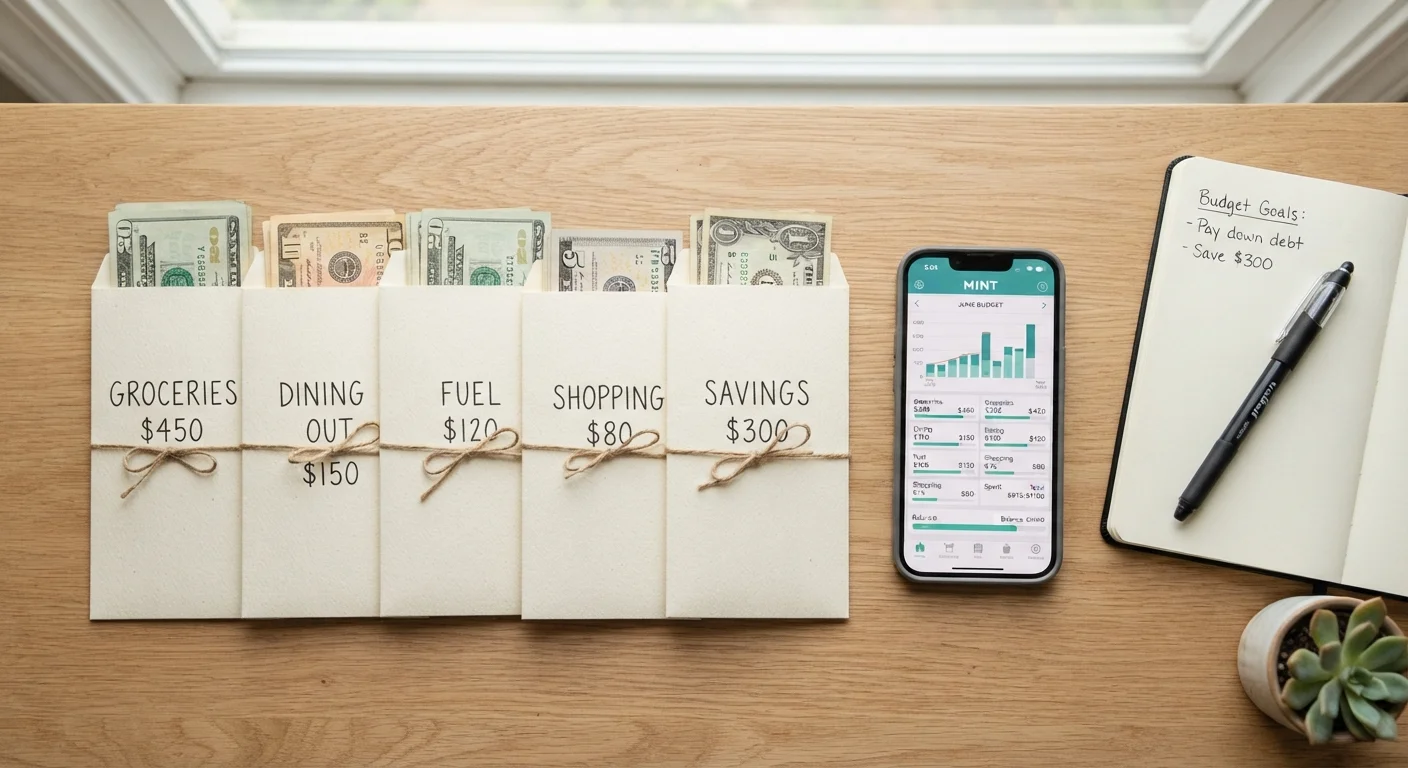
Key Takeaways
- Cash envelopes create hard spending limits by making money physical and finite.
- Digital trackers offer automation and real-time data but require consistent app engagement.
- Neither method is objectively superior - the right choice depends on your spending psychology.
- Overspenders with cards often find cash envelopes more effective at changing behavior.
- Digital tools work best for people managing multiple accounts, income streams, or irregular expenses.
Option A
Cash Envelope Method
The tactile, analog approach to hard spending limits.
Best for: People who overspend with cards and benefit from physically feeling money leave their hands.
Option B
Digital Spending Trackers
The data-driven, always-with-you budgeting companion.
Best for: People who prefer automatic categorization and real-time visibility across multiple accounts.
If you consistently overspend on dining, groceries, or entertainment
Cash Envelope Method
Physical cash creates an undeniable boundary - when the envelope is empty, spending stops. No override, no rounding error.
If you manage multiple accounts, subscriptions, or irregular income
Digital Spending Trackers
Apps sync across accounts automatically, making it far easier to see the full picture when cash isn't practical.
If you're new to budgeting and want to build the habit quickly
Cash Envelope Method
The simplicity of cash envelopes requires no technical setup and offers immediate, tangible feedback on spending.
If you travel frequently or make a lot of online purchases
Digital Spending Trackers
Cash is impractical for digital transactions; a tracking app captures every charge without requiring you to carry bills.
If you want to reduce financial stress while staying accountable
Digital Spending Trackers
Automated categorization reduces manual tracking burden, making it easier to stay consistent without daily friction.
How Each Method Works
The cash envelope method is straightforward: at the start of each budget period, you withdraw physical cash and divide it into labeled envelopes - one for groceries, one for dining out, one for entertainment, and so on. Once an envelope is empty, spending in that category stops until the next period. No borrowing from other envelopes unless you consciously decide to reallocate.
The concept traces back to decades of personal finance tradition and is often associated with zero-based budgeting frameworks, where every dollar has a predetermined job before the month begins. If you're just starting out with budgeting, the envelope system's tactile simplicity can help concepts click faster than abstract spreadsheets.
Digital spending trackers - app-based tools that connect to your bank accounts and credit cards - work differently. They pull transaction data automatically, categorize purchases (sometimes with manual correction), and display your spending against preset limits in real time. Most apps allow you to set monthly budgets by category and alert you when you're approaching a limit. The main value proposition is visibility at scale: see all your accounts, all your spending, in one place.
Key Differences at a Glance
Understanding where these methods diverge helps you predict which will fit your habits. The comparison below covers the dimensions that matter most for day-to-day usability.
| Criterion | Cash Envelopes | Digital Trackers |
|---|---|---|
| Setup effort | Low - cash, envelopes, labels | Moderate - account linking, category setup |
| Spending friction | High - physical limit enforced | Low - easy to overspend and review later |
| Works for online purchases | No | Yes |
| Real-time visibility | Manual count only | Automatic, updated frequently |
| Best habit type | Impulse spenders needing hard stops | Awareness-driven, disciplined reviewers |
| Privacy risk | None - no data sharing | Requires linking financial accounts |
| Ongoing effort | Weekly cash withdrawal trips | Regular app check-ins, category corrections |
One nuance worth noting: digital trackers vary significantly in how they handle shared expenses, cash transactions, and manual entry. If you use cash heavily for some categories, a digital tracker will show incomplete data unless you log those transactions by hand - a friction point that defeats some of the automation benefit.
You Don't Have to Choose Just One
Some people use a hybrid approach: cash envelopes for discretionary, high-temptation categories like dining and entertainment, while relying on a digital tracker for fixed bills, savings goals, and overall account monitoring. This combination captures the psychological brake of cash where it matters most while maintaining full visibility across the budget. There's no rule requiring a single system - the priority is consistency, not purity.
The Psychology Behind Each Approach
Research in behavioral economics consistently finds that payment method affects spending behavior. Paying with physical cash tends to feel more painful than swiping a card - an effect sometimes called the "pain of paying." This friction is exactly what makes the envelope system effective for people prone to impulse spending. The psychological weight of handing over bills is a real brake on behavior that a card tap simply doesn't replicate.
Digital trackers, by contrast, rely on awareness rather than friction. They work best when you check in regularly and respond to alerts proactively. If your weakness is not noticing how small purchases accumulate, a tracker with clear visual dashboards can be eye-opening. However, if you tend to dismiss notifications or avoid looking at your finances when things feel tight, the awareness tool loses its power.
~33%
Americans with no formal monthly budget
According to recurring NFCC consumer financial literacy surveys, roughly one in three American adults does not follow a budget, underscoring the accessibility challenge any system must overcome.
Higher
Spending when paying by card vs. cash
Multiple behavioral economics studies, including research published in the Journal of Consumer Research, have found that card payments are associated with higher spending relative to cash for the same purchases.
Pairing either method with a monthly budget review helps reinforce progress and catch category creep before it compounds.
Practical Considerations Before Choosing
Before committing, run through a few practical realities:
- Safety and convenience: Carrying significant cash poses theft risk. If you live in a city or travel often, digital tracking may be safer. See how budgeting principles apply when travel spending patterns are in play.
- Irregular income: Freelancers or gig workers with variable paychecks may find it difficult to pre-load envelopes accurately. Digital tools can adjust category targets mid-month more fluidly.
- Shared finances: Couples budgeting together may find digital trackers easier to sync across two phones than coordinating physical envelopes.
- Online bills and subscriptions: Rent, utilities, and streaming services can't be paid from an envelope. Both methods require some adaptation for fixed, auto-charged expenses.
Neither approach operates in isolation from broader financial goals. If managing debt is also a priority, understanding structured payoff strategies - like those covered in the debt avalanche and snowball comparison - will complement whichever budgeting method you choose. For a broader foundation, explore resources on saving and debt.
This article is for general informational and educational purposes only and does not constitute personalized financial advice. Consult a qualified financial professional for guidance tailored to your individual circumstances.