

Key Takeaways
- Native plants are adapted to local soils and rainfall, typically requiring less supplemental watering once established.
- They provide critical habitat for pollinators, birds, and insects that co-evolved with those specific species.
- Replacing even a portion of a traditional lawn with native plants can significantly reduce maintenance demands.
- Regional specificity matters - a plant native to one part of the US may behave like an invasive species elsewhere.
- Native plantings pair well with healthy soil practices and mulching to accelerate establishment.
Native Plants
Native plants are species that evolved naturally in a specific region over thousands of years, without human introduction. Because they developed alongside local soils, rainfall patterns, insects, and wildlife, they're inherently suited to thrive with minimal intervention. In gardening, "going native" means replacing or supplementing conventional landscaping with these regionally adapted species.
Ecologists define a plant as native relative to a specific ecoregion, not just a broad geographic area - so "native to the US" is far less meaningful than "native to the Mid-Atlantic Piedmont" or "native to the Pacific Northwest lowlands."
Why the Traditional Lawn Is Being Questioned
For much of the 20th century, the lush, uniform green lawn was the standard of a well-kept American home. Today, ecologists, water managers, and an increasing number of homeowners are looking at that same lawn and asking whether the tradeoffs are worth it.
Conventional turfgrass - the type covering most American yards - is typically a non-native species that requires regular mowing, irrigation, synthetic fertilizer, and pesticide applications to maintain. Compared to year-round lawn maintenance, native plant gardens tend to become increasingly self-sustaining after establishment.
The issue isn't aesthetics alone. Turfgrass provides almost no habitat value for native insects, which are the foundation of local food webs. A lawn that looks green and healthy may function, ecologically speaking, as something close to a biological desert.
Native Doesn't Always Mean Wild-Looking
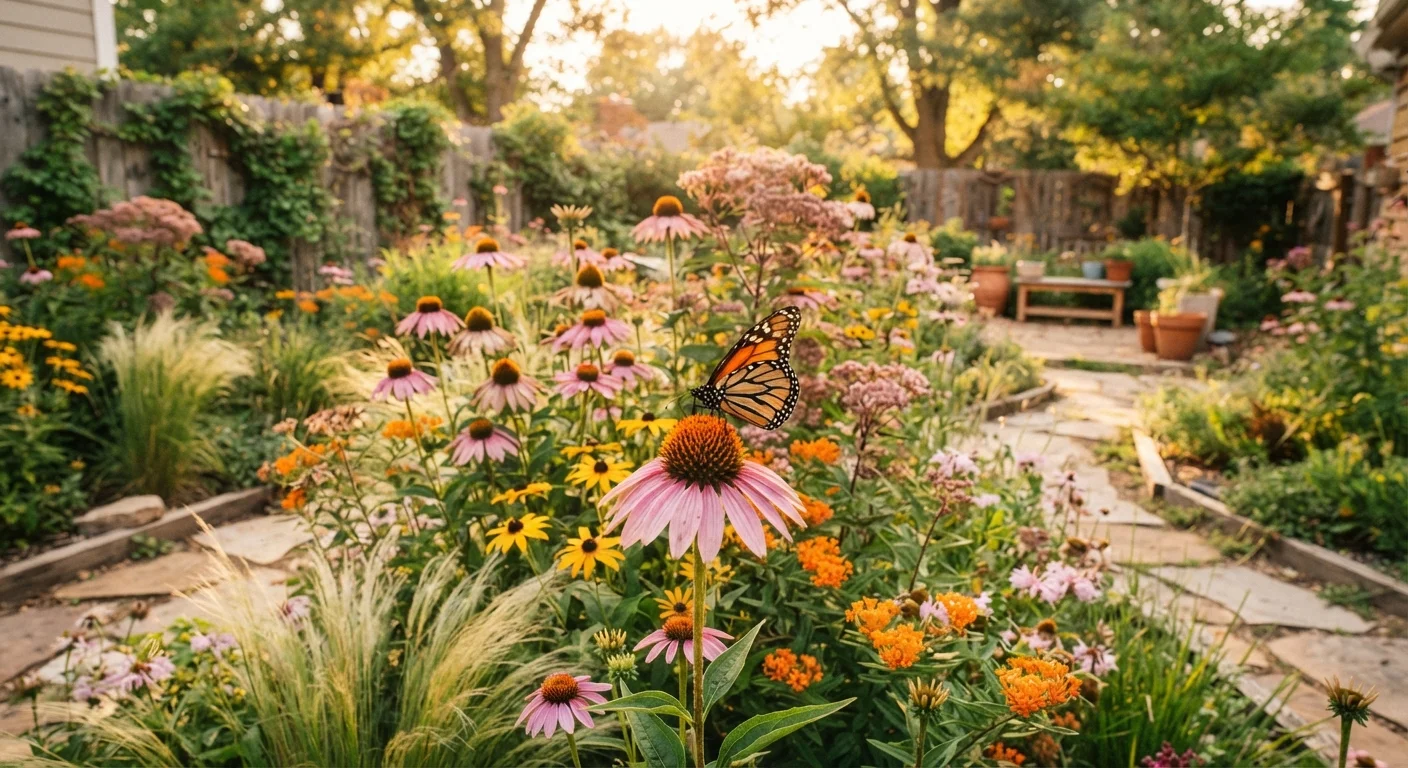
A common misconception is that native plant gardens are unkempt or purely naturalistic. In practice, native plants can be arranged in structured beds, formal borders, and tidy groupings that satisfy most neighborhood aesthetics. Plenty of natives - coneflowers, black-eyed Susans, ornamental grasses - are widely used in conventional landscaping already.
What Native Plants Actually Do in a Landscape
Native plants don't just survive in your climate - they actively support it. Their root systems, which can extend several feet deeper than turf grass, improve soil structure, increase water infiltration, and reduce runoff. This underground work matters enormously for soil health that fertilizers alone can't replicate.
Above ground, native plants provide the food sources and shelter that local wildlife depends on. Insects, particularly specialist species, often can only reproduce using specific native host plants. Native oaks, for example, support hundreds of caterpillar species - a critical food source for nesting birds.
40M+
Acres of lawn in the contiguous United States
Estimates from NASA and USGS research suggest American lawns collectively cover more land than any single irrigated crop.
~30%
Of US residential water use going to landscaping
The EPA estimates outdoor water use - primarily lawn irrigation - accounts for roughly 30% of household water consumption, with much lost to evaporation or runoff.
96%
Of terrestrial birds depend on insects to feed young
Research by entomologist Douglas Tallamy at the University of Delaware found that almost all land-based bird species require insects - many of them plant-specialist species - to raise their chicks.
Flowering natives also extend the bloom calendar in ways that exotic ornamentals often don't, offering nectar from early spring through late fall when managed landscapes tend to go quiet. This continuity matters for pollinators preparing for winter or migration.
How to Start Converting Your Yard
Most successful native gardens begin with one defined area rather than an immediate full-yard overhaul. A garden bed along a fence, a slope that's difficult to mow, or a shady corner under a tree are all natural starting points.
Before purchasing plants, identify your ecoregion. A plant native to coastal Georgia may be completely unsuited to the Midwest. Local native plant societies, cooperative extension offices, and university horticulture programs are reliable resources for regionally appropriate species lists - and they're often free.
Start With a Plant List From Your Extension Office
Your state's cooperative extension service (typically affiliated with a land-grant university) publishes free, regionally specific native plant lists tailored to your climate zone and soil type. These lists are vetted by horticulturalists and ecologists and are far more reliable than general internet searches or broad regional guides. Many also flag species that are native to the US but invasive in particular sub-regions.
When it comes to soil preparation, resist the urge to heavily amend before planting natives. Many native species evolved in lean, unamended soils and can struggle with over-fertilized conditions. Light preparation - removing existing turf, loosening compaction - is typically sufficient. Pair your planting with a layer of wood chip mulch to suppress weeds and retain moisture; see how mulching transforms garden beds for more detail on technique and timing.
Most native perennials look modest in their first season as they establish roots. Patience during this phase pays off significantly in years two and three, when many species begin to naturalize and spread on their own. For a broader look at how perennials behave over time, perennials vs. annuals explores how multi-year plants can anchor a planting plan.
What the Research and Conservation Community Says
Ecologists have been making the case for native plantings in residential landscapes for several decades. The broader public conversation has accelerated as habitat loss, pollinator decline, and drought conditions have become more widely recognized concerns.
“Bringing nature home doesn't mean letting your yard go wild. It means making deliberate choices to include the plants that local wildlife evolved with - and the benefits compound over time as the ecosystem responds.”
— Douglas Tallamy, Entomologist and author, University of Delaware
Conservation organizations and land-grant universities across the US now produce regionally specific planting guides aimed directly at homeowners. The guidance is consistent: even small native patches in suburban yards contribute meaningfully to landscape-scale ecological connectivity - what researchers sometimes call "wildlife corridors" through otherwise fragmented habitat.
For homeowners interested in the full picture of what their outdoor environment is made of - from soil to plant selection - the foundational step is understanding the ground beneath your plants. Our guide to soil health basics explains what most yards are actually working with and how to read what your soil needs.