

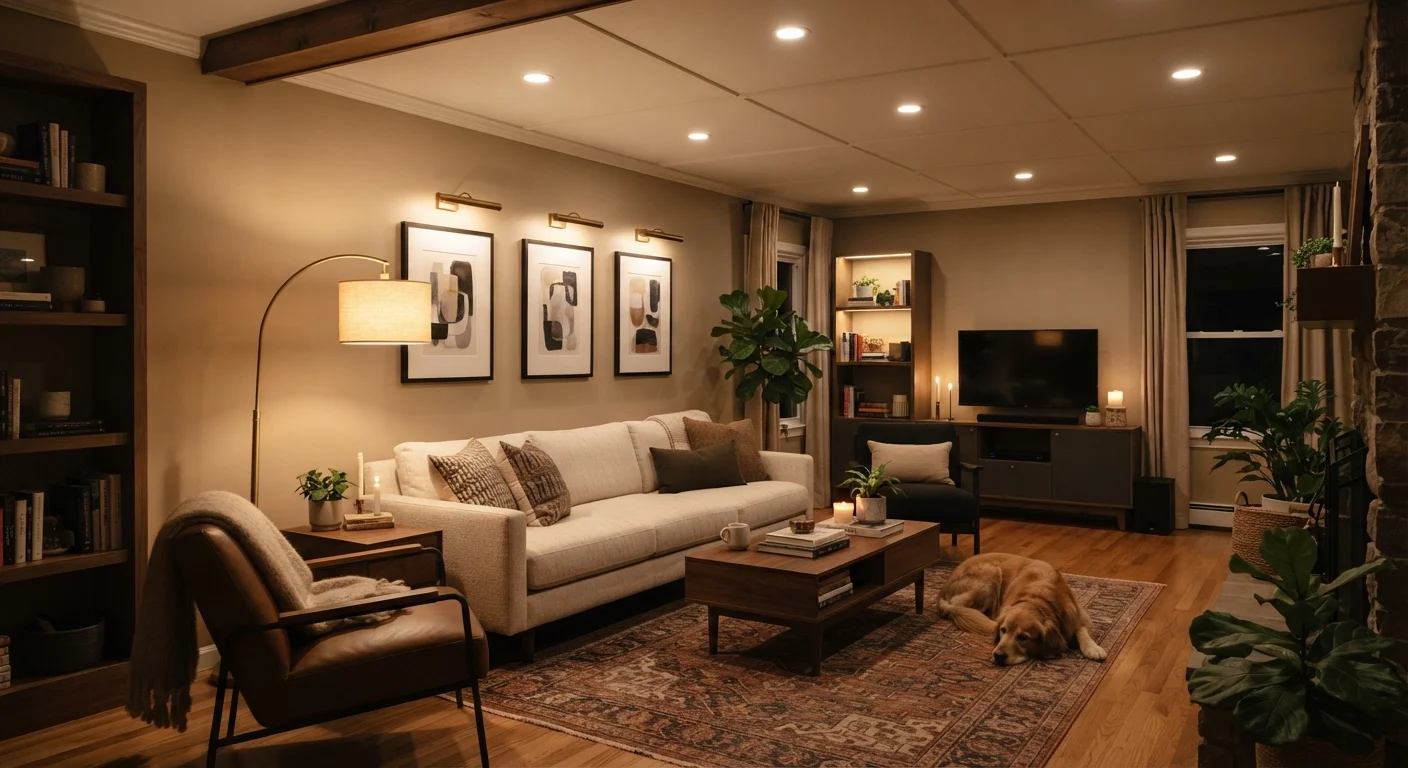
Key Takeaways
- Overhead-only lighting flattens a room and creates harsh shadows that no dimmer switch can fully fix.
- Three distinct layers - ambient, task, and accent - work together to make a room both functional and visually comfortable.
- Lighting decisions are best made during rough-in, before walls close up and rewiring becomes expensive.
- Dimmer switches and varied fixture heights are among the highest-impact, lowest-cost upgrades available.
- Open floor plans require zone-specific lighting plans, not a single overhead solution for the entire space.
Why One Overhead Fixture Is Never Enough
Walk into almost any renovated room and you'll find the same oversight: a centered ceiling fixture or a grid of recessed cans, all on one switch, flooding the space with uniform light. It's clean. It's simple. And it's the single most common lighting mistake homeowners make.
The problem isn't brightness - it's flatness. Uniform overhead light casts shadows straight downward, eliminates depth and texture from walls and surfaces, and removes any ability to shift the room's mood or function. When you sit down in the evening, that same light that worked fine at noon now feels clinical and tiring.
The solution, which professional designers have relied on for decades, is layered lighting: deliberately combining multiple light sources at different heights, intensities, and purposes. It sounds architectural, but the principle applies equally to a small bedroom refresh and a full kitchen gut. If you're planning any renovation, understanding this before the drywall goes up is the difference between a room that feels finished and one that always feels slightly off.
For projects that involve structural decisions - especially if you're opening walls to run new circuits - it's worth reviewing our guide on identifying load-bearing walls before any work begins.
The Three Layers and What Each One Does
Every well-lit room relies on the same three-layer framework. Think of them as working simultaneously, each solving a different problem.
Ambient (General) Light
This is your base layer - the broad, diffused light that replaces daylight once the sun goes down. Recessed fixtures, flush-mount ceiling lights, and pendant fixtures all contribute here. Ambient light should feel even and non-glaring, covering the room without hotspots. On its own, though, it's insufficient.
Task Light
Task lighting puts focused illumination exactly where work happens: over a kitchen counter, beside a reading chair, above a bathroom vanity mirror. It reduces eye strain and makes detail-oriented activities genuinely easier. Under-cabinet lighting in kitchens is one of the clearest examples - it eliminates the shadow your body casts when you stand at the counter under overhead-only light.
Accent Light
Accent lighting is directional and intentional. Its job is to create visual interest - drawing the eye to artwork, architectural features, built-in shelving, or textured wall materials. Adjustable recessed fixtures, picture lights, and LED strip lighting inside niches all fall here. Without this layer, even a beautifully decorated room can look dimensionless after dark.
Planning Lighting Before the Walls Close
The most expensive lighting mistake isn't buying the wrong fixture - it's not planning the circuit locations before rough-in. Electrical rough-in happens early in a renovation, right after framing and before insulation or drywall. Once walls close, adding or moving a junction box means cutting, patching, and repainting - costs that cascade quickly.
This is the moment to ask: where will task lighting be needed? Does this wall need a switched outlet for a floor lamp? Should this alcove have a dedicated accent circuit? These decisions cost very little to make during rough-in and significantly more afterward. Our article on hidden renovation costs covers exactly how electrical change-orders become budget surprises.
Permits and Licensed Electricians
Any new circuit, panel modification, or junction box installation typically requires an electrical permit and inspection in most US jurisdictions. Work performed without permits can affect homeowner's insurance coverage and complicate future home sales. Always verify local requirements with your municipality and hire a licensed electrician for wiring work beyond simple fixture swaps.
For kitchens specifically - where task, ambient, and accent needs collide around counters, islands, and upper cabinets - lighting decisions touch nearly every trade. Our kitchen renovation planning guide walks through how to sequence these decisions alongside cabinetry and appliance placement.
Open floor plans present a particular challenge: a single lighting plan can't serve a dining area, a kitchen zone, and a living space simultaneously. Each functional zone within the open plan benefits from its own ambient source and at least one task or accent layer. See our discussion of open floor plan trade-offs for more on how layout shapes your lighting options.
Quick Upgrades That Make an Immediate Difference
You don't need a full renovation to start applying the layering principle. Several high-impact changes work within existing electrical setups and produce immediately noticeable results.
The layering principle isn't limited to interiors. If your project extends outside, the same ambient-task-accent logic applies to landscape and patio spaces - our guide on outdoor lighting ideas covers how placement shapes both safety and atmosphere in yards and garden areas.