

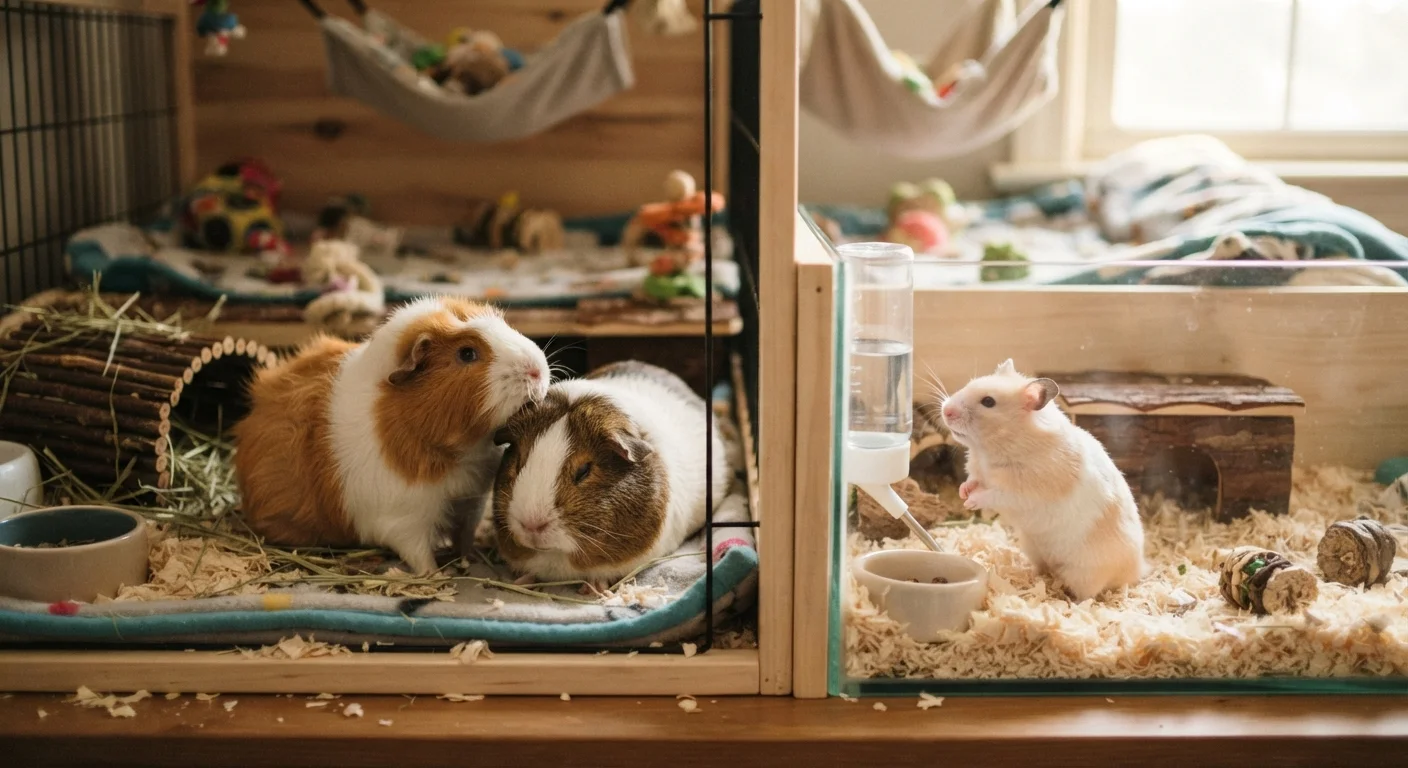
Key Takeaways
- Guinea pigs are highly social and generally suffer when housed alone; pairs or small groups are strongly recommended.
- Syrian hamsters are naturally solitary and can become aggressive or stressed when cohabited with another hamster.
- Rabbits can thrive in bonded pairs, but introductions require patience and a careful, staged process.
- Species biology — not owner preference — should drive every housing decision for small pets.
- Even solitary species need significant environmental enrichment and daily human interaction to maintain wellbeing.
Our Verdict
There is no universal answer to whether small animals should be housed alone or in pairs — the right choice is entirely species-dependent. Guinea pigs need companionship to flourish, while Syrian hamsters are better served by thoughtfully enriched solo housing. Rabbits occupy a middle ground where paired housing is beneficial but demands careful introduction. Understanding these distinctions is the single most important step an owner can take toward supporting their pet's welfare.
| Best for | Recommended |
|---|---|
| Owners of guinea pigs seeking the most welfare-supportive setup | Paired or small-group housing |
| Owners of Syrian hamsters wanting to avoid stress and injury | Solo housing with enriched environment |
| Rabbit owners willing to invest time in proper bonding | Bonded pairs with gradual introduction |
| Owners of less common species such as chinchillas or gerbils | Species-specific research and exotic vet consultation |
Why Housing Structure Matters More Than Most Owners Expect
When people picture small pet welfare, diet and cage size tend to dominate the conversation. But social housing — whether an animal lives alone or with a companion — is equally influential on physical health and psychological wellbeing. Getting it wrong in either direction can cause chronic stress, behavioral problems, and even shortened lifespans.
Research in animal welfare science increasingly uses behavioral indicators — such as stereotypic pacing, over-grooming, and reduced exploratory activity — to assess whether a housing arrangement is meeting a species' needs. What that research consistently shows is that social needs are species-specific, shaped by millions of years of evolutionary history, not by what happens to be convenient for the owner.
See our comparison of guinea pigs and rabbits for a broader look at how these two popular species differ across multiple care dimensions.
Guinea Pigs: Companionship Is a Welfare Requirement
Among common small pets, guinea pigs (Cavia porcellus) present the clearest case for paired or group housing. In the wild, they live in social groups and use vocalizations, grooming, and huddling behaviors to bond and regulate stress. Studies of captive guinea pigs consistently show that animals housed alone display elevated cortisol levels and more frequent stress-related behaviors than those housed with companions.
Several European countries, including Switzerland, have gone as far as codifying guinea pig companionship into animal welfare law. While US regulations haven't followed suit, the scientific consensus among exotic animal veterinarians and welfare researchers strongly supports same-sex pairs or small, carefully managed groups.
When a Solo Pet Is the Only Option
If circumstances make paired housing impossible, prioritize enrichment. For guinea pigs this means extended daily out-of-cage time and varied foraging opportunities. For solitary-appropriate species like Syrian hamsters, focus on substrate depth, appropriate wheel size, and novel foraging challenges. Enrichment cannot replicate conspecific bonds for social species, but it meaningfully supports wellbeing.
For owners who can only keep one guinea pig — due to allergy, space, or other constraints — daily extended handling and added environmental enrichment can partially compensate, but does not fully replace conspecific (same-species) social interaction.
Syrian Hamsters: Solitary by Nature, Not by Neglect
The Syrian hamster (Mesocricetus auratus) occupies the opposite end of the social spectrum. In their native semi-arid habitats, Syrian hamsters are territorial and actively avoid other adults outside of brief mating encounters. Housing two Syrian hamsters together — even with ample space — routinely results in fighting, injury, and severe chronic stress for the subordinate animal.
This is one of the most common misconceptions among new small pet owners, who may assume that "more animals = more happiness." For Syrian hamsters, solo housing is welfare-supportive housing. The owner's role shifts to providing rich environmental enrichment: appropriately sized wheels, burrowing substrate, foraging opportunities, and regular interaction.
| Guinea Pig | Syrian Hamster | Rabbit | Gerbil | Chinchilla | |
|---|---|---|---|---|---|
| Natural social structure | Group-living | Solitary | Group-living | Group-living | Group-living |
| Recommended housing | Pairs or small groups | Solo only | Bonded pairs | Same-sex pairs | Pairs or small groups |
| Risk of cohabitation conflict | Low with same-sex pairs | Very high | Moderate without bonding | Low if introduced young | Low to moderate |
| Stress if housed alone | High — documented welfare concern | Low — natural preference | Moderate to high | High | Moderate to high |
| Introduction difficulty | Moderate | N/A — avoid | High | Low to moderate | Moderate |
Dwarf hamster species — including Roborovski and Campbell's dwarf hamsters — have somewhat more social tendencies and may tolerate same-sex pairs established from a young age, though conflict can still occur. Any cohabitation should be closely monitored.
Rabbits, Chinchillas, and Other Species: A More Complex Picture
Rabbits in the wild live in social groups, and research supports the welfare benefits of bonded pairs in domestic settings — including reduced stress hormones and increased positive behavioral states. However, rabbits are also highly territorial, and introductions between unfamiliar individuals can result in serious injury without a gradual, structured bonding process. Our article on what rabbit housing actually needs covers the space requirements that make successful bonding more achievable.
Chinchillas are another social species that generally benefit from companionship, though individual personalities vary considerably. Gerbils, similarly, do best in pairs or small same-sex groups — single gerbils often show signs of depression and shortened lifespan in research settings.
For less common exotic species, reliable species-specific data can be harder to find. Hedgehogs, for instance, are primarily solitary. Sugar gliders are colony animals that tend to decline both physically and emotionally without conspecific contact. Our guide to hedgehogs, chinchillas, and sugar gliders explores these nuances further.
When in doubt about a species' social requirements, consulting an exotic animal veterinarian is the most reliable path to an evidence-based answer.
Practical Considerations When Making Your Housing Decision
Even when the biology supports paired housing, real-world factors matter. A second animal means additional veterinary costs, more food and bedding, and — critically — more space. Pairing animals in an enclosure that's too small can introduce resource competition and stress that undermines the intended welfare benefit. See our piece on why rabbits need more space than most owners realize for a reminder of how often enclosure size is underestimated.
Key questions to ask before deciding:
- What does the science say about my specific species? Look for guidance from exotic animal veterinary organizations or peer-reviewed welfare research.
- Can I provide adequate space for two animals? Cohabiting animals need separate feeding stations, hides, and enrichment to reduce conflict.
- Am I prepared for the introduction process? Many species require weeks of careful, staged introductions before cohabitation is safe.
- What happens if the pairing fails? Have a plan for separate housing if animals prove incompatible.
Social housing, done well, is one of the most meaningful improvements an owner can make to their pet's quality of life. Done poorly, it can cause significant harm. Let species biology — not assumptions — guide the decision.
This article provides general educational information about small animal care and is not a substitute for guidance from a qualified exotic animal veterinarian familiar with your pet's specific needs.