

Key Takeaways
- Most commercial rabbit cages fall well short of the minimum space rabbits need to thrive.
- Rabbits require daily free-roaming time outside their enclosure to support physical and mental health.
- Confinement in undersized housing can cause stereotypic behaviors, muscle atrophy, and chronic stress.
- Space requirements scale with body size — larger breeds need proportionally more room.
- Enrichment and social housing considerations are inseparable from space planning.
The Gap Between 'Fits' and 'Sufficient'
Rabbits are the third most popular small mammal kept as pets in the United States, yet they are among the most frequently housed in conditions that fall well short of their actual needs. The disconnect starts at the point of sale: enclosures designed to hold a rabbit are routinely mistaken for enclosures designed to support one.
Unlike cats and dogs — whose space requirements are more visually obvious — rabbits appear content when resting, which can mask chronic stress or physical deterioration caused by confinement. A rabbit sitting quietly in a small cage is not necessarily a happy rabbit; it may simply have run out of options.
If you're comparing rabbits to other small pets, our guide to guinea pigs vs. rabbits outlines how space demands differ across species and can help prospective owners calibrate expectations before bringing a rabbit home.
Cage Size Labels Are Not Welfare Standards
Pet store cages marketed as 'rabbit-sized' are typically sized for transport, not long-term living. Many welfare organizations and veterinary groups recommend a minimum enclosure of 12 square feet with access to at least 32 square feet of exercise space daily. No label on a product box substitutes for species-appropriate housing standards.
Common Mistakes Rabbit Owners Make With Housing Space
The following errors appear repeatedly across rabbit ownership communities. Each stems from understandable assumptions — but each carries real welfare consequences that owners can avoid with the right information.
Choosing an enclosure based on the rabbit's body length alone, without accounting for full stretch and hop distance.
Why it happens: Most cage packaging lists dimensions that fit the rabbit's resting body, misleading owners into thinking 'fits inside' equals 'appropriate.'
Treating free-roaming time as optional rather than a daily non-negotiable requirement.
Why it happens: Owners often assume a spacious-looking cage removes the need for out-of-enclosure exercise, particularly if the rabbit seems calm inside.
Scaling housing the same way for all breeds regardless of adult body size.
Why it happens: Owners often purchase housing before the rabbit reaches full adult size, or use the same standards for a Netherland Dwarf as for a Flemish Giant.
Assuming that adding enrichment objects inside a small cage compensates for insufficient floor space.
Why it happens: Enrichment is widely promoted as a welfare tool, which can lead owners to believe that toys and tunnels inside a cramped cage solve the core space problem.
Overlooking how housing needs change as rabbits age or develop health conditions.
Why it happens: Owners establish a setup during the rabbit's youth and rarely revisit it, not anticipating that mobility, joint health, and behavioral needs shift over time.
Chronic Confinement Has Real Health Consequences
Rabbits kept in undersized enclosures without adequate exercise are at heightened risk for spinal deformities, obesity, and GI motility problems. Stereotypic behaviors — such as bar-chewing, repetitive circling, or excessive grooming — can develop quickly and are difficult to reverse once established. These are welfare red flags, not personality quirks.
For owners also navigating decisions about whether to house rabbits alone or with a companion, paired vs. solo housing research is worth reviewing — social housing affects space needs and behavioral health simultaneously.
What Adequate Space Actually Looks Like in Practice
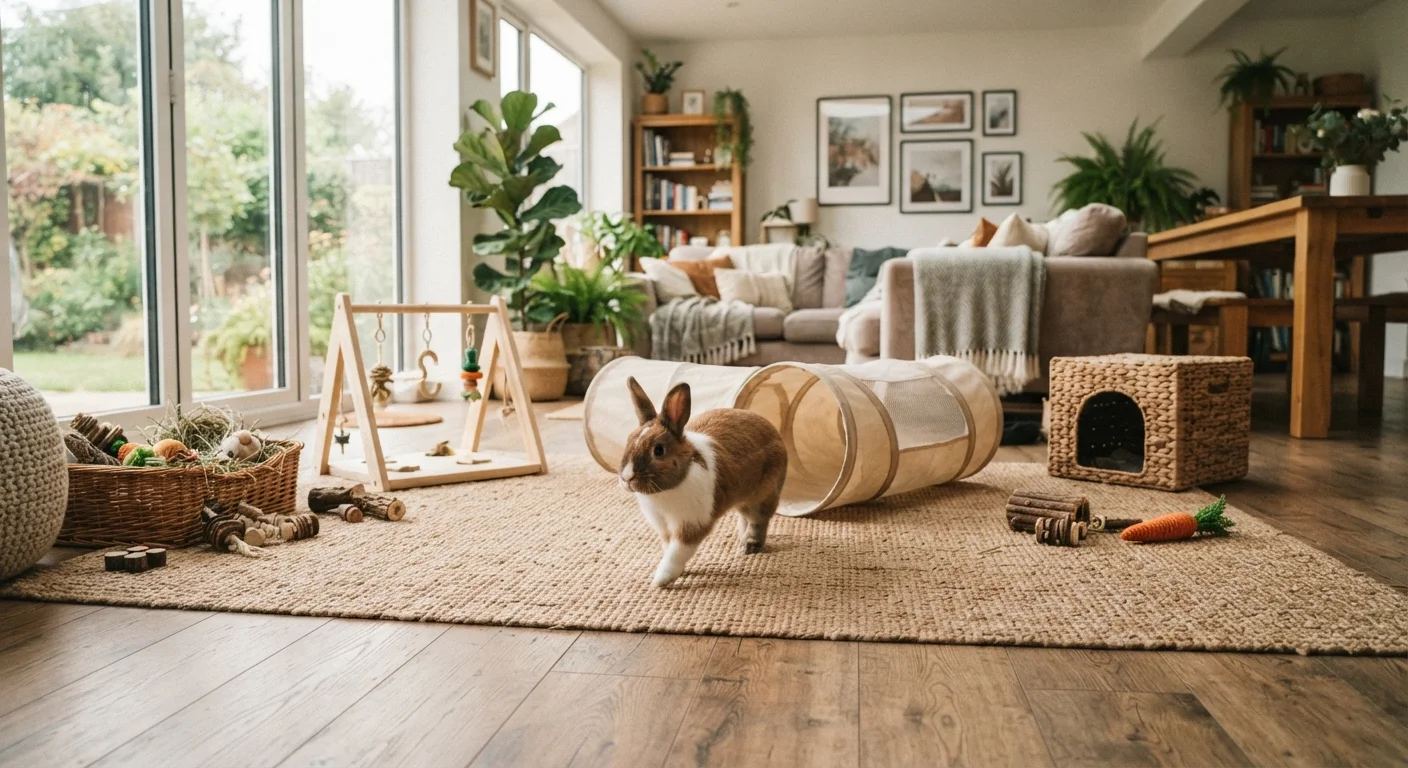
Translating welfare guidelines into real-world living situations requires some flexibility, but the core principles are consistent: rabbits need space to run, jump, stretch fully, and retreat. Many owners find that converting a section of a room using exercise pens, baby gates, or a dedicated bunny-proofed area works far better than any commercially sold cage.
12 sq ft
Minimum recommended enclosure size for a single rabbit
The Rabbit Welfare Association and Fund (RWAF) recommends at least 10–12 square feet of living space as a baseline, combined with 32 square feet of exercise area.
3–4 hrs
Daily free-roaming exercise time rabbits need
Veterinary and rabbit welfare organizations widely recommend a minimum of three to four hours of out-of-enclosure exercise each day for domestic rabbits.
Flooring matters too. Wire-bottomed enclosures are associated with sore hocks (ulcerative pododermatitis), a painful condition affecting the feet. Solid, non-slip flooring — covered with fleece, natural fiber mats, or hay — distributes weight more evenly and encourages natural movement patterns.
Diet and space are interconnected welfare factors. Rabbits who graze freely on hay — which should form the bulk of their diet — tend to move more naturally throughout the day. Our feeding myths guide addresses several widespread misconceptions about rabbit nutrition that can compound the effects of poor housing.
For a thorough breakdown of what a rabbit's living environment should include beyond just square footage, see our dedicated rabbit housing guide.